Loading
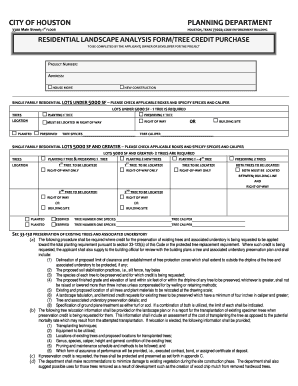
Get Tx Residential Landscape Analysis Form/tree Credit Purchase
How it works
-

Open form follow the instructions
-

Easily sign the form with your finger
-

Send filled & signed form or save
How to fill out the TX Residential Landscape Analysis Form/Tree Credit Purchase online
Filling out the TX Residential Landscape Analysis Form/Tree Credit Purchase online can be straightforward with the right guidance. This comprehensive guide will walk you through each section of the form, ensuring you understand the information required and making the experience seamless.
Follow the steps to complete your form successfully.
- Click ‘Get Form’ button to access the form and open it in your editor.
- Begin by entering the project number and address in the specified fields. Accurate information is essential for processing your form effectively.
- Indicate whether the project involves a house move or new construction by checking the applicable box.
- For single-family residential lots under 5000 square feet, select the options for planting or preserving a tree. Specify the species and caliper of the tree in the provided sections.
- If your lot is 5000 square feet or greater, check the appropriate boxes for planting and preserving trees, again providing the species and caliper details.
- For preservation credit requests, include detailed information regarding existing trees, including a preservation plan and any proposed soil stabilization methods.
- After completing the form, review all entries for accuracy. Ensure all required sections are filled out and check for any missing information.
- Once satisfied with the form, save your changes. You may also have the option to download, print, or share the completed form as needed.
Complete your TX Residential Landscape Analysis Form/Tree Credit Purchase online today!
Related links form
University Of Chicago Student Application For Third Party Contract Invoicing (TPC) 2020
Brandeis University Tuition Remission & Tax Waiver Application For Employees 2020
Hofstra University Verification Of Child Support Paid 2019
Hofstra University Non-Custodial Parent Information Waiver Request 2019
The Shumard Oak is a popular choice for planting close to houses in North Texas. It is a large, deciduous tree with a broad, spreading canopy that provides excellent shade. The Shumard Oak is known for its tolerance to a variety of soil conditions, including clay soils common in the region.