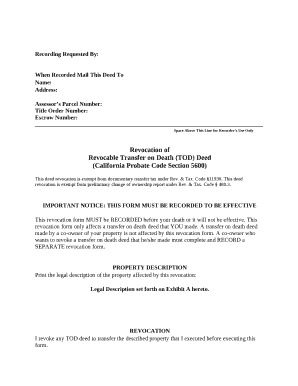
Space Above This Line for Recorder s Use Only Revocation of Revocable Transfer on Death (TOD) Deed (California Probate Code Section 5600) This deed revocation is exempt from documentary transfer tax under Rev. & Tax. Code 11930. This deed revocation is exempt from preliminary change of ownership report under Rev. & Tax. Code 480.3. IMPORTANT NOTICE: THIS FORM MUST BE RECORDED TO BE EFFECTIVE This revocation form MUST be RECORDED before your death or it will not be effec.

How it works
  • Open form

    Open form follow the instructions

  • Easily sign form

    Easily sign the form with your finger

  • Share form

    Send filled & signed form or save

How to fill out the CA Revocation Of Revocable Transfer On Death (TOD) Deed online

Revoking a Transfer on Death Deed in California is a straightforward process when you have the right guidance. This comprehensive guide will help you navigate the steps to properly fill out the CA Revocation Of Revocable Transfer On Death Deed online, ensuring your intentions are clearly stated and legally recognized.

Follow the steps to successfully complete your form online.

  1. Click ‘Get Form’ button to obtain the form and open it in the editor.
  2. Fill in the 'Recording Requested By' section with your name and address. This information identifies who is requesting the recording of the deed.
  3. Enter the Assessor’s Parcel Number and Title Order Number if applicable. These identifiers help locate the specific property in public records.
  4. State the Escrow Number if you have one. This number is often necessary for tracking the transaction if involved in an escrow process.
  5. Print the legal description of the property in the designated section. It is essential to accurately describe the property to avoid any confusion.
  6. In the 'Revocation' section, clearly state your intent to revoke any prior TOD deed associated with the property.
  7. Sign and date the form. Make sure your signature matches the name as shown on your title documents for proper validation.
  8. If required, obtain an acknowledgment from a notary public. The acknowledgment confirms your identity and capacity when signing the form.
  9. Review the entire document for accuracy and completeness before finalizing it.
  10. Finally, save your form and choose to download, print, or share it as needed.

Get started today by completing your documents online for a smoother process!

Get form

Experience a faster way to fill out and sign forms on the web. Access the most extensive library of templates available.

Related content

Revocation Transfer on Death Deed

IMPORTANT NOTICE: THIS FORM MUST BE RECORDED TO BE EFFECTIVE. This revocation form MUST be...

Learn more
Revocable Transfer on Death Deed: Follow-Up Study

Nov 21, 2019 — Clarify standing of beneficiary to contest revocation of RTODD. If an...

Learn more
Probate Law Journal of Ohio

The transferor can change his or her mind at any time and record a new transfer on death...

Learn more
Questions & Answers

Get answers to your most pressing questions about US Legal Forms API.

Contact support

What is the disadvantage of a TOD deed?

Although a transfer on death deed appears to have simplicity, there are many shortcomings. The first of which is that, if the named beneficiary dies before the property owner does, the deed becomes invalid. The property could then fall into probate upon the owner's death.

You may transfer any of the following types of California real estate with a TOD deed: property that contains one to four residential units. a condominium unit, or. a parcel of agricultural land of 40 or fewer acres that includes a single-family residence.

By filling out a simple form, notarizing it, having two witnesses sign, and recording it with the County Recorder's Office, you name a person or people to receive the property upon your death – the beneficiaries. Unlike a joint tenant deed, the TOD deed can be revoked if you change your mind.

The California legislature introduced Transfer on Death Deeds in 2016, and they updated the law effective 2022. The law is not simple. Transfer on death needs must be notarized and recorded with the local county recorder. Just like a standard grant deed or quitclaim deed.

Complications if a Beneficiary Predeceases You: If a beneficiary named on a TOD deed dies before you, the deed does not automatically account for this scenario. This could lead to the property reverting to your estate and going through probate, contrary to the purpose of the TOD deed.

You must wait at least 40 days after the person dies. What if I need help? Or, read the law on property transfers. See California Probate Code, §§ 13100-13115.

Transfer-on-Death Registration for Vehicles California allows transfer-on-death registration of vehicles. If you register your vehicle this way, the beneficiary you name will automatically inherit the vehicle after your death. No probate court proceeding will be necessary.

In addition to the notary requirement, a transfer on death deed must be signed by two witnesses (similar to a will), and it must be recorded within 60 days of the notary date. Further, when the property owner dies, the beneficiary of the transfer on death deed must give legal notice to the property owner's heirs.

Get This Form Now!

Use professional pre-built templates to fill in and sign documents online faster. Get access to thousands of forms.

If you believe that this page should be taken down, please follow our DMCA take down process here.

Get CA Revocation Of Revocable Transfer On Death (TOD) Deed