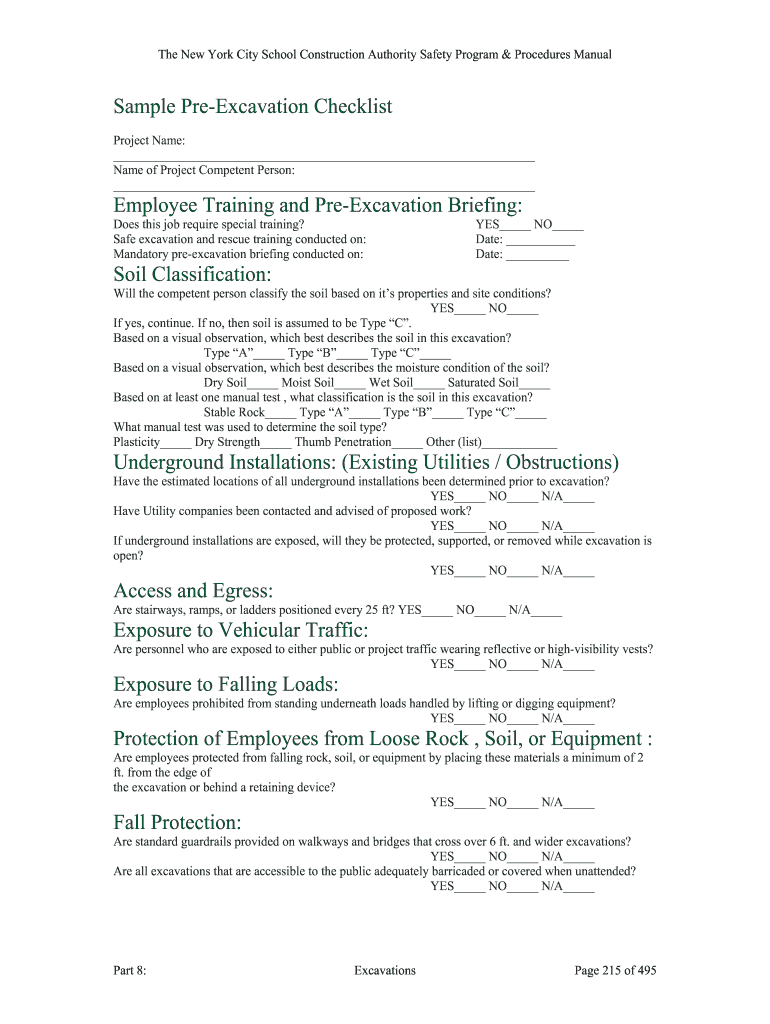
The New York City School Construction Authority Safety Program & Procedures Manual Sample PreExcavation Checklist Project Name: Name of Project Competent Person: Employee Training and PreExcavation.

Open form follow the instructions

Easily sign the form with your finger

Send filled & signed form or save
How to fill out the NYCSCA Sample Pre-Excavation Checklist online
Completing the NYCSCA Sample Pre-Excavation Checklist online is essential for maintaining safety at excavation sites. This guide provides clear instructions on how to expertly fill out the checklist, ensuring that all critical safety protocols are addressed.
Follow the steps to complete the checklist efficiently.
- Click 'Get Form' button to access the form and open it for editing.
- Begin by entering the project name in the designated field at the top of the form. Ensure that the project name is accurate and clearly written.
- Next, fill in the name of the project competent person, who is responsible for overseeing safety at the excavation site.
- In the section titled Employee Training and Pre-Excavation Briefing, indicate if special training is required by selecting 'YES' or 'NO'. If applicable, record the respective dates for safe excavation and rescue training, as well as the mandatory pre-excavation briefing.
- Proceed to the Soil Classification section. Determine if the competent person will classify the soil based on its properties. If so, select 'YES' and indicate the soil type and moisture condition observed. If not, mark 'NO', and proceed to consider the soil as Type 'C'.
- Complete the manual test section by selecting the type of test performed. Options include Plasticity, Dry Strength, or Thumb Penetration, among others.
- In the Underground Installations section, confirm whether the estimated locations of all underground installations have been determined prior to excavation. Answer each sub-question by marking 'YES', 'NO', or 'N/A' as appropriate.
- Next, address Access and Egress; ensure you confirm the placement of stairways, ramps, or ladders positioned every 25 feet.
- In the Exposure to Vehicular Traffic section, confirm that personnel exposed to traffic are wearing high-visibility vests.
- Assess the safety measures regarding exposure to falling loads, ensuring that employees are not standing under lifted loads.
- Continue filling out the form by ensuring that employees are protected from loose materials by marking 'YES' or 'NO'.
- In the Fall Protection section, confirm that guardrails are installed properly where necessary and that excavations are secured when unattended.
- In the Inspections section, confirm that daily inspections are being conducted by the competent person and after any rainstorm or hazard-increasing occurrences.
- Complete the Shielding or Shoring section by answering whether all protective systems have been properly designed and are checked daily for any signs of movement.
- Lastly, the competent person should sign and date the checklist in the designated signature area to confirm the inspection is complete.
- After completing the form, save your changes. You can also download, print, or share the completed checklist as necessary.
Encourage others to keep their excavation projects safe by completing their own NYCSCA Sample Pre-Excavation Checklist online.
Experience a faster way to fill out and sign forms on the web. Access the most extensive library of templates available.
Related content
Mar 28, 2023 — Pre-cleaned sample containers, coolers, sample labels, and a chain of...
This guidance document is not a standard or regulation, and it creates no new legal...
Get answers to your most pressing questions about US Legal Forms API.
What is the checklist for excavation?
Checklist : Excavation SrCheck Item8Means of access and exit from the work area provided?9Check set out.10Check excavation size with tolerance (offset)11Check for loose materials / loose soil.8 more rows
What must be checked prior to excavating?
Inspect your trenches daily before work begins. It is important you check for any fallen machinery, equipment or even PPE that may have been left haphazardly within your excavation area. It also helps to familiarise yourself with the job at hand to ensure the entire team is working towards a unified goal.
What does OSHA require in regards to excavation?
OSHA requires employers to provide ladders, steps, ramps, or other safe means of egress for workers working in trench excavations 4 feet (1.22 meters) or deeper. The means of egress must be located so as not to require workers to travel more than 25 feet (7.62 meters) laterally within the trench.
What is the excavation rule of 5?
Trenches five feet deep or greater require a protective system unless the excavation is made entirely in stable rock. If the trench is fewer than five feet deep, a competent person may determine a protective system is not required.
What is required around an excavation?
Keep excavated soil (spoils) and other materials at least 2 feet (0.6 meters) from trench edges. Know where underground utilities are located before digging. Test for atmospheric hazards such as low oxygen, hazardous fumes and toxic gases when > 4 feet deep. Inspect trenches at the start of each shift.
Use professional pre-built templates to fill in and sign documents online faster. Get access to thousands of forms.
If you believe that this page should be taken down, please follow our DMCA take down process here.