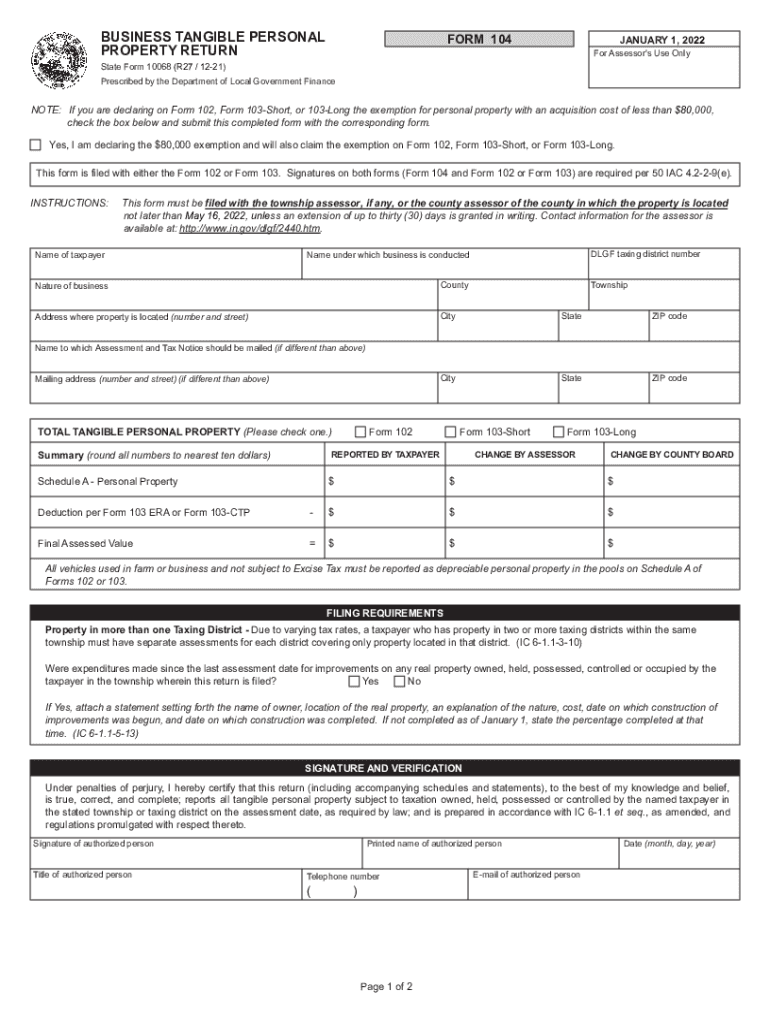
TE: If you are declaring on Form 102, Form 103-Short, or 103-Long the exemption for personal property with an acquisition cost of less than $80,000, check the box below and submit this completed form with the corresponding form. Yes, I am declaring the $80,000 exemption and will also claim the exemption on Form 102, Form 103-Short, or Form 103-Long. This form is filed with either the Form 102 or Form 103. Signatures on both forms (Form 104 and Form 102 or Form 103) are required per 50 IAC 4.2-2-.
Loading

Open form follow the instructions

Easily sign the form with your finger

Send filled & signed form or save
How to fill out the IN SF 10068 (Form 104) online
Filling out the IN SF 10068 (Form 104) online can be a straightforward process when guided properly. This user-friendly guide will walk you through each section of the form, ensuring you understand what to include and how to submit it efficiently.
Follow the steps to successfully complete the form.
- Click ‘Get Form’ button to obtain the form and open it in the editor.
- Begin by entering the name of the taxpayer as it appears on legal documents. Ensure all information is accurate and reflects current business records.
- Next, input the DLGF taxing district number. This number is crucial as it helps identify the taxing jurisdiction for your property.
- Fill in the name under which the business is conducted. This should match any registered business names.
- Indicate the nature of your business by selecting the most appropriate description from the provided options.
- Enter the county and township where your property is located. This section is vital for correctly routing your form.
- Provide the physical address where the property is situated, including the street number and name, city, state, and ZIP code.
- If the name or address for sending the Assessment and Tax Notice is different, fill that information in accordingly.
- In the total tangible personal property section, check the relevant box to indicate whether you are using Form 102 or Form 103-Short or Long. Report all figures accurately, rounding to the nearest ten dollars.
- Complete Schedule A - Personal Property, ensuring all vehicles used in the business are reported as depreciable property.
- Answer whether there have been improvements made to real property since the last assessment. If yes, be prepared to attach a detailed statement covering required information.
- Sign and verify the form under penalties of perjury at the bottom. Ensure that all required fields are completed before proceeding.
- Once you have filled in all sections of the form accurately, review for any errors or omissions. After confirming all details are correct, save your changes.
- Finally, download, print, or share the completed form as appropriate, and submit it to the relevant assessor's office before the deadline.
Complete your IN SF 10068 (Form 104) online today to ensure compliance and avoid penalties.
Experience a faster way to fill out and sign forms on the web. Access the most extensive library of templates available.
Related content
Records is required, and no forms need be submitted. ... Records may include, but are not...
Jan 1, 2016 — owned and not owned on the assessment date. This form is confidential. (SF...
manuals, and forms, visit www.lghvac.com. ... 104-105. Troubleshooting . ... If...
Get answers to your most pressing questions about US Legal Forms API.
How do I apply for property tax exemption in Indiana?
The owner of the property must file State Form 9284 / Form 136 with the County Assessor. The owner must provide all information requested on the application and accompanying information sheet. There is no filing fee. WHAT HAPPENS IF THE OWNERSHIP OR USE OF AN EXEMPT PROPERTY CHANGES?
Does Indiana have personal property tax on vehicles?
Licensed motor vehicles subject to the Motor Vehicle Excise Tax are exempt from the personal property tax. Intangible personal property, all-terrain vehicles, snowmobiles, human powered boats, wheelchairs, and yard and garden tractors used for non-businesses purposes are exempt.
What form is used for property tax exemption in Indiana?
To apply for a not for profit exemption, fill out an Application for Property Tax Exemption (Form 136). Submit two copies to the Marion County Assessor's Office by mail or in person at any of our office locations by April 1. You must also include copies of the following: Organization by-laws.
What is considered personal property in Indiana?
Business tangible personal property is the value of all property besides real estate that is used in your business or organization. It includes equipment used in the production of income or held as an investment; billboards; foundations for the equipment; and all other tangible property other than real property.
What is the PPT exemption in Indiana?
Business Personal Property Tax Exemption If the cost of all of your business personal property is less than $80,000, your business or organization is entitled to a business personal property exemption.
How much is Indiana personal property tax?
The amount you'll pay in property taxes varies depending on where you live and how much your home is worth, but the statewide average effective property tax rate is 0.75%. Homeowners who live in their primary residence in Indiana are eligible for a number of deductions that can push rates below that average, though.
What is an Indiana ST 105 form?
Indiana Form ST-105, General Sales Tax Exemption Certificate.
What is the senior property tax exemption in Indiana?
Over Age 65 Deduction $14,000 is deducted from the assessed value of the property. Property owners must occupy as their principal place of residence. Adjusted gross income cannot exceed $30,000 when filing single, and combined household income cannot exceed $40,000.
Use professional pre-built templates to fill in and sign documents online faster. Get access to thousands of forms.
If you believe that this page should be taken down, please follow our DMCA take down process here.
This form is available in several versions. Select the version you need from the drop-down list below.