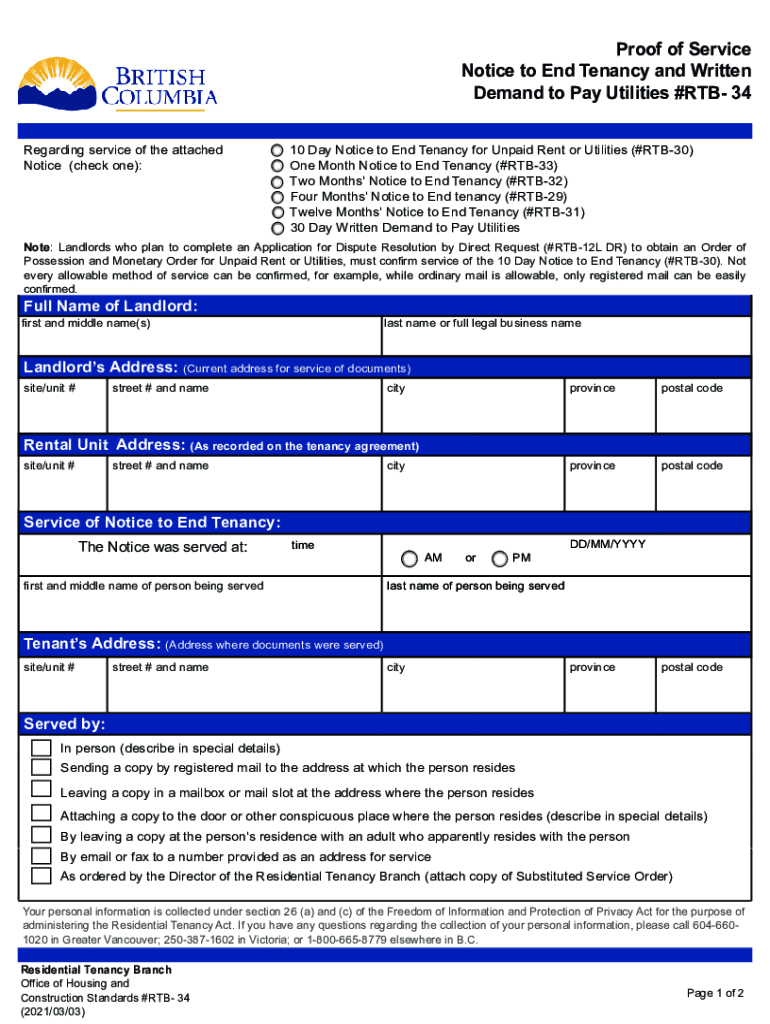
Onth Notice to End Tenancy (#RTB-33) Two Months' Notice to End Tenancy (#RTB-32) Four Months' Notice to End tenancy (#RTB-29) Twelve Months' Notice to End Tenancy (#RTB-31) 30 Day Written Demand to Pay Utilities Note: Landlords who plan to complete an Application for Dispute Resolution by Direct Request (#RTB-12L DR) to obtain an Order of Possession and Monetary Order for Unpaid Rent or Utilities, must confirm service of the 10 Day Notice to End Tenancy (#RTB-30). Not every allowable method of.
Loading

Open form follow the instructions

Easily sign the form with your finger

Send filled & signed form or save
How to fill out the Canada RTB-34 - British Columbia online
Filling out the Canada RTB-34 form accurately is crucial for effective communication regarding tenancy issues. This guide provides step-by-step instructions to help users complete the form online with confidence and ease.
Follow the steps to successfully fill out the RTB-34 form online.
- Use the ‘Get Form’ button to access the RTB-34 form and open it in your preferred editing tool.
- In the first section, enter the full name of the landlord, including their last name and first and middle name(s) as applicable.
- Input the landlord’s current address for service of documents, including the site/unit number, street number and name, city, province, and postal code.
- Provide the rental unit address as it appears on the tenancy agreement, ensuring accuracy in the site/unit number, street number and name, city, province, and postal code.
- Specify the time the Notice to End Tenancy was served. Include the first and middle name of the person being served, their last name, and indicate whether it was AM or PM.
- List the tenant’s address where documents were served, similar to the format used for the rental unit address.
- Indicate how the Notice was served by selecting one of the provided options and describing any special details if applicable.
- Complete the special details section to describe how and to whom the documents were served.
- Provide confirmation of service by attaching the appropriate documentation such as a hand delivery receipt or registered mail receipt.
- In the witness statement section, provide the necessary details regarding who observed the service, ensuring to include signatures and dates where required.
- Lastly, confirm that the notice was served by writing your full name, signing the form, and providing your address if it differs from the landlord’s provided address.
- Once all sections are complete, remember to save your changes, and choose to download, print, or share the completed form as needed.
Complete your documents online today for a smoother tenancy process.
Experience a faster way to fill out and sign forms on the web. Access the most extensive library of templates available.
Related content
... RTB-3 (describing SCE's methodology). 294 Exh. TURN-201 at 60. 295 SDG&E ... 34-35;...
units in British Columbia can approach the local Residential Tenancy Branch. (RTB), a...
CANADA. Alberta. He\'lett·Packard (Canada) Ud. 3030 3rd Al'enue rl.E. CALGARY, Alberta...
Get answers to your most pressing questions about US Legal Forms API.
How do I legally evict a tenant in BC?
Depending on the cause of eviction, landlords must give tenants a specific amount of time before forcefully removing the tenant. An eviction notice must be served in person, by mail, or by attaching to the door of the home address. Email can only be used if the parties have provided an email for service.
Does text count as written notice BC?
The Residential Tenancy Act has rules about how tenants and landlords can give or “serve” certain documents to each other. For example, a tenant can mail their one-month notice to move out, but should never send it using text or social media messaging.
What is the phone number for the RTB in BC?
For support in your preferred language, call 1-800-665-8779.
How many months notice does a landlord have to give a tenant BC?
“Landlord's Use” Evictions: If your landlord or a person who purchases the property from them wants to occupy your rental unit, allow a close family member to occupy your unit, make serious renovations to your unit, or demolish your unit, they might be able to evict you with two or four months' notice for “landlord's ...
What's the fastest a landlord can evict you?
Eviction is a legal process a landlord uses to make you move out. To evict you, your landlord must give you a 3, 30, 60 or 90-day notice. If you get one of these, it's important that you take action, like pay the rent you owe, move out, or get legal help.
What if my tenant refuses to leave BC?
Take the Order of Possession to the BC Supreme Court and obtain a Writ of Possession. Use the Writ of Possession to hire a court-approved bailiff to physically remove the tenant and their belongings.
On what grounds can you evict a tenant in BC?
One month notice for non-compliance with the tenancy agreement or Residential Tenancy Act Interfered with or disturbed other occupants or the landlord. Affected the health, safety or rights of others. Put the landlord's property at risk.
What can landlords legally ask for in BC?
What information can landlords ask for in B.C.? Name and contact information. Current address and previous rental history. References from previous landlords or employers. Proof of income or employment. Credit history or report.
Use professional pre-built templates to fill in and sign documents online faster. Get access to thousands of forms.
If you believe that this page should be taken down, please follow our DMCA take down process here.