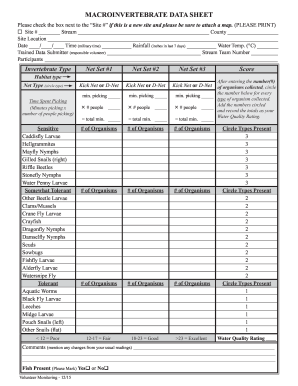
MACROINVERTEBRATE DATA SHEET Please check the box next to the Site # if this is a new site and please be sure to attach a map. (PLEASE PRINT) Site # Stream County Site Location Date / / Time (military.
Open form follow the instructions
Easily sign the form with your finger
Send filled & signed form or save
How to fill out the MO Water Quality Volunteer Macroinvertebrate Data Sheet online
Filling out the MO Water Quality Volunteer Macroinvertebrate Data Sheet online is a vital step in monitoring and preserving the water quality in your local streams. This guide provides you with clear, step-by-step instructions to ensure accurate and effective completion of the form.
Follow the steps to successfully complete the data sheet.
- Click ‘Get Form’ button to obtain the form and open it for editing. Ensure you are familiar with the required information before proceeding.
- Locate the ‘Site #’ section. If this is a new monitoring site, check the box next to ‘Site #’ and provide the site number, stream name, and the corresponding county.
- Fill in the ‘Site Location’ field with a detailed description of the monitoring site. This will assist in future reference and data consistency.
- Enter the date of monitoring in the format ____/____/____ and note the time using military time. Record any rainfall in inches measured over the last seven days, followed by the water temperature in degrees Celsius.
- Indicate the name of the ‘Trained Data Submitter,’ which is the responsible volunteer for this data entry, and include the Stream Team Number.
- Document the participants who assisted in the collection of the data. Their involvement is important for transparency and accuracy.
- For each net set, select the net type (Kick Net or D-Net) and enter the number of organisms collected in the corresponding fields for Net Sets #1, #2, and #3.
- Review the organisms collected, marking the types present with circles for each net and noting the total minutes spent picking in the respective fields.
- Calculate the Water Quality Rating based on the total numbers provided, using the defined scoring criteria (Poor, Fair, Good, Excellent).
- In the comments section, mention any changes observed from usual readings to provide context to the data.
- Indicate whether fish were present by marking 'Yes' or 'No' accordingly.
- Once all sections of the form are completed, make sure to save your changes. You can download, print, or share the form as needed.
Start filling out your data sheet online today to contribute to the water quality monitoring efforts in your community.
Experience a faster way to fill out and sign forms on the web. Access the most extensive library of templates available.
Related content
by SH Walk · 1997 · Cited by 23 — Water Quality Sampling Field Data Sheet (PDF, 6.2...
by M Louw · 2019 · Cited by 2 — • Water quality assessment. • We also train data...
by SH Walk · 1997 · Cited by 23 — Water Quality Sampling Field Data Sheet (PDF, 6.2...
Get answers to your most pressing questions about US Legal Forms API.
Which macroinvertebrate is intolerant of water pollution?
Certain macroinvertebrates, like the mayfly nymph, are highly intolerant of water pollution. Their presence indicates a clean and healthy water habitat, whereas their absence often signifies pollution or poor water quality. This relationship is important to note when filling out the MO Water Quality Volunteer Macroinvertebrate Data Sheet.
How would you sample for macroinvertebrates in a stream?
To sample for macroinvertebrates in a stream, choose a location with varying depths and flow rates. Use a kick net to disturb the bottom and trap organisms as they are dislodged. This method not only facilitates effective collection but also ensures that your data is comprehensive for the MO Water Quality Volunteer Macroinvertebrate Data Sheet.
How do you collect aquatic macroinvertebrates?
Collecting aquatic macroinvertebrates involves using equipment like nets, sampling devices, and containers. After identifying a stream or pond, gently disturb the substrate to release organisms into the water column. The collected samples can be analyzed later, enhancing your findings recorded in the MO Water Quality Volunteer Macroinvertebrate Data Sheet.
How are macroinvertebrates used to indicate water quality?
Macroinvertebrates serve as indicators of water quality due to their sensitivity to changes in their environment. Different species respond differently to pollutants; thus, their presence or absence can reveal the overall health of the ecosystem. Collecting this information is a primary goal of the MO Water Quality Volunteer Macroinvertebrate Data Sheet.
How to sample aquatic invertebrates?
You can sample aquatic invertebrates by using a combination of nets and traps. Begin by choosing a suitable location, then use a dip net to sweep through the water to capture specimens. This allows for a representative collection of invertebrates, making your data more valuable for the MO Water Quality Volunteer Macroinvertebrate Data Sheet.
What is a sample of a macroinvertebrate?
A sample of a macroinvertebrate consists of small aquatic organisms, such as insects or crustaceans, visible without a microscope. These creatures play vital roles in the ecosystem and help scientists assess water quality. The information gathered is essential for filling out the MO Water Quality Volunteer Macroinvertebrate Data Sheet accurately.
How do you sample macroinvertebrates in streams?
To sample macroinvertebrates in streams effectively, select a site with diverse habitats. Use a kick net to disturb the substrate and collect organisms as they drift into the net. Following the collection, transfer the contents into a container for identification. This approach is crucial for the MO Water Quality Volunteer Macroinvertebrate Data Sheet.
Do macroinvertebrates live in polluted water?
Yes, many macroinvertebrates can live in polluted water, particularly those that are pollution tolerant. However, high levels of pollution can reduce overall diversity and health of these organisms. Using the MO Water Quality Volunteer Macroinvertebrate Data Sheet allows volunteers to track which species are present under different pollution levels, contributing to important conservation efforts.
What do macroinvertebrates need to survive?
Macroinvertebrates need clean water, food sources, and suitable environments for survival. They often thrive in areas with ample vegetation and stable substrates. Data gathered through the MO Water Quality Volunteer Macroinvertebrate Data Sheet can highlight essential conditions necessary for these organisms to flourish.
Could a pollution tolerant macroinvertebrate live in clean water?
Indeed, a pollution tolerant macroinvertebrate can live in clean water, as these organisms are adaptable. Their survival in various conditions does not mean they prefer polluted environments. The MO Water Quality Volunteer Macroinvertebrate Data Sheet helps volunteers track these organisms, providing insights into the overall health of our aquatic ecosystems.
Use professional pre-built templates to fill in and sign documents online faster. Get access to thousands of forms.
If you believe that this page should be taken down, please follow our DMCA take down process here.