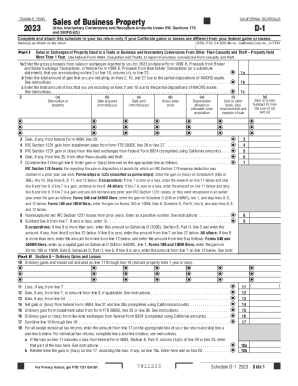
TAXABLE YEAR2023Sales of Business PropertyCALIFORNIA SCHEDULED1(Also, Involuntary Conversions and Recapture Amounts Under IRC Sections 179 and 280F(b)(2))Complete and attach this schedule to your.

How it works
  • Open form

    Open form follow the instructions

  • Easily sign form

    Easily sign the form with your finger

  • Share form

    Send filled & signed form or save

How to fill out the CA FTB Schedule D-1 online

Filling out the CA FTB Schedule D-1 can seem complex, but with a structured approach, it becomes manageable. This guide will provide you with step-by-step instructions to help you complete the form accurately online.

Follow the steps to successfully complete the form.

  1. Press the 'Get Form' button to access the document and open it for editing.
  2. Begin with the top section where you enter your name(s) as shown on your tax return, followed by your Social Security Number (SSN), Individual Taxpayer Identification Number (ITIN), California Secretary of State (SOS) file number, California corporation number, or Federal Employer Identification Number (FEIN).
  3. In Part I, provide details about the sales or exchanges of property used in your trade or business. This includes entering the gross proceeds from sales or exchanges as reported to you, the total gain from partial dispositions of MACRS assets, and the total loss likewise.
  4. List the description of the property, acquisition date (formatted mm/dd/yyyy), sale date, gross sales price, and depreciation allowed or allowable since acquisition. Ensure to calculate your gain or loss correctly by subtracting the cost or other basis from your total sales price.
  5. Continue to complete the sections regarding IRC Section 1231 assets and any gains or losses from property disposals. Follow the specific instructions for your type of entity (partnerships, S corporations, and individual filers) to ensure you report correctly.
  6. For ordinary gains and losses, include all relevant details such as acquisition and sale dates, gross sales price, and the corresponding basis. Accurately summarize the totals for each category.
  7. After finishing all sections, review your entries carefully for accuracy. At this point, you can save changes, download a copy for your records, print the form, or share it as necessary.

Ensure your tax documents are accurate and complete by filing the necessary forms online today.

Get form

Experience a faster way to fill out and sign forms on the web. Access the most extensive library of templates available.

Related content

2019 Schedule D-1 Sales of Business Property

CALIFORNIA SCHEDULE. D-1. Complete and attach this schedule to your tax return only if...

Learn more
CA Exempt Organization Business Income Tax Return...

California Exempt Organization. Business Income Tax Return ... b Net gain (loss) from Part...

Learn more
AT&T California SCHEDULE CAL.PUC NO. A2 San...

1 Nov 2010 — 37 - SURCHARGE TO FUND CALIFORNIA PUBLIC UTILITIES. COMMISSION...

Learn more
Questions & Answers

Get answers to your most pressing questions about US Legal Forms API.

Contact support

Do I need to file a Schedule D?

Schedule D is required when a taxpayer reports capital gains or losses from investments or the result of a business venture or partnership. The calculations from Schedule D are combined with individual tax return form 1040, where it will affect the adjusted gross income amount.

Most people use the Schedule D form to report capital gains and losses that result from the sale or trade of certain property during the year. As of 2011, however, the Internal Revenue Service created a new form, Form 8949, that some taxpayers will have to file along with their Schedule D and 1040 forms.

The Schedule D form is what most people use to report capital gains and losses that result from the sale or trade of certain property during the year. Most people use the Schedule D form to report capital gains and losses that result from the sale or trade of certain property during the year.

Carry over net losses of more than $3,000 to next year's return. You can carry over capital losses indefinitely. Figure your allowable capital loss on Schedule D and enter it on Form 1040, Line 13. If you have an unused prior-year loss, you can subtract it from this year's net capital gains.

IRS Form 8949 is used to report capital gains and losses from investments for tax purposes. ... Filing this form also requires a Schedule D and a Form 1099-B, which is provided by brokerages to taxpayers.

California Capital Loss Carryover WorksheetLoss from Schedule D (540), line 11, stated as a positive number. Amount from Form 540, line 17. Amount from Form 540, line 18.

If you sold a capital asset, such as a stock or bond, you must complete and attach Form 8949 and Schedule D. Exception 1. You have no capital losses, and your only capital gains are capital gain distributions from Form(s) 1099-DIV, Box 2a (or substitute statements). ...

Schedule D is used to report income or losses from capital assets. Assets owned by you are considered capital assets. These include your home, car, boat, furniture, and stocks, to name a few. There is a lengthy list of items that are not capital assets, which you can see on page D-2 of the Schedule D instructions.

California does generally follow the federal treatment of capital loss carryovers. However, it does not allow capital loss carrybacks. So as long as you didn't do a carryback, California losses will match the Federal.

Related Content. In the UK, tax was charged on income falling within certain categories, which were previously known as Schedules. The profits of trades, professions or vocations were subject to tax under Schedule D of the Income and Corporation Taxes Act 1988.

Get This Form Now!

Use professional pre-built templates to fill in and sign documents online faster. Get access to thousands of forms.

If you believe that this page should be taken down, please follow our DMCA take down process here.

Get CA FTB Schedule D-1