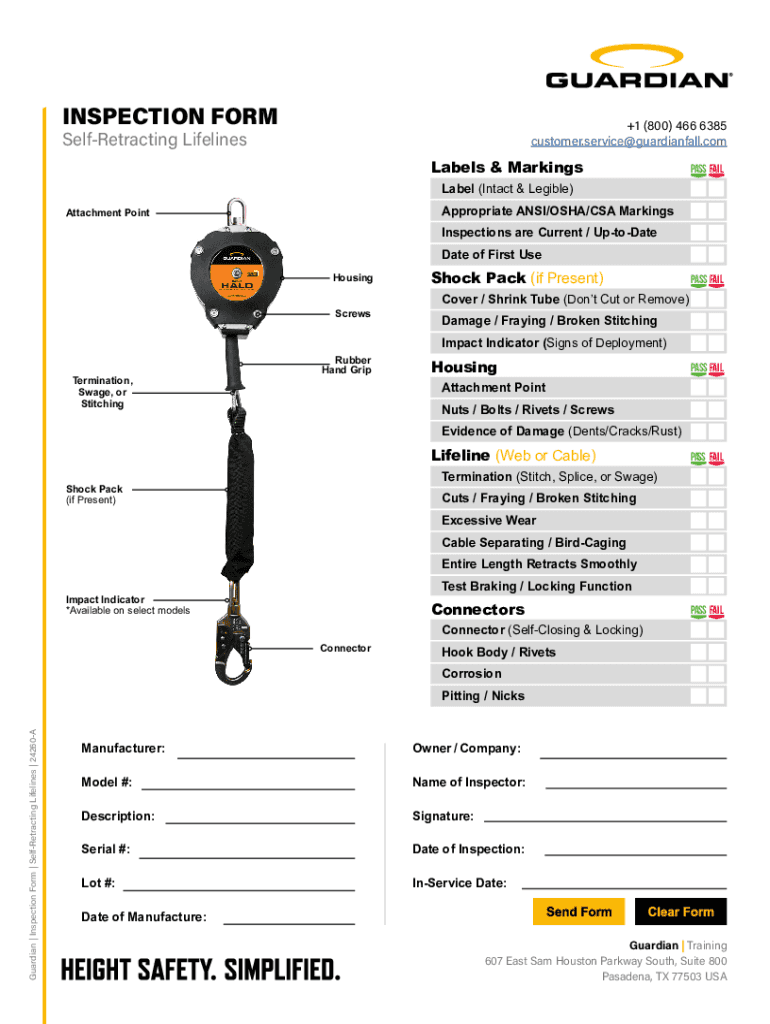
Nt Inspections are Current / Up-to-Date Date of First Use Housing Screws Shock Pack (if Present) Pass fail Cover / Shrink Tube (Don t Cut or Remove) Damage / Fraying / Broken Stitching Impact Indicator (Signs of Deployment) Termination, Swage, or Stitching Rubber Hand Grip Housing Pass fail Attachment Point Nuts / Bolts / Rivets / Screws Evidence of Damage (Dents/Cracks/Rust) Lifeline (Web or Cable) Pass fail Termination (Stitch, Splice, or Swage) Shock Pack (if Present) Cuts / F.
Loading

Open form follow the instructions

Easily sign the form with your finger

Send filled & signed form or save
How to fill out the Guardian Fall Inspection Form Self-Retracting Lifelines online
This guide provides comprehensive instructions for filling out the Guardian Fall Inspection Form for Self-Retracting Lifelines online. By following these steps, users can ensure that their inspection process is thorough and well-documented.
Follow the steps to complete the inspection form correctly.
- Use the 'Get Form' button to access the inspection form and open it in the designated editor.
- Begin by filling in the Manufacturer and Owner/Company details at the top of the form. Ensure that all information is accurate and up to date.
- Next, provide the Model #, Serial #, and Lot #. These identifiers are crucial for tracking and accountability.
- Enter the name of the inspector in the designated field. This ensures that there is a responsible person for the inspection process.
- Fill in the Date of Inspection and the In-Service Date. This helps establish a timeline for maintenance and compliance.
- Complete the section on Labels & Markings by indicating whether the label is intact and legible, and whether it includes appropriate ANSI/OSHA/CSA markings. Document any observations as needed.
- Inspect the Attachment Point for current inspection status, and record the Date of First Use.
- Assess the Shock Pack if present, noting any damage, fraying, or signs of deployment and ensuring the cover is intact.
- Continue evaluating the housing for any signs of damage, dents, cracks, rust, or evidence of wear and tear.
- Examine the lifeline, checking for cuts, fraying, and ensuring that it retracts smoothly. Perform a test of the braking and locking function.
- Check the connectors for corrosion and ensure that they are self-closing and lock securely.
- Finally, review the entire form for completeness and accuracy. Once satisfied, save your changes, and you may download, print, or share the completed form as necessary.
Take the next step in ensuring safety by completing your inspection forms online today.
Experience a faster way to fill out and sign forms on the web. Access the most extensive library of templates available.
Related content
Product Inspection Guide. 800.873.5242 • www.millerfallprotection.com. 2. Page 3....
Fall Limiters - Inspection. Retractable Lanyard (Housing/Cover Field Removable)...
IMPORTANT: Record the product identification information from the ID label in the...
Get answers to your most pressing questions about US Legal Forms API.
What is the new OSHA standard for fall protection?
When must employers provide Fall Protection? The 6-foot rule. Subpart M requires the use of fall protection when construction workers are working at heights of 6 feet or greater above a lower level.
What are the requirements for a retractable lanyard inspection?
All hardware must be free of cracks, sharp edges, deformation, corrosion, or any evidence of defect. The lanyard must fully extract and retract smoothly without any slack being created upon retraction. Note: Many people often do this inspection point incorrectly by not extracting the entire length of webbing or cable.
How long are self-retracting lifelines?
A self-retracting lifeline consists of the lifeline, housing unit, and mechanism. Lifelines are most commonly made from webbing, rope, or cable, which is typically either stainless or galvanized steel. These connectors can be as short as 6 ft. and as long as 195 ft., depending on the product.
What is the inspection checklist for fall protection equipment?
Inspect for damage, distortion, sharp edges, burrs, cracks and corrosion. Webbing: Inspect for cuts, burns, tears, abrasions, frays, excessive soiling and discoloration. Stitching: Inspect for pulled or cut stitches. Labels: Inspect, making certain all labels are securely held in place and are legible.
What is the distance between self retracting lifelines?
This is the distance the worker falls before the system beings to arrest/slow the fall. When using self-retracting lifelines, the typical free fall distance is 2 feet.
What is the OSHA 6 foot rule?
Each employee 6 feet (1.8 m) or more above dangerous equipment shall be protected from fall hazards by guardrail systems, personal fall arrest systems, or safety net systems.
What is the standard for self retracting lifelines?
Self-retracting lifelines and lanyards that automatically limit free fall distances to 2 feet (0.61 m) or less shall be capable of sustaining a minimum tensile load of 3,000 pounds (13.34 Kn) applied to a self-retracting lifeline or lanyard with the lifeline or lanyard in the fully extended position.
How do you inspect a self-retracting lifeline?
2:38 4:25 How to Inspect your Self-Retracting Device - YouTube YouTube Start of suggested clip End of suggested clip Let it retract back into the housing it should retract smoothly. Now repeat this but now pull out aMoreLet it retract back into the housing it should retract smoothly. Now repeat this but now pull out a hundred percent of the Lifeline. Again. You always want to maintain a light tension on the Lifeline.
How long are SRLs good for?
As long as they pass a competent person inspection as designated by OSHA, you can use our safety harnesses and SRLs for many years. By storing your safety harnesses appropriately and ensuring they pass inspections, you could have harnesses for up to 10 or 12 years that arrest falls like brand new.
What monthly inspections are required by OSHA?
Some OSHA standards require monthly equipment inspections, included are: Fire extinguishers. Eyewashes and safety showers. Cranes and hoists. Emergency escape respirators and self-contained breathing apparatus.
Use professional pre-built templates to fill in and sign documents online faster. Get access to thousands of forms.
If you believe that this page should be taken down, please follow our DMCA take down process here.