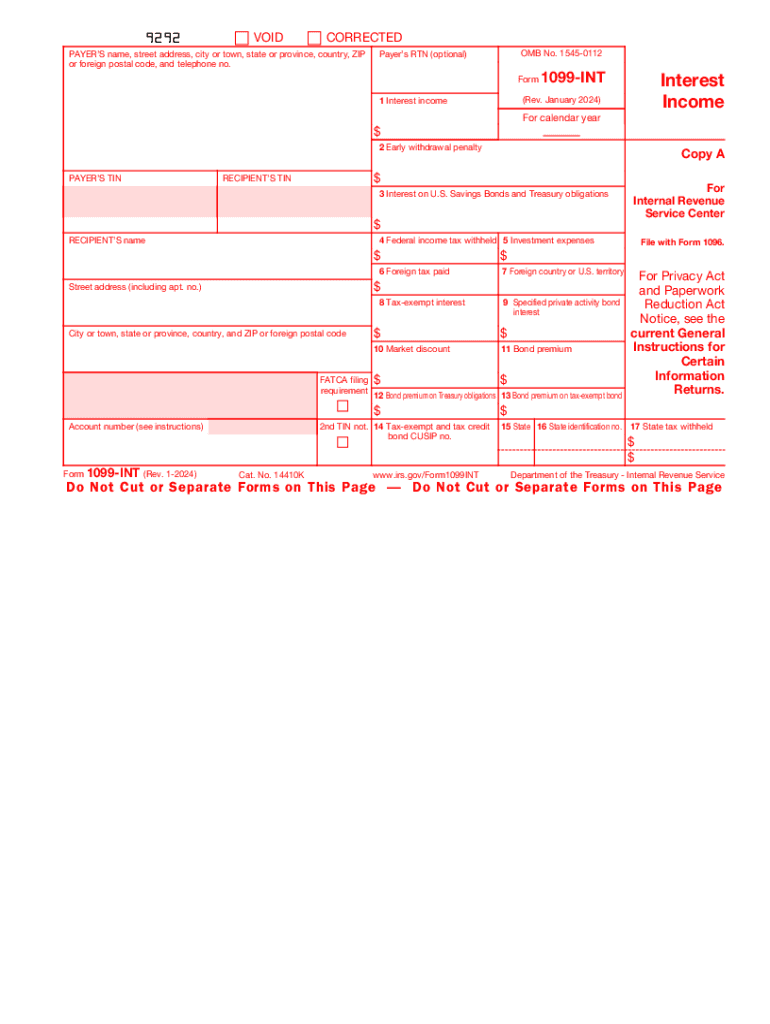
Attention: Copy A of this form is provided for informational purposes only. Copy A appears in red, similar to the official IRS form. The official printed version of Copy A of this IRS form is scannable,.
Loading

Open form follow the instructions

Easily sign the form with your finger

Send filled & signed form or save
How to fill out the IRS 1099-INT online
This guide provides step-by-step instructions on filling out the IRS 1099-INT form online, which is used to report interest income. Whether you are a seasoned taxpayer or new to this process, this guide aims to simplify the task for you.
Follow the steps to complete the IRS 1099-INT online.
- Click ‘Get Form’ button to obtain the form and open it for completion.
- Fill in the payer’s name and address, including the city, state, and ZIP code, in the designated fields. Optionally, you may provide the payer's routing transit number (RTN).
- Enter the recipient's name and address, including the city, state, and ZIP code, in the appropriate fields. You will also need to include the recipient's taxpayer identification number (TIN).
- Report the total interest income paid to the recipient during the calendar year in Box 1. If applicable, include any early withdrawal penalty in Box 2.
- If there were any interest payments from U.S. savings bonds or Treasury obligations, complete Box 3. Fill in any federal income tax withheld in Box 4.
- Complete the investment expenses in Box 5 and report any foreign taxes paid in Box 6. For tax-exempt interest, fill out Box 8.
- Complete any other applicable boxes such as market discount, bond premium, or state tax information as necessary.
- Once all information has been entered, review for accuracy. Users can then save changes, download, print, or share the completed form.
Start filling out your IRS 1099-INT form online today!
Experience a faster way to fill out and sign forms on the web. Access the most extensive library of templates available.
Related content
Sep 18, 2023 — Information about Form 1099-INT, Interest Income, including recent...
Dec 7, 2023 — Use Form 1040-ES to figure and pay your estimated tax for 2024. Estimated...
Nov 13, 2017 — Form 1099-INT in box 3.) For a taxable covered security, Form 1099-OID...
Get answers to your most pressing questions about US Legal Forms API.
How do I report bond income?
For paper savings bonds The interest will be reported under the name and Social Security Number of the person who cashes the bond or who owns it when it matures. The 1099-INT will include all the interest the bond earned over its lifetime.
Where do I enter bond premium on tax return?
For a covered security acquired with OID and bond premium, if you choose to report qualified stated interest in box 2 of Form 1099-OID, you must report any bond premium amortization on that security in box 10 of Form 1099-OID.
What is a 1099 B?
Form 1099-B reports the proceeds from sales of capital assets, such as stocks and bonds. U.S. tax law requires broker-dealers to report information about these sales to sellers and to the IRS. Recipients of Form 1099-B use it to calculate capital gains or losses on their federal and state income tax returns.
What shows income from dividends?
IRS Form 1099-DIV, Box 1a, Ordinary Dividends sent from your broker shows all your dividends. Qualified dividends are listed in Box 1b on form 1099-DIV and are the portion of ordinary dividends from Box 1a that meet the criteria to be treated as qualified dividends.
Is a bond premium tax deductible?
Depending on the type of bond, the premium can be tax-deductible and amortized over the life of the bond on a pro-rata basis.
What is reported on Schedule B?
Schedule B is an IRS tax form that must be completed if a taxpayer receives interest income and/or ordinary dividends over the course of the year of more than $1,500. The schedule must accompany a taxpayer's Form 1040. Taxpayers use information from Forms 1099-INT and 1099-DIV to complete Schedule B.
Where do I report bond premium on my taxes?
If the investor chooses to amortize the bond premium, it is done by reporting the amortized premium on the tax return for the first year this election applies. This amount is shown as a negative amount on Schedule B of the tax return and is netted against any other interest income realized during the year.
What is the difference between a 1099 INT and a 1099-Div?
The 1099-INT is an interest statement, and the 1099-DIV is a dividend statement. These are both reported on the Schedule B.
Use professional pre-built templates to fill in and sign documents online faster. Get access to thousands of forms.
If you believe that this page should be taken down, please follow our DMCA take down process here.