Loading
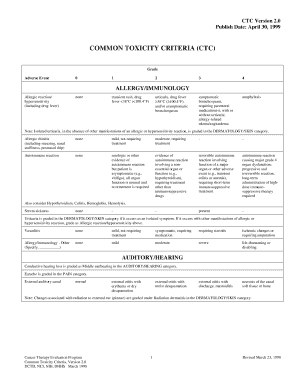
Get Common Toxicity Criteria (ctc) - Cancer Therapy Evaluation Program - Ctep Cancer
How it works
-

Open form follow the instructions
-

Easily sign the form with your finger
-

Send filled & signed form or save
How to use or fill out the Common Toxicity Criteria (ctc) - Cancer Therapy Evaluation Program - Ctep Cancer online
This guide provides a clear and comprehensive overview of how to fill out the Common Toxicity Criteria (ctc) used in cancer therapy evaluations. Designed to assist users of all backgrounds, this guide will walk you through each section of the form in a straightforward manner.
Follow the steps to accurately complete each section of the ctc form.
- Press the ‘Get Form’ button to access the Common Toxicity Criteria form and open it in your preferred editor.
- Begin by entering the patient information, which includes details such as patient ID, study number, and relevant dates. Ensure accuracy to maintain data integrity.
- Move to the adverse events section. For each event listed, select the appropriate grade by reviewing the descriptions provided in the criteria. Take care to interpret the symptoms correctly.
- For any adverse events that do not fit into predefined categories, utilize the 'Other' sections to specify details and provide clear definitions if necessary.
- Ensure that each entry is consistent and confirm that any changes in the patient's condition are documented in the timeline of adverse events, recording dates and grades as applicable.
- Review the entire form for completeness. Check all entries and ensure that all required fields have been filled out accurately.
- Once satisfied with the form, save your changes. You can then download, print, or share the completed document as needed.
Start filling out the Common Toxicity Criteria form online today to ensure accurate documentation and evaluation of cancer therapy.
CTCAE stands for Common Terminology Criteria for Adverse Events; these criteria are also called "common toxicity criteria." In CTCAE, an adverse event (AE) is defined as any abnormal clinical finding temporally associated with the use of a therapy for cancer; causality is not required.
Industry-leading security and compliance
US Legal Forms protects your data by complying with industry-specific security standards.
-
In businnes since 199725+ years providing professional legal documents.
-
Accredited businessGuarantees that a business meets BBB accreditation standards in the US and Canada.
-
Secured by BraintreeValidated Level 1 PCI DSS compliant payment gateway that accepts most major credit and debit card brands from across the globe.