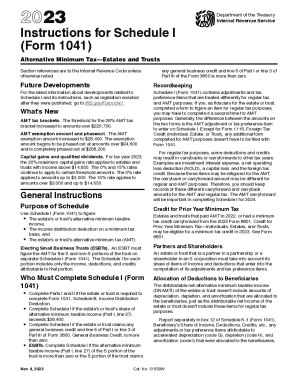
2023Instructions for Schedule I (Form 1041)Department of the Treasury Internal Revenue ServiceAlternative Minimum TaxEstates and Trusts Section references are to the Internal Revenue Code unless otherwise.

How it works
  • Open form

    Open form follow the instructions

  • Easily sign form

    Easily sign the form with your finger

  • Share form

    Send filled & signed form or save

How to fill out the Form 1041-A - Trust Accumulation Of Charitable online

Filling out Form 1041-A is an important process for trusts that accumulate income for charitable purposes. This guide provides a clear, step-by-step approach to assist users in completing the form accurately and efficiently online.

Follow the steps to complete Form 1041-A online.

  1. Press the ‘Get Form’ button to obtain the form and access it in an online editing tool.
  2. Carefully read the form instructions to understand the requirements for filling out each section. Begin with entering general information such as the name of the trust, its employer identification number, and address in the designated fields.
  3. In Section A, outline the income that the trust has accumulated. This includes interest, dividends, and other types of income generated throughout the tax year. Ensure to use accurate amounts as shown on bank statements and tax documents.
  4. Proceed to Section B to list the deductions that the trust can claim. This may include amounts set aside for charitable contributions. Refer to internal guidelines about qualified deductions.
  5. In Section C, enter the distributions made to charitable organizations and specify the amount. Ensure to cross-check with the trust's financial records for accuracy.
  6. Section D requires the calculation of taxable income. Use the amounts from Sections A and B to complete this section accurately. Seek guidance if you are unsure about specific calculations.
  7. Review all entered information for accuracy and completeness. Ensure all calculations are correct and all required fields are filled.
  8. Finally, save your changes, download a copy of the completed form, or print it for your records. If necessary, you can share it with relevant parties for their verification.

Complete and file your Form 1041-A online today to ensure compliance and proper management of trust distributions.

Get form

Experience a faster way to fill out and sign forms on the web. Access the most extensive library of templates available.

Related content

About Form 1041-A, U.S. Information Return Trust...

Feb 21, 2023 — Form 1041-A is used by trusts claiming a contributions deduction under...

Learn more
Form 1041-A, U.S. information return trust...

Form 1041-A, U.S. information return trust accumulation of charitable amounts. Format:...

Learn more
2017 Instructions for Form 1045

Dec 6, 2017 — An estate or trust can file an amended Form 1041, U.S. Income Tax. Return...

Learn more
Questions & Answers

Get answers to your most pressing questions about US Legal Forms API.

Contact support

How is income from a charitable remainder trust taxed?

Payments from a charitable remainder trust are taxable to the non-charitable beneficiaries and must be reported to them on Schedule K-1 (Form 1041), Beneficiary's Share of Income, Deductions and Credits.

The Internal Revenue Code subjects charitable trusts that are not exempt from tax to some of the same requirements and restrictions that apply to private foundations, if the trusts have any unexpired interests devoted to charitable purposes for which a charitable deduction was allowed.

Charities operate solely for charitable purposes and foundations primarily operate to supply funds. Nonprofits, however, are more flexible with their activities. They operate for charitable purposes, civic improvement, welfare, recreation and pleasure.

Registered charities in Canada include hospitals, schools, churches, and non-profit organizations that provide community services. It's important to note that donations to individuals, political parties, or for-profit organizations are not eligible for tax deductions.

More In Help. Generally, you can only deduct charitable contributions if you itemize deductions on Schedule A (Form 1040), Itemized Deductions. Gifts to individuals are not deductible. Only qualified organizations are eligible to receive tax deductible contributions.

A particular group of people is often chosen to be the designated beneficiaries of the trust, such as veterans. A charitable trust differs from a foundation because you don't have to file any documents with the government. This is why some people opt for them instead of a foundation since this allows for more privacy.

On Form 1041, you can claim deductions for expenses such as attorney, accountant and return preparer fees, fiduciary fees and itemized deductions. After the section on deductions is complete you'll get to the kicker – taxes and payments.

Trusts other than split-interest trusts or non-exempt charitable trusts that claim a deduction for charitable gifts must also file Form 1041-A unless the trust distributes currently to the beneficiaries all of the Distributable Net Income of the trust.

Beneficiaries of charitable remainder trusts must report on their personal income tax returns payments received from the trust reflected on Schedule K-1 (Form 1041), Beneficiary's Share of Income, Deductions and Credits.

Schedule J (Form 1041) plays a crucial role in reporting the accumulation distribution for certain complex trusts. It helps the Internal Revenue Service (IRS) determine the taxable income retained by the trust, ensuring appropriate taxation at the trust level.

Get This Form Now!

Use professional pre-built templates to fill in and sign documents online faster. Get access to thousands of forms.

If you believe that this page should be taken down, please follow our DMCA take down process here.

Get Form 1041-A - Trust Accumulation Of Charitable