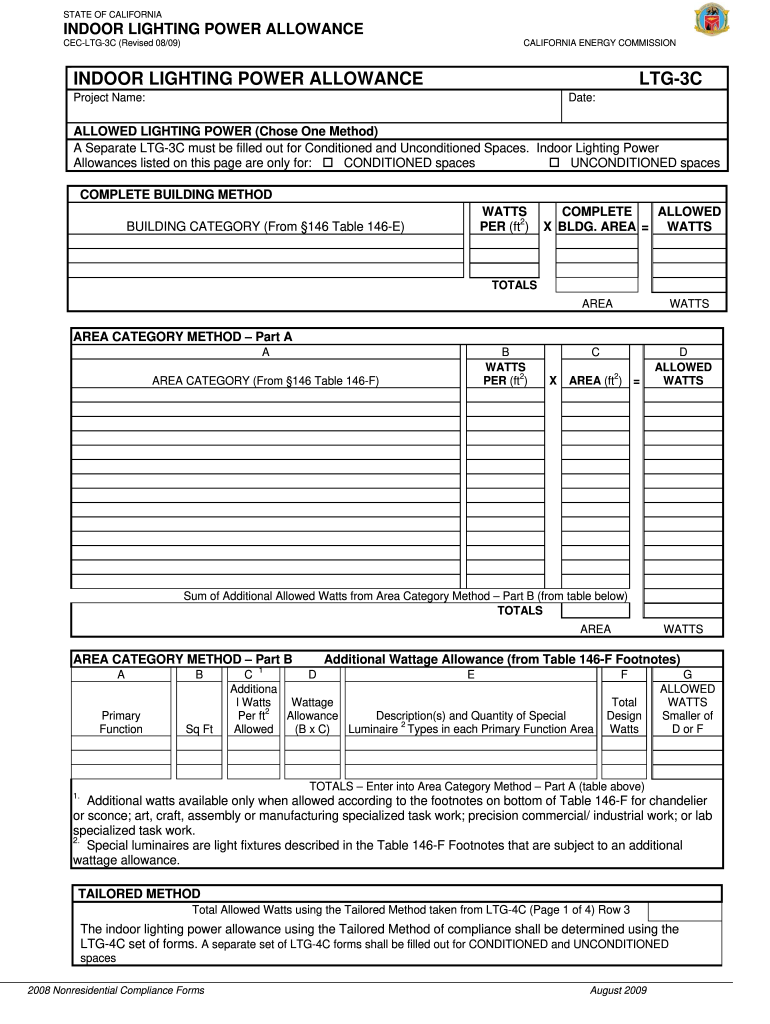
STATE OF CALIFORNIA INDOOR LIGHTING POWER ALLOWANCE CEC-LTG-3C Revised 08/09 CALIFORNIA ENERGY COMMISSION LTG-3C Project Name Date ALLOWED LIGHTING POWER Chose One Method A Separate LTG-3C must be filled out for Conditioned and Unconditioned Spaces. Indoor Lighting Power Allowances listed on this page are only for CONDITIONED spaces COMPLETE BUILDING METHOD BUILDING CATEGORY From 146 Table 146-E WATTS PER ft2 COMPLETE ALLOWED X BLDG* AREA WATTS TOTALS AREA AREA CATEGORY METHOD Part A A AREA CATEGORY From 146 Table 146-F B C X AREA ft2 D Sum of Additional Allowed Watts from Area Category Method Part B from table below Primary Function Sq Ft Additional Wattage Allowance from Table 146-F Footnotes C 1 E Additiona l Watts Wattage Per ft2 Allowance Description s and Quantity of Special Allowed B x C Luminaire Types in each Primary Function Area F Total Design G Smaller of D or F TOTALS Enter into Area Category Method Part A table above or sconce art craft assembly or manufacturing speci....
Loading

Open form follow the instructions

Easily sign the form with your finger

Send filled & signed form or save
How to fill out the CA LTG-3C online
The CA LTG-3C form is essential for calculating indoor lighting power allowances in various building spaces. This guide will assist you in completing it accurately and efficiently using an online format.
Follow the steps to successfully complete the CA LTG-3C form.
- Click the ‘Get Form’ button to access the form and open it in your preferred online editor.
- Begin by entering the project name and date at the top of the form. These details are necessary for identifying your submission.
- Indicate the method for calculating allowed lighting power by selecting either conditioned or unconditioned spaces. Ensure you understand the criteria for both categories.
- Follow the building category section by referencing §146 Table 146-E to obtain the watts per square foot applicable to your specific building category. Multiply this value by the building area to compute the total allowed watts.
- Proceed to the area category method, Part A. Reference §146 Table 146-F to complete the area category and wattage calculations, entering the total allowed watts for the area.
- If applicable, complete Part B of the area category method by specifying the primary function of the area, square footage, and additional wattage allowances based on Table 146-F footnotes.
- Total the design watts for the areas and identify the smaller value between the allowed watts calculated in Part A and Part B.
- If utilizing the tailored method, reference the LTG-4C forms to determine the total allowed watts, ensuring to fill out separate forms for conditioned and unconditioned spaces.
- Once you have completed all sections of the CA LTG-3C, you can save your changes, download the form, print it, or share it as needed.
Complete your CA LTG-3C form online today for efficient indoor lighting power allowance calculations.
Experience a faster way to fill out and sign forms on the web. Access the most extensive library of templates available.
Related content
This table is a list of mandatory requirements for lighting for interior commons areas (>...
The goal of this work is to improve code comprehension and compliance among contractors...
Handling the cord on this product will expose you to lead, a chemical known to the State...
Get answers to your most pressing questions about US Legal Forms API.
What is the easiest way to get a teaching credential in California?
The easiest way to obtain a teaching credential in California is to follow a clear and defined process. This involves earning the appropriate degree, completing required examinations, and submitting a well-prepared application. Utilizing the CA LTG-3C program aids in breaking down the steps involved. The uslegalforms platform can also support you with forms and resources tailored to your needs.
How to become a professor at a community college in California?
Becoming a professor at a community college in California requires you to hold a master's degree or higher. It’s also important to gain teaching experience, as this is often a critical factor in hiring decisions. The CA LTG-3C program can help you streamline the necessary paperwork and requirements. Consider exploring resources on the uslegalforms platform to enhance your chances of success.
How to get a community college teaching credential in California?
To secure a community college teaching credential in California, you will generally need to earn a graduate degree in the relevant field. Furthermore, having relevant teaching experience can enhance your qualifications. Using the CA LTG-3C framework is beneficial for understanding application processes and credential requirements. The uslegalforms platform provides valuable templates and guidance to assist you.
How to get California inflation relief?
For California inflation relief, individuals may explore the state's programs designed to provide financial assistance. Checking eligibility for initiatives that may include tax refunds and direct payments is essential. The CA LTG-3C program offers insights on navigating these benefits. Utilize resources on the uslegalforms platform to understand your options better.
How to get California Community College teaching credential?
To obtain a California Community College teaching credential, you must meet specific requirements set by the state. Typically, you need a master's degree or higher in the subject area you wish to teach. Additionally, completing the CA LTG-3C program can guide you through the necessary steps and document preparation. Consider using the uslegalforms platform to find resources that simplify this process.
How much do Live Scan operators make in California?
Live Scan operators in California typically earn between $20,000 and $50,000 annually, depending on their experience and the facilities they work for. Factors such as location and demand can further influence their earnings. This field continues to grow, and tools like CA LTG-3C can provide insights into career paths and potential earnings.
How to fill out a fingerprint card in California?
Filling out a fingerprint card in California involves writing your personal details, such as name and address, in specific sections. You must also include your date of birth and the reason for fingerprinting. Make sure to provide clear, legible prints in the designated areas, and consider using references like CA LTG-3C for more details on proper formatting.
How to fill out CA Live Scan form?
To fill out the CA Live Scan form, first ensure you have all necessary personal information, including your name, address, and the reason for scanning. The form requires you to indicate the agency that requests the background check. Make sure to sign and date the form before you visit a Live Scan provider, as proper completion is key to avoiding delays, and CA LTG-3C can guide you through this process.
How to fill out a California bill of sale?
Filling out a California bill of sale is straightforward. Start by including the seller's and buyer’s full names and addresses. Then, clearly describe the item being sold, including its condition. Lastly, ensure both parties sign and date the document to make it valid; consider using CA LTG-3C as a resource for templates and examples.
What shows up on a Live Scan background check in California?
A Live Scan background check in California typically reveals your criminal history, including misdemeanor and felony convictions. It also includes details about any pending charges. The process involves your fingerprints, which are scanned and submitted to the Department of Justice for verification. Using the CA LTG-3C can ensure you understand this process better.
Use professional pre-built templates to fill in and sign documents online faster. Get access to thousands of forms.
If you believe that this page should be taken down, please follow our DMCA take down process here.