Corporate officers as filed with the Secretary of State, any fictitious business name statement, corporate number and agent for service of process) Husband and Wife or Domestic Partnership co-ownership (Attach copy of business license and, if applicable, fictitious business name statement and supply both spouses’/partners’ names) Corporation from a State Other Than California (Attach copy of approved certificate from California Secretary of State qualifying and authorizing corporation to t.

How it works
  • Open form

    Open form follow the instructions

  • Easily sign form

    Easily sign the form with your finger

  • Share form

    Send filled & signed form or save

How to use or fill out the CA CalRecycle 186 (Formerly CIWMB 186) online

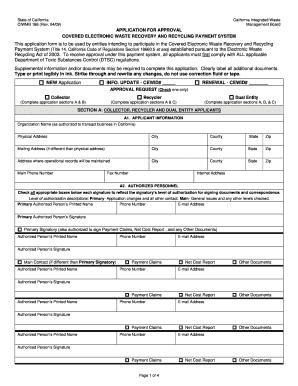
This guide provides users with a clear, step-by-step process to fill out the CA CalRecycle 186 application form online, ensuring compliance with the Electronic Waste Recycling Act of 2003. It offers comprehensive support to all users, regardless of their experience level in legal documentation.

Follow the steps to complete the application accurately and efficiently.

  1. Press the ‘Get Form’ button to access the CA CalRecycle 186 online. This action allows you to open the form for editing.
  2. In Section A, enter your organization name as registered to conduct business in California. Fill out the physical and mailing addresses, including city, county, state, and zip code. Specify where operational records will be maintained and provide a main phone number, fax number, and internet address as required.
  3. Complete the Authorized Personnel section by providing the printed names, phone numbers, email addresses, and signatures of all authorized individuals responsible for signing documents and correspondence on behalf of your organization. Select the appropriate level of authorization for each signatory.
  4. Indicate your organization type in Section A3 by checking the appropriate box. Be sure to attach any necessary documentation such as business licenses or organizational approval letters as stated in the instructions.
  5. In Section B, fulfill the Department of Toxic Substance Control (DTSC) notification requirements by providing the name of the organization under which your entity notified DTSC and the date of the last notification or report.
  6. In Part B1, specify the types of sources from which Covered Electronic Waste (CEW) will be recovered by checking the relevant boxes and detailing your collection activities.
  7. Review and complete the certification statements in Section B2 and provide required initials to indicate your understanding and agreement with the conditions stated.
  8. In Section B3, provide the printed name, signature, location, and date signed of the primary authorized person to complete the collector portion of the application before proceeding to Section C if applicable, for recyclers and dual entity applicants.
  9. For Section C applicants, complete the certification requirements in C1 by initialing each requirement, including compliance confirmations and inspection details.
  10. In C2, identify the recycling methods that will be used and specify the CEW types. Ensure to check the intent to process CEWs if applicable.
  11. Complete the Payee Data Record (STD. 204 Form) as instructed in C3, ensuring it is signed by the primary applicant before submission.
  12. Finally, review and sign the declaration and signature section in C5 for recyclers, certifying that all provided information is true. Send your completed application and all supplementary documents to the address provided at the end of the form.

Begin the process of filling out the CA CalRecycle 186 online to ensure your organization's participation in the recovery and recycling payment system.

Get form

Experience a faster way to fill out and sign forms on the web. Access the most extensive library of templates available.

Related content

History of California Solid Waste Law - CalRecycle...

This history of solid waste law includes highlights of significant legislation enacted in...

Learn more
A History of Waste Management in the City of San...

The law also created the California Integrated Waste Management Board (CIWMB), now...

Learn more
Questions & Answers

Get answers to your most pressing questions about US Legal Forms API.

Contact support

What is a proof of designation for CalRecycle?

A proof of designation for CalRecycle is an official document that certifies compliance with CA CalRecycle 186 (Formerly CIWMB 186). This document proves that your business meets the necessary requirements to participate in California's recycling programs. Having this proof is essential for businesses looking to demonstrate their commitment to recycling. If you are uncertain about how to obtain it, uslegalforms offers guidance and templates to help you navigate the requirements.

The new law, CA CalRecycle 186 (Formerly CIWMB 186), aims to enhance recycling efforts across California. It focuses on reducing waste and increasing the efficiency of recycling programs statewide. This legislation encourages businesses and individuals to actively participate in recycling and helps ensure that recyclable materials are properly processed. As a result, California moves closer to a sustainable future.

In California, you typically receive around 5 to 10 cents for recycling aluminum cans, depending on the can's size, as outlined by the CA CalRecycle 186 (Formerly CIWMB 186) regulations. This incentive encourages individuals and businesses alike to recycle their cans rather than disposing of them in landfills. By participating in recycling, you not only gain some financial return but also contribute to environmental preservation. Check local guidelines for any updates on recycling fees.

The new recycling law in California, known as CA CalRecycle 186 (Formerly CIWMB 186), aims to enhance recycling efforts statewide. This law sets forth new regulations to improve recycling facilities and increase recycling rates for various materials. By promoting better recycling practices, it also ensures that California meets its sustainability goals. As you engage with this law, consider how it impacts both businesses and residents across the state.

CalRecycle oversees California's recycling programs, focusing on electronic waste, which falls under CA CalRecycle 186 (Formerly CIWMB 186). The agency develops guidelines and supports initiatives that encourage recycling and waste reduction. By working with manufacturers, retailers, and residents, CalRecycle fosters a circular economy in the state. Thus, the agency plays a vital role in promoting sustainable practices across California.

When you recycle electronics through programs under CA CalRecycle 186 (Formerly CIWMB 186), your items are sent to certified recycling facilities. These facilities responsibly process the materials to extract valuable components and ensure safe disposal of hazardous substances. This process not only recycles valuable materials but also protects the environment from harmful e-waste. You can trust that your recycling efforts contribute to a greener future.

Yes, CalRecycle is a government agency in California dedicated to waste management and recycling efforts. Under CA CalRecycle 186 (Formerly CIWMB 186), the agency oversees the implementation of electronic waste recycling programs. By managing various recycling initiatives, CalRecycle helps residents and businesses find effective disposal solutions for their electronic devices. This agency plays a crucial role in promoting sustainable practices.

The California Electronic Waste Recycling Act of 2003 establishes a framework for the safe and responsible recycling of electronic waste. This law creates a recycling program for covered electronic devices, mandated by CA CalRecycle 186 (Formerly CIWMB 186). Businesses and residents can return their electronic products to designated collection sites for proper disposal. This act helps reduce environmental hazards associated with e-waste, fostering a cleaner California.

SB 1383 is a groundbreaking law aimed at reducing organic waste disposal in California. It requires jurisdictions to establish organic waste collection and recycling programs, directly influencing businesses under CA CalRecycle 186 (Formerly CIWMB 186). This law aims to divert a significant amount of organic waste from landfills, promoting composting and responsible waste management. The implementation of SB 1383 can ultimately foster a healthier environment and community.

Recycling rules in California dictate how and what materials can be recycled. The state outlines guidelines for different waste types and requires businesses to have a recycling plan in place, as mandated by CA CalRecycle 186 (Formerly CIWMB 186). Understanding these rules helps businesses implement effective recycling practices and contribute to California’s environmental goals. You can find comprehensive resources and templates on platforms like USLegalForms to help establish your recycling program.

Get This Form Now!

Use professional pre-built templates to fill in and sign documents online faster. Get access to thousands of forms.

If you believe that this page should be taken down, please follow our DMCA take down process here.

CA CalRecycle 186 (Formerly CIWMB 186) Form

This form is available in several versions. Select the version you need from the drop-down list below.

Get CA CalRecycle 186 (Formerly CIWMB 186)