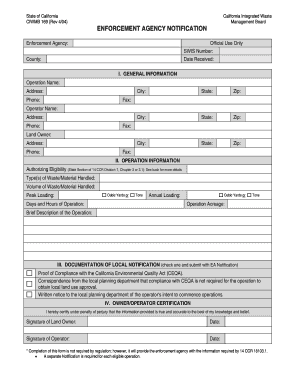
NERAL INFORMATION Operation Name: Address: Phone: City: State: Zip: City: State: Zip: City: State: Zip: Fax: Operator Name: Address: Phone: Fax: Land Owner: Address: Phone: Fax: II. OPERATION INFORMATION Authorizing Eligibility (State Section of 14 CCR Division 7, Chapter 3 or 3.1): See back for more details Type(s) of Waste/Material Handled: Volume of Waste/Material Handled: Peak Loading: Cubic Yards or Days and Hours of Operation: Tons Annual Loading: Cubic Yards or Tons .
Open form follow the instructions
Easily sign the form with your finger
Send filled & signed form or save
How to fill out the CA CalRecycle 169 (Formerly CIWMB 169) online
Completing the CA CalRecycle 169 form is essential for notifying enforcement agencies regarding waste management operations in California. This guide will assist you through the process of filling out the form online, ensuring you provide all necessary information accurately and efficiently.
Follow the steps to complete the online CA CalRecycle 169 form.
- Press the ‘Get Form’ button to download the CA CalRecycle 169 form and open it in your editing tool.
- Fill in the 'Enforcement Agency' section with the relevant details, including the SWIS number and the date received. Ensure accuracy in listing the county.
- In the 'General Information' section, enter the operation name, address, phone number, city, state, and zip code. Repeat this for operator name, landowner, and their contact details.
- Navigate to the 'Operation Information' part. Specify the authorizing eligibility by referring to the appropriate Title 14 regulation. Account for the types of waste or material handled and the respective volumes.
- Indicate the days and hours of operation, annual loading metrics, and operation acreage. Provide a brief description of the operation to give context to the agency.
- Complete the 'Documentation of Local Notification' by checking the applicable compliance proof option and attaching any required documents.
- In the 'Owner/Operator Certification' section, ensure the landowner and operator sign and date the form to certify the accuracy of the information provided.
- Once all sections are filled out, review the form for completeness and accuracy. You can then save your changes, download the completed form, print it, or share it as necessary.
Start the process of filling out your CA CalRecycle 169 form online today to ensure compliance with local regulations.
Experience a faster way to fill out and sign forms on the web. Access the most extensive library of templates available.
Related content
Jul 1, 2025 — SWRCB & CalRecycle (formerly CIWMB). §20395. SWRCB - Constituents of...
Dec 31, 2011 — Many of the local governments responded with information, some did not...
Get answers to your most pressing questions about US Legal Forms API.
What does CalRecycle do?
CA CalRecycle 169 (Formerly CIWMB 169) plays a crucial role in managing California's recycling and waste disposal systems. They oversee regulatory programs, promote recycling initiatives, and provide resources to assist residents and businesses in their recycling efforts. Additionally, CalRecycle develops educational materials to inform the public about the importance of recycling. By engaging with CalRecycle, you can learn how to optimize your recycling practices for a more sustainable future.
Is CalRecycle a government agency?
Yes, CA CalRecycle 169 (Formerly CIWMB 169) is indeed a government agency that operates under the California Environmental Protection Agency. Their mission focuses on enhancing recycling efforts and reducing waste across the state. As part of this initiative, CalRecycle collaborates with various stakeholders, including the public and businesses, to develop effective recycling programs. This ensures that everyone in California can contribute to a cleaner environment.
Where does my recycling actually go?
When you recycle through CA CalRecycle 169 (Formerly CIWMB 169), your materials are collected and transported to recycling facilities. These facilities process the materials, transforming them into new products or raw materials. It's essential to understand that your recycling contributes to a closed-loop system, promoting environmental sustainability. By participating in CA CalRecycle 169, you actively support a greener future.
When was CalRecycle established?
CalRecycle was established in 2003, as part of California's effort to enhance its recycling and waste management framework. The formation of CA CalRecycle 169 (Formerly CIWMB 169) allowed the state to focus more effectively on recycling initiatives and regulatory compliance. Since then, CalRecycle has implemented successful programs to improve recycling rates and encourage sustainable practices.
When was recycling created?
Recycling, as a formal practice, began in the United States during the late 1960s and early 1970s, spurred by environmental awareness and resource scarcity. Various legislation, including the roots of the CA CalRecycle 169 (Formerly CIWMB 169), emerged during this time to formalize recycling efforts across the nation. This movement aimed not only to reduce waste but also to promote a sustainable way of living.
What is a tier notification form?
A tier notification form is a document used to inform relevant authorities about the status of a recycling operation. It plays a critical role in ensuring compliance with the regulations set forth by CA CalRecycle 169 (Formerly CIWMB 169). By submitting this form, facilities can clarify their operational tiers and ensure they meet all legal obligations under California's recycling laws.
What is the purpose of the Tier 2 report?
The Tier 2 report serves to inform local authorities and emergency responders about the presence and hazards of specific materials, as required under CA CalRecycle 169 (Formerly CIWMB 169). This report promotes safety and preparedness in case of chemical spills or other emergencies. By maintaining accurate Tier 2 reports, organizations can take proactive measures to safeguard public health and the environment. Leveraging USLegalForms can facilitate persistent compliance with these reporting requirements.
What is a Tier 2 document?
A Tier 2 document is a detailed report that builds on the information provided in the Tier I report, as mandated by CA CalRecycle 169 (Formerly CIWMB 169). This document includes more specific details about hazardous materials, including their locations and potential risks. Tier 2 documents are vital for emergency response planning and community awareness. Accessing user-friendly resources, such as those offered by USLegalForms, can streamline the creation of your Tier 2 documents.
What is Tier I reporting?
Tier I reporting refers to the process of compiling and submitting information about hazardous materials under CA CalRecycle 169 (Formerly CIWMB 169). This report provides an overview of the types and quantities of hazardous waste generated, which must align with state regulations. Accurate Tier I reporting is crucial for ensuring environmental safety and public health. Using platforms like USLegalForms can simplify this process, providing templates and guidance for compliance.
What is a Tier 1 notification?
A Tier 1 notification is a formal communication required under CA CalRecycle 169 (Formerly CIWMB 169) regulations. This notification is sent to inform relevant parties about certain activities or changes related to waste management. It's essential for compliance with state laws and helps ensure that waste is handled properly. By understanding Tier 1 notifications, you can better navigate the reporting process and maintain adherence to regulatory standards.
Use professional pre-built templates to fill in and sign documents online faster. Get access to thousands of forms.
If you believe that this page should be taken down, please follow our DMCA take down process here.
This form is available in several versions. Select the version you need from the drop-down list below.