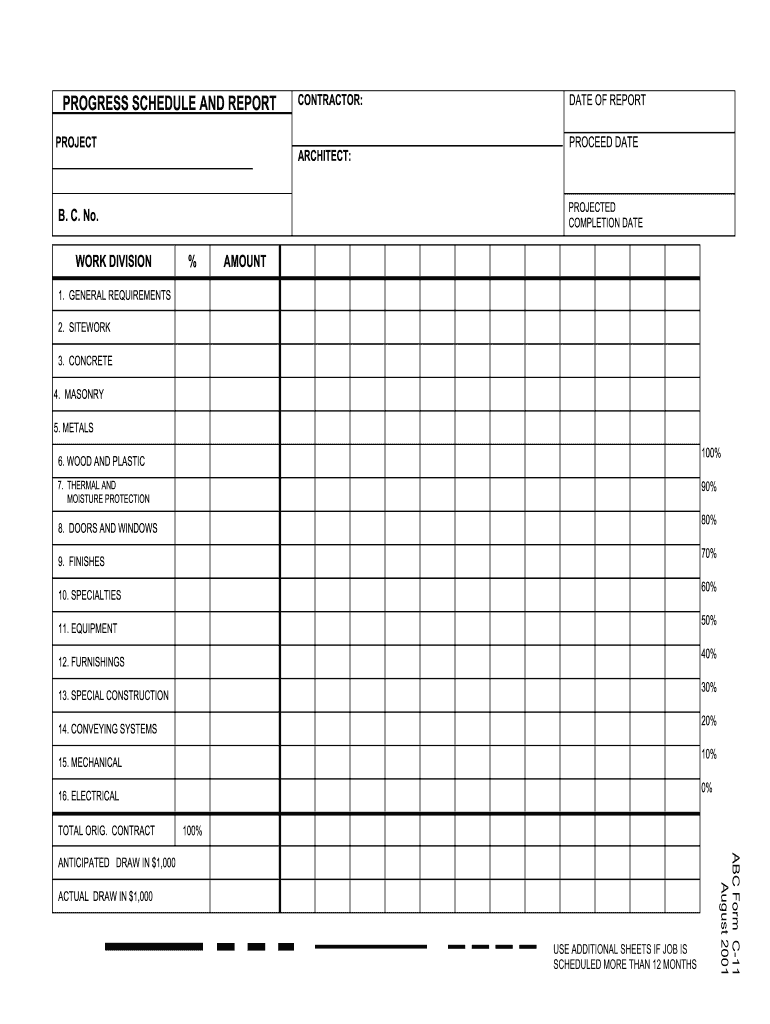
% AMOUNT 1. GENERAL REQUIREMENTS 2. SITEWORK 3. CONCRETE 4. MASONRY 5. METALS 100% 6. WOOD AND PLASTIC 7. THERMAL AND MOISTURE PROTECTION 90% 80% 8. DOORS AND WINDOWS 70% 9. FINISHES 60% 10. SPECIALTIES 50% 11. EQUIPMENT 40% 12. FURNISHINGS 30% 13. SPECIAL CONSTRUCTION 20% 14. CONVEYING SYSTEMS 10% 15. MECHANICAL 0% 16. ELECTRICAL TOTAL ORIG. CONTRACT 100% ACTUAL DRAW IN $1,000 USE ADDITIONAL SHEETS IF JOB IS SCHEDULED MORE THAN 12 MONTHS ABC Form C-11 August 2001 ANT.
Loading

Open form follow the instructions

Easily sign the form with your finger

Send filled & signed form or save
How to fill out the AL ABC C-11 online
Completing the AL ABC C-11 form is crucial for tracking project progress and financials in construction projects. This guide will provide clear, step-by-step instructions on how to accurately fill out this form online, ensuring you capture all necessary details effectively.
Follow the steps to complete the AL ABC C-11 form online
- To begin, click the ‘Get Form’ button to access the AL ABC C-11 document. This will enable you to open the form in your preferred online editing tool.
- Enter the date of the report in the designated field at the top of the form.
- Fill in the project information, including the project name, contractor name, and architect details.
- Indicate the projected completion date and provide the B. C. number in the appropriate sections.
- In the work division section, allocate the percentage completion for each category: general requirements, sitework, concrete, masonry, metals, wood and plastic, thermal and moisture protection, doors and windows, finishes, specialties, equipment, furnishings, special construction, conveying systems, mechanical, and electrical.
- For each category, enter the actual and anticipated draw amounts in thousands of dollars.
- If the job is scheduled for more than 12 months, use additional sheets as necessary to provide a complete view of your project schedule.
- Review all entries for accuracy before proceeding to finalize the form.
- Once you have filled out the form, you can save your changes, download a copy, print the document, or share it as needed.
Start filling out the AL ABC C-11 online today to keep your project on track.
Experience a faster way to fill out and sign forms on the web. Access the most extensive library of templates available.
Related content
Aug 19, 2025 — Founder genetic variants of ABCC4 and ABCC11 in the Japanese population...
Sep 16, 2013 — Yoshiura et al. (2006) then found the gene responsible: ABCC11...
The Aurora UPC is implemented with the Aurora Base. Controller (ABC) heat pump control...
Get answers to your most pressing questions about US Legal Forms API.
Where does the ABCC11 gene come from?
The variation between ear wax in ethnicities around the world are specifically due to the ABCC11 gene alleles. It is believed the allele originated in ancient East Asian population.
Which ethnicity has the most body odor?
Although there is some controversy on the subject of "racial" variation in body odor, it is determined that African blacks probably produce the greatest amount of apocrine sweat, which is the known substrate for axillary odor.
What ethnicity does not have body odor?
While only 2 percent of Europeans lack the genes for smelly armpits, most East Asians and almost all Koreans lack this gene, Day told LiveScience.
Which ethnicity has the most ABCC11 gene?
ABCC11: the “no body odor gene” Genetic variants that cause a loss of function of the ABCC11 gene are very common among East Asian ethnicities (80-90% of the population). In other population groups, it is rare to have no body odor.
What races have dry earwax?
Dry earwax is found in 80-95% of people of East Asian descent, but in less than 3% of people of European or African descent. This distinct geographic distribution of earwax type provides clues about early human migration patterns.
What is the genetic code ABCC11?
ATP-binding cassette transporter sub-family C member 11 is a protein that in humans is encoded by the ABCC11 gene. The gene is responsible for determination of human cerumen type (wet or dry ear wax) and presence of underarm osmidrosis (odor associated with sweat caused by excessive apocrine secretion).
What is the ABCC11 gene for wet earwax?
You can thank your ABCC11 gene for your earwax type. This gene contains instructions for a protein that moves fat into, and out of, your cells. People who have 1 or 2 copies of the C variant in the ABCC11 gene have more fat in their earwax, making it wet and sticky.
Use professional pre-built templates to fill in and sign documents online faster. Get access to thousands of forms.
If you believe that this page should be taken down, please follow our DMCA take down process here.