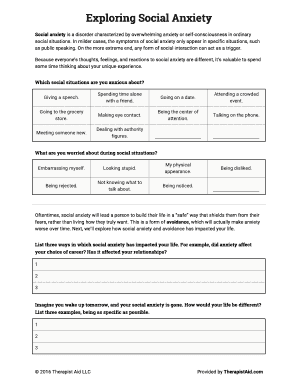
Ear in specific situations, such as public speaking. On the more extreme end, any form of social interaction can act as a trigger. Because everyone s thoughts, feelings, and reactions to social anxiety are different, it s valuable to spend some time thinking about your unique experience. Which social situations are you anxious about? Giving a speech. Spending time alone with a friend. Going on a date. Attending a crowded event. Going to the grocery store. Making eye contact. Being the.

How it works
  • Open form

    Open form follow the instructions

  • Easily sign form

    Easily sign the form with your finger

  • Share form

    Send filled & signed form or save

How to fill out the Therapist Aid Exploring Social Anxiety online

Filling out the Therapist Aid Exploring Social Anxiety form can provide valuable insights into your experiences with social anxiety. This guide will help you navigate each section of the form effectively, ensuring you articulate your thoughts clearly and find beneficial strategies for overcoming challenges.

Follow the steps to complete the form successfully.

  1. Click the ‘Get Form’ button to access the form and open it in your chosen editor.
  2. Begin by identifying social situations that provoke anxiety. Reflect on specific scenarios from the provided list, such as giving a speech or attending a crowded event. Write down the ones that resonate with your experiences.
  3. Next, think about your worries during these social situations. Consider factors like physical appearance or fear of being rejected. This will help you articulate the internal struggles you face.
  4. In the following section, list three ways in which social anxiety has impacted your life. Consider aspects like career choices or personal relationships and provide honest reflections.
  5. Lastly, envision a future without social anxiety. Describe how your daily life would differ by listing three specific changes. This will help you focus on your goals and aspirations.
  6. Once you have filled out all sections thoughtfully, you can save your changes, download the completed form for your records, or print it for physical use.

Take the next step towards managing social anxiety by completing the form online today.

Get form

Experience a faster way to fill out and sign forms on the web. Access the most extensive library of templates available.

Related content

Social Anxiety Disorder: More Than Just Shyness...

Another treatment option for social anxiety disorder is acceptance and commitment therapy...

Learn more
Shyness and Social Anxiety Infosheet

Research has shown that Selective Serotonin Reuptake Inhibitor (SSRI) medications, (e.g....

Learn more
1 Appendix 1. INTERVENTION MANUAL for ...

SAFE protocol: All sessions are facilitated by two therapists trained in the SAFE...

Learn more
Questions & Answers

Get answers to your most pressing questions about US Legal Forms API.

Contact support

What activities help with social anxiety?

Behavioral Therapy Activities Group Conversations about general matters (i.e., the weather, movies, TV, hobbies, sports, interests, likes, dislikes, etc.) Mingling, conversations, small talk, 1:1 small talk, 3-4 person group mingling. Introductions - "The Circle of Death" (This is a paradox; it really doesn't kill you!)

Cognitive-behavioral therapy (CBT) is highly effective in the treatment of anxiety. During CBT treatment, your psychologist will help you learn different ways to identify and manage the factors that contribute to your anxiety. CBT involves a combination of cognitive therapy and behavior therapy.

Processing of self as a social object. Clark & Wells' model proposes that during an acute episode of social anxiety, the anxious individual will process themselves as a social object – a key marker of which is an increase in self-consciousness.

Cognitive behavioral therapy is one of the most effective types of therapy for social anxiety disorder. This treatment can be used to change the negative thoughts that contribute to anxiety, help you learn new coping strategies, and gradually decrease the fear you experience in social situations.

Negative experiences. Children who experience teasing, bullying, rejection, ridicule or humiliation may be more prone to social anxiety disorder. In addition, other negative events in life, such as family conflict, trauma or abuse, may be associated with this disorder.

Exposure therapy (ET), which follows the Pavlovian extinction model, is regarded as the gold-standard treatment for social anxiety disorder (SAD).

Cognitive behavioral therapy is one of the most effective types of therapy for social anxiety disorder. This treatment can be used to change the negative thoughts that contribute to anxiety, help you learn new coping strategies, and gradually decrease the fear you experience in social situations.

These 9 strategies offer a place to begin. Talk with a therapist. ... Explore specific situations that trigger anxiety. ... Challenge negative thoughts. ... Take small steps. ... Role-play with people you trust. ... Try relaxation techniques. ... Practice acts of kindness. ... Limit alcohol.

Get This Form Now!

Use professional pre-built templates to fill in and sign documents online faster. Get access to thousands of forms.

If you believe that this page should be taken down, please follow our DMCA take down process here.

Get Therapist Aid Exploring Social Anxiety