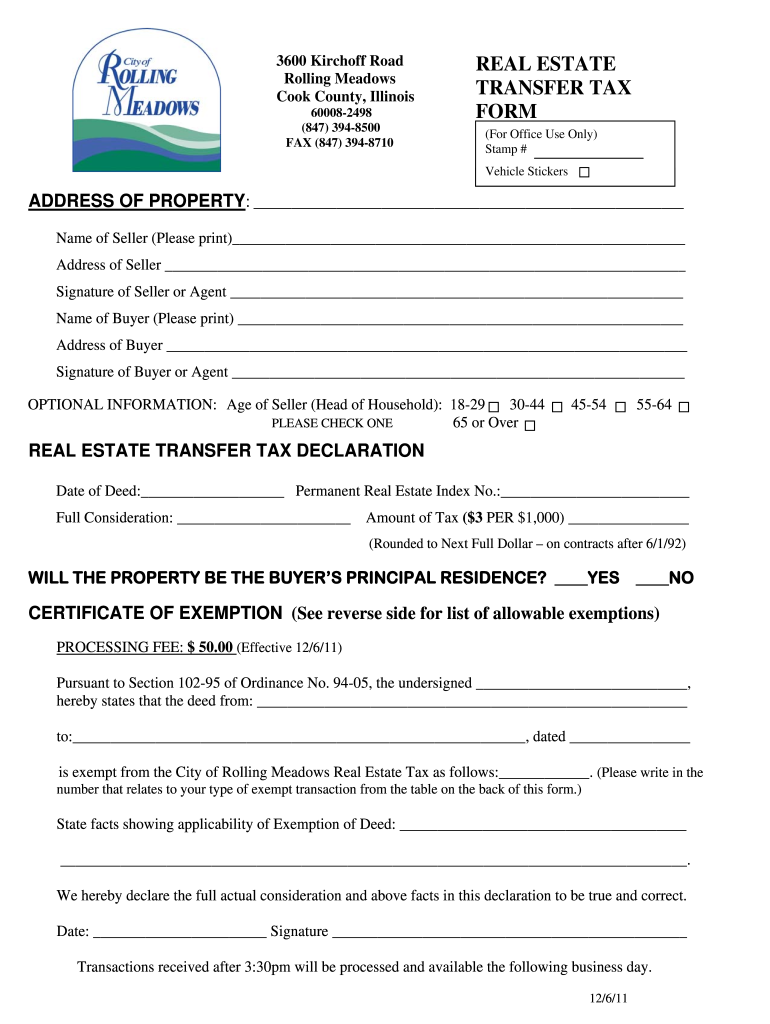
Y: _________________________________________________________ Name of Seller (Please print)____________________________________________________________ Address of Seller _____________________________________________________________________ Signature of Seller or Agent ____________________________________________________________ Name of Buyer (Please print) ___________________________________________________________ Address of Buyer _________________________________________________________________.
Loading

Open form follow the instructions

Easily sign the form with your finger

Send filled & signed form or save
How to fill out the IL Real Estate Transfer Tax online
The IL Real Estate Transfer Tax form is an essential document for property transactions in Illinois. This guide provides clear, step-by-step instructions on how to accurately complete the form online, ensuring all necessary details are included.
Follow the steps to fill out the IL Real Estate Transfer Tax form online.
- Click 'Get Form' button to obtain the form and open it in your preferred online editor.
- Enter the address of the property being transferred. This information is vital for identifying the location of the transaction.
- Provide the name and address of the seller. Ensure this information is printed clearly for verification purposes.
- The seller or their agent must sign the form, indicating agreement and authenticity of the provided information.
- Next, fill in the name and address of the buyer, following the same guidelines to ensure clarity.
- Obtain the signature of the buyer or their agent to validate the transaction.
- If applicable, select the age category of the seller as listed: 18-29, 30-44, 45-54, 55-64, or 65 and over.
- Fill out the Real Estate Transfer Tax Declaration section, including the date of deed and Permanent Real Estate Index Number.
- Calculate the full consideration and the corresponding amount of tax due, ensuring to round to the next full dollar.
- Indicate whether the property will be the buyer's principal residence by selecting 'Yes' or 'No'.
- If claiming an exemption, provide details as stated in the Certificate of Exemption, including the applicable exemption type.
- Complete any additional statements required to affirm the accuracy of the information provided.
- Finally, save your changes, and download, print, or share the completed form as needed.
Complete your IL Real Estate Transfer Tax form online today for a smooth transaction!
Experience a faster way to fill out and sign forms on the web. Access the most extensive library of templates available.
Related content
Counties may impose a tax of 25 cents per $500 of value on real estate transactions. Home...
by DA Simon — TAXING THE POOR THROUGH REAL ESTATE TRANSFERS. Illinois residents are...
Dec 21, 2011 — D. File Form 4797 with your Form 1040 for each year in which you sell or...
Get answers to your most pressing questions about US Legal Forms API.
What deeds are exempt from transfer tax in Illinois?
In Illinois, several types of deeds can be exempt from the IL Real Estate Transfer Tax. These exemptions may include deeds related to government transactions, certain nonprofit organizations, or family transfers under specific conditions. It's crucial to thoroughly understand these exemptions to ensure compliance. For assistance in identifying applicable exemptions, consider reaching out to uslegalforms for detailed guidance.
Does Illinois have Tod deeds?
Yes, Illinois does recognize Transfer on Death (TOD) deeds, allowing property owners to designate beneficiaries who will receive the property upon their death without undergoing probate. While TOD deeds do not incur the IL Real Estate Transfer Tax during the owner's lifetime, the tax may apply when the property is transferred to beneficiaries. Utilizing services like uslegalforms can guide you in setting up these deeds correctly.
Which deed requires the Illinois transfer tax?
In Illinois, any deed transferring ownership of real property usually requires payment of the IL Real Estate Transfer Tax. This includes warranty deeds, quitclaim deeds, and special warranty deeds. Be aware that certain exempt deeds may apply, but generally, most transactions will incur this tax. Consulting with uslegalforms can help clarify the type of deed you are dealing with.
Who is usually responsible for paying the Illinois transfer tax due in a real estate transaction?
In Illinois, the seller is generally responsible for paying the IL Real Estate Transfer Tax. However, this is often a point of negotiation between the buyer and seller. Familiarizing yourself with local customs or consulting a real estate professional can provide clarity on this subject. Platforms like uslegalforms can assist you in understanding responsibilities tied to this tax.
How to avoid real estate transfer tax?
To avoid the IL Real Estate Transfer Tax, one potential strategy is to consider gifting the property instead of selling it. When you gift property to a family member or charitable organization, you may not incur transfer taxes. Additionally, you can explore the possibility of filing for exemptions under specific conditions, such as for certain types of transactions or property uses. Using services like uslegalforms can help provide guidance on navigating these options effectively.
Who is exempt from Illinois transfer tax?
Certain individuals and entities may qualify for exemptions from IL Real Estate Transfer Tax in Illinois. For instance, transfers between spouses or in cases of foreclosure might be exempt. Additionally, government entities and non-profit organizations may also be exempt under specific conditions. It is wise to consult with an attorney to clarify eligibility for exemptions.
Who pays transfer taxes in Illinois, the buyer or the seller?
In Illinois, the responsibility for paying the IL Real Estate Transfer Tax typically falls on the seller. However, this can be negotiated between the buyer and seller during the sale agreement. It's essential for both parties to discuss and clarify who will bear these costs upfront.
How do you transfer a property title in Illinois?
To transfer a property title in Illinois, you need to complete a deed that includes the names of the buyer and seller, as well as the property description. After signing the deed, it must be recorded with the county clerk's office to provide public notice of the ownership change. Utilizing a platform like USLegalForms can simplify the documentation process and ensure compliance with local regulations.
How do I avoid real estate transfer tax?
One way to avoid real estate transfer tax in Illinois is by utilizing specific exemptions, such as certain property transfers between family members or government entities. You could also consider using a life estate deed to transfer property without triggering taxes. Understanding these options helps you navigate the IL real estate transfer tax more effectively. Our platform can guide you in exploring these alternatives.
What is the easiest way to transfer ownership of a house?
The easiest way to transfer ownership of a house involves using a quitclaim deed, which requires minimal paperwork. This method allows you to transfer interest without guaranteeing the title's validity. It’s often used between family members or in divorces. You may also consider our platform, USLegalForms, for streamlined legal forms.
Use professional pre-built templates to fill in and sign documents online faster. Get access to thousands of forms.
If you believe that this page should be taken down, please follow our DMCA take down process here.