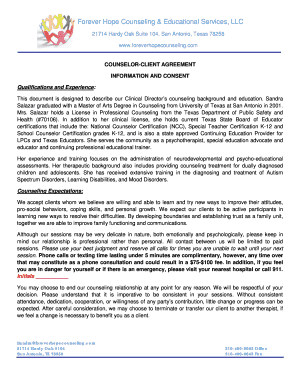
Ons and Experience: This document is designed to describe our Clinical Director s counseling background and education. Sandra Salazar graduated with a Master of Arts Degree in Counseling from University of Texas at San Antonio in 2001. Mrs. Salazar holds a License in Professional Counseling from the Texas Department of Public Safety and Health (#70106). In addition to her clinical license, she holds current Texas State Board of Educator certifications that include the: National Counselor Certi.
Open form follow the instructions
Easily sign the form with your finger
Send filled & signed form or save
How to fill out the TX Forever Hope Counseling & Educational Services Counselor-Client Agreement online
This guide provides users with a clear and supportive approach to completing the TX Forever Hope Counseling & Educational Services Counselor-Client Agreement online. It details each section of the form, ensuring that users understand the necessary fields and can confidently provide their information.
Follow the steps to complete your Counselor-Client Agreement with ease.
- Click ‘Get Form’ button to obtain the form and open it in the editor.
- Begin by entering your personal information in the designated fields. This includes your full name, date of birth, home address, and contact details. Ensure that all entries are accurate to avoid any delays.
- Review the qualifications and experience section, which outlines the professional background of the clinical director. This helps to establish trust and transparency regarding the services provided.
- Carefully read through the counseling expectations section. This provides insight into the anticipated client engagement and the nature of the counseling relationship. Initial your agreement in the space provided.
- Continue to the fees section, where you will find details about service costs. Make sure to note the cancellation policies and potential fees associated with missed appointments. Initial to confirm your understanding.
- Complete the records and confidentiality section, acknowledging the limits of confidentiality with electronic communications. Again, initial to indicate your comprehension of these terms.
- Sign and date the agreement at the designated spaces provided at the end of the document. Make sure that the signature represents your acknowledgment of all terms outlined in the agreement.
- Lastly, review all entries for accuracy and completeness. Once everything looks correct, save your changes. You may download, print, or share the completed form as needed.
Complete your documents online today to ensure a smooth and efficient counseling process.
Experience a faster way to fill out and sign forms on the web. Access the most extensive library of templates available.
Get answers to your most pressing questions about US Legal Forms API.
How long should I keep the same therapist?
In general, clients should stay in therapy for as long as they feel like they are growing and making progress. Once you start to feel like you're not growing anymore, or in a sense, it seems you've outgrown your current therapist, it may be time to consider switching therapists.
When should you let go of your therapist?
You start feeling bored. You both start repeating yourselves. Your interactions become "chattier" and include more small talk. You don't notice as much of a difference after therapy. You find more reasons to miss sessions and cancel more frequently.
How do you know when to end therapy?
You and your therapist have had a great relationship, but it's time to move on. You've seen consistent growth and progress to the point of not having much to talk about in sessions. You feel like you've accomplished what you came to therapy for. You feel like you've developed the tools you need to cope.
How many tries should you give a therapist?
Give your therapist three tries. Usually, it takes at least three sessions before you start to understand how your therapist can impact your life. It is important to remember that when you meet people, first impressions are important and lasting. It's the same with therapy — you're getting to know each other.
What is the average number of therapy sessions?
Many people will reach their goals in around 12 to 20 sessions. And many others benefit from longer-term work over several years. We're flexible to work with you as long as you need and will support you as long as it helps.
How do you know if therapy isn't working?
A few clear signs of therapy not working are: feeling judged by your therapist. omitting information from your provider for fear of their reaction. consistently feeling worse in-between sessions and not receiving tools to move through the discomfort. a complete lack of progress over the course of months.
How long should you give a therapist?
The number of recommended sessions varies by condition and treatment type, however, the majority of psychotherapy clients report feeling better after 3 months; those with depression and anxiety experience significant improvement after short and longer time frames, 1-2 months & 3-4.
Is 10 years too long to be in therapy?
There is no one-size-fits-all approach when it comes to how long to stay in therapy. Some people feel better after just a few sessions and are ready to move on. Others need more time, and may require long-term care based on the seriousness of their mental health condition.
Use professional pre-built templates to fill in and sign documents online faster. Get access to thousands of forms.
If you believe that this page should be taken down, please follow our DMCA take down process here.