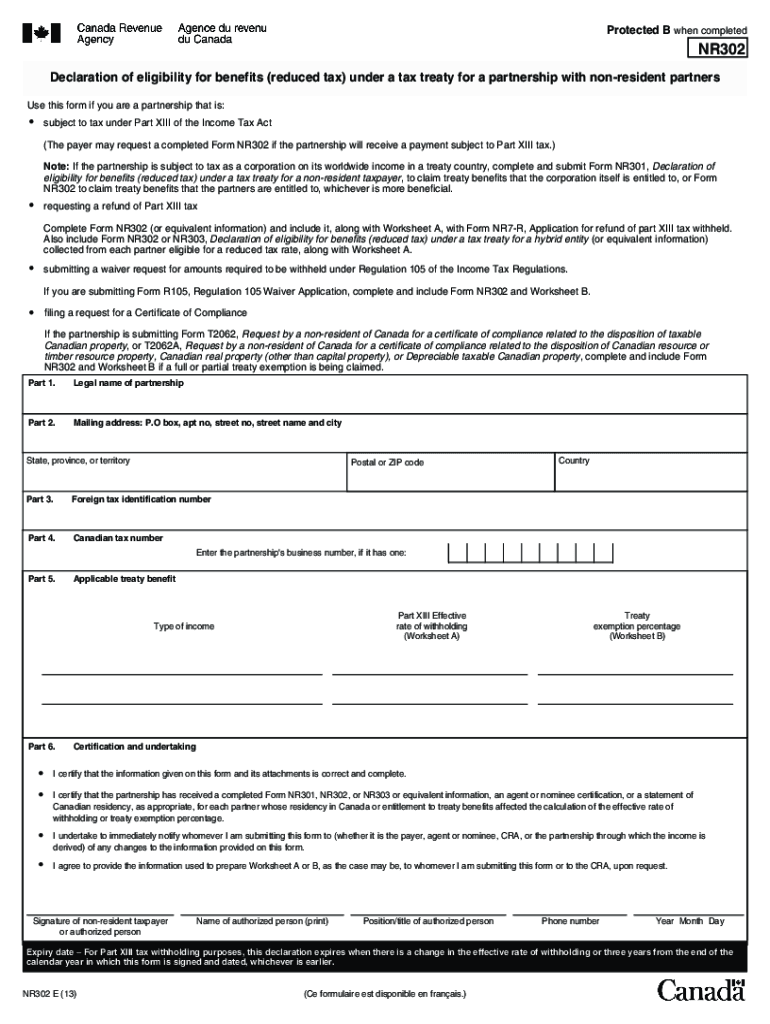
Protected B when completedNR302 Declaration of eligibility for benefits (reduced tax) under a tax treaty for a partnership with nonresident partners Use this form if you are a partnership that is:subject.
Loading

Open form follow the instructions

Easily sign the form with your finger

Send filled & signed form or save
How to fill out the Canada NR302 online
Filling out the Canada NR302 form is essential for partnerships seeking reduced tax rates under tax treaties. This guide provides clear instructions to help you complete the form accurately, ensuring you can efficiently navigate the process.
Follow the steps to fill out the Canada NR302 form online effectively.
- Click 'Get Form' button to obtain the form and open it in the editor.
- In Part 1, enter the legal name of the partnership. This is the official name under which the partnership operates.
- In Part 2, provide the mailing address including P.O. Box, apartment number, street number, street name, city, province or territory, and postal or ZIP code.
- In Part 3, input the foreign tax identification number of the partnership if applicable.
- In Part 4, enter the Canadian tax number of the partnership. Include the partnership’s business number if it has one.
- In Part 5, select the applicable treaty benefit and input the effective rate of withholding from Worksheet A. Specify the type of income your partnership will receive.
- In Part 6, record the treaty exemption percentage derived from Worksheet B relevant to your partnership's income.
- Complete the certification and undertaking section. Certify that all information provided is correct and complete. Ensure accurate signature, name, position/title, phone number, and date.
- After filling out all necessary sections, review your form for accuracy. Save your changes, and proceed to download, print, or share your completed form as needed.
Complete your Canada NR302 form online today to ensure you benefit from reduced tax rates under applicable treaties.
Experience a faster way to fill out and sign forms on the web. Access the most extensive library of templates available.
Related content
... NR302 OR NR303 OR COMPLETE THE DECLARATION OF CANADIAN TAX RESIDENCE ABOVE....
This is likewise one of the factors by obtaining the soft documents of this Nr 302 Final...
Lincoln Electric NA-5N user manual · 1. Make sure the electrode wire is fed into the...
Get answers to your most pressing questions about US Legal Forms API.
Do non residents of Canada need to file taxes?
Your tax obligations. As a non-resident of Canada, you pay tax on income you receive from sources in Canada. The type of tax you pay and the requirement to file an income tax return depend on the type of income you receive. Generally, Canadian income received by a non-resident is subject to Part XIII tax or Part I tax.
What is the non-resident withholding tax in Canada Part XIII?
The basic rate of Part XIII tax is 25% of the gross payment (no deductions permitted), subject to reduction under an applicable tax treaty (if any) between Canada and the recipient's country of residence.
Who pays withholding tax Canada?
Payroll taxes The employer is responsible for withholding the employees' CPP contributions at source and remitting this amount to the CRA.
What is NR302?
NR302, Declaration of eligibility for benefits (reduced tax) under a tax treaty for a partnership with non-resident partners.
What is the non-resident withholding tax in Canada?
Canadian financial institutions and other payers have to withhold non-resident tax at a rate of 25% on certain types of Canadian-source income they pay or credit to you as a non-resident of Canada. The most common types of income that could be subject to non-resident withholding tax include: interest.
What is the tie breaker rule between US and Canada?
If your centre of vital interests is closer to Canada and you do not have these same ties in the U.S., you may tie break to Canada. If you are treated as a resident of Canada under the Treaty, you are treated as a non-resident of the U.S. in figuring your U.S. income tax and may be eligible to claim a treaty exemption.
How much is withholding tax in Canada?
Use the following lump-sum withholding rates to deduct income tax: 10% (5% for Quebec) on amounts up to and including $5,000. 20% (10% for Quebec) on amounts over $5,000 up to and including $15,000. 30% (15% for Quebec) on amounts over $15,000.
Use professional pre-built templates to fill in and sign documents online faster. Get access to thousands of forms.
If you believe that this page should be taken down, please follow our DMCA take down process here.