Loading
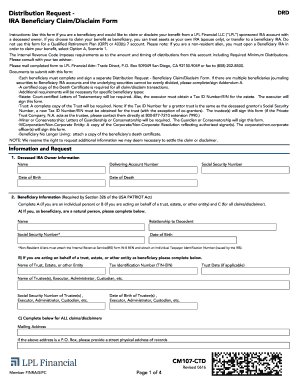
Get Lpl Financial Cm107-cdt 2016-2026
How it works
-

Open form follow the instructions
-

Easily sign the form with your finger
-

Send filled & signed form or save
How to fill out the LPL Financial CM107-CDT online
The LPL Financial CM107-CDT form is a crucial document for beneficiaries looking to claim or disclaim their benefits from a deceased owner's IRA account. This guide provides clear, step-by-step instructions on how to fill out the form accurately and efficiently.
Follow the steps to complete the LPL Financial CM107-CDT form online.
- Click the ‘Get Form’ button to obtain the form and open it in the designated online editor.
- Begin by filling out the 'Deceased IRA Owner Information' section. Provide the name, delivering account number, date of birth, date of death, and social security number of the deceased.
- In the 'Beneficiary Information' section, complete either Section A (if you are an individual), Section B (if you are acting on behalf of a trust or estate), or Section C (for all claims/disclaimers). Include necessary details such as name, relationship to the decedent, and tax identification numbers where applicable.
- Proceed to the 'Beneficiary Options' section. Choose the option that applies to your situation: Option A for a direct transfer to a Beneficiary IRA, Option B for a spousal transfer, or Option C for a beneficiary disclaimer. Fill out the relevant details based on your selected option.
- Complete the 'Signature' section. Sign and date the form, confirming that you have read the Beneficiary Information Guide and understand the associated tax implications.
- Lastly, after reviewing all the information for accuracy, you can save changes, download, print, or share the completed form as necessary.
Start filling out your LPL Financial CM107-CDT form online today to ensure your claim or disclaimer is processed smoothly.
"Disclaim" the inherited retirement account Regardless of your relationship with the account holder, you can opt to disclaim, or not accept, the inheritance and pass on the assets to an alternate beneficiary, such as another family member.