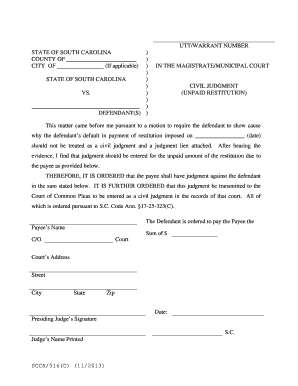
) DEFENDANT(S) ) IN THE MAGISTRATE/MUNICIPAL COURT CIVIL JUDGMENT (UNPAID RESTITUTION) This matter came before me pursuant to a motion to require the defendant to show cause why the defendant s default in payment of restitution imposed on (date) should not be treated as a civil judgment and a judgment lien attached. After hearing the evidence, I find that judgment should be entered for the unpaid amount of the restitution due to the payee as provided below. THEREFORE,.
Open form follow the instructions
Easily sign the form with your finger
Send filled & signed form or save
How to fill out the SC SCCA/516(C) online
The SC SCCA/516(C) form is crucial for documenting civil judgments related to unpaid restitution in South Carolina. This guide will provide step-by-step instructions to help users complete the form accurately and efficiently online.
Follow the steps to successfully fill out the SC SCCA/516(C) form online.
- Click ‘Get Form’ button to obtain the form and access it in an online editor.
- Identify the section for the ‘County of’ and fill in the name of the county where the case is being heard.
- In the ‘City of’ field, enter the appropriate city name if applicable.
- Under the ‘Defendant(s)’ section, clearly write the full name(s) of the defendant(s) involved in the case.
- Locate the ‘Date’ field next to the imposition of restitution and enter the correct date when the restitution was ordered.
- In the ‘Payee’s Name’ area, provide the name of the individual or organization entitled to receive the restitution payment.
- Fill out the ‘Sum of $’ field with the total amount of unpaid restitution due.
- Complete the ‘C/O’ section with to whom the court documentation should be addressed.
- Enter the ‘Court’ name where the judgment will be filed.
- Provide the ‘Court’s Address’ by filling in the street address, city, state, and zip code.
- Finally, ensure the form is signed by the presiding judge, including their printed name and date.
- Save your changes, and then download, print, or share the completed form as necessary.
Begin your process today by filling out the SC SCCA/516(C) form online.
Experience a faster way to fill out and sign forms on the web. Access the most extensive library of templates available.
Related content
2023-301-C) - Petition of the South Carolina Office of Regulatory Staff for ... 1997-516...
Winter, 240 S.C. 516, 531, 126 S.E.2d 570 (1962) (Bussey, dissenting) ... (SCCA) 160 F.2d...
SC#ERR 000004 SC$FTL 000010 SC#NON 000040. SC$WRN 000002 SDANAM 000044 SDBLK ... C. NUMQ...
Get answers to your most pressing questions about US Legal Forms API.
How do I enforce a Judgement in South Carolina?
Executing the Judgment You must execute the judgment. A document called a writ of execution must be prepared, attested to by the clerk of court, and delivered to the sheriff. This gives the sheriff the power to take possession of any non-exempt personal property and, if necessary, real property.
How long is a Judgement valid in SC?
A magistrate's judgment is valid for three years, whereas a circuit court judgment is valid for ten years. Therefore, the filing of a magistrate's judgment in circuit court extends the life of the judgment to that of the circuit court's. Judgments in South Carolina may not be renewed.
Where are judgments filed in South Carolina?
Upon the rendering of a verdict (by the jury or the judge in a non-jury matter), the final judgment of the court should be entered in the civil docket book of the magistrate's court.
How do I file a satisfaction of judgment in South Carolina?
In the case of a satisfaction of a fine, the magistrate or municipal court should file the actual satisfaction of judgment. In the case of a satisfaction for restitution, the victim or the court may file the satisfaction with the circuit clerk of court. SCCA 516 (E) has been developed for this purpose.
How do I execute a Judgement in South Carolina?
First, the creditor has to apply for an execution by the Sheriff. These executions rarely create any benefits. After the Sheriff returns the execution uncollected (also called Nulla Bona), then the creditor must file an action called Supplemental Proceedings with the Master-in-Equity.
What happens if a defendant does not pay a judgment in SC?
There shall be three kinds of executions, (a) against the property of the judgment debtor, (b) against his person and (c) for the delivery of the possession of real or personal property or such delivery with damages for withholding the property. They shall be deemed the process of the court.
Use professional pre-built templates to fill in and sign documents online faster. Get access to thousands of forms.
If you believe that this page should be taken down, please follow our DMCA take down process here.