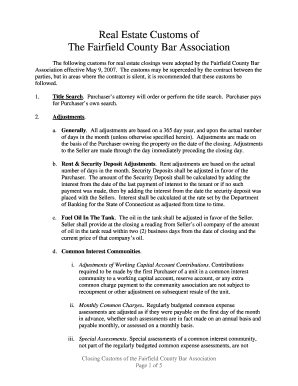
be superceded by the contract between the parties, but in areas where the contract is silent, it is recommended that these customs be followed. 1. Title Search. Purchaser’s attorney will order or perform the title search. Purchaser pays for Purchaser’s own search. 2. Adjustments. a. Generally. All adjustments are based on a 365 day year, and upon the actual number of days in the month (unless otherwise specified herein). Adjustments are made on the basis of the Purchaser owning the prope.
Open form follow the instructions
Easily sign the form with your finger
Send filled & signed form or save
How to fill out the CT Closing Customs online
Filling out the CT Closing Customs form is an essential part of the real estate closing process in Connecticut. This guide will provide you with a clear and detailed overview of how to complete the form effectively, ensuring you understand each section and its requirements.
Follow the steps to complete the CT Closing Customs form successfully.
- Press the ‘Get Form’ button to access the CT Closing Customs form in a digital format, ready for editing.
- Begin by entering the property address at the top of the form. Ensure that the address is accurately typed to avoid any discrepancies.
- List the names of the seller(s) and purchaser(s), making sure to use full legal names as they appear in any relevant documentation.
- Input the purchase price of the property as defined in the sales agreement. This figure should reflect the agreed-upon amount between the parties.
- Complete the title search section by noting whether the purchaser's attorney conducted the title search and any findings that may affect the closing.
- In the adjustments section, detail each adjustment applicable to the transaction, referencing items like security deposits and fuel oil levels in the tank.
- Fill out the closing details, including the location where the closing will take place and the specific funds that will be provided at closing.
- Ensure to provide mechanic’s lien waivers if applicable, along with any additional required documents such as the Non-Foreign Affidavit and Title Insurance Affidavit.
- Review the completed form for accuracy and clarity before saving your changes.
- Once reviewed, save the document, and choose whether to download, print, or share the form as needed.
Complete your CT Closing Customs form online today to ensure a smooth and efficient closing process.
Experience a faster way to fill out and sign forms on the web. Access the most extensive library of templates available.
Related content
Jul 24, 2008 — At the closing, the HUD-1 must reflect the actual settlement costs of the...
Jul 29, 2024 — New Rules Govern Residential Property Sales Beginning in mid-August...
The contractual service covers the customs clearance of alcohol at the port of entry where...
Get answers to your most pressing questions about US Legal Forms API.
Do you need an attorney to close on a house in CT?
Having an attorney is not a requirement to close on a house in Connecticut. However, an attorney can provide valuable support and guidance throughout the closing process, especially when dealing with complex issues. Understanding and following CT Closing Customs can be easier with their expertise, ensuring a smoother transaction overall.
Can you close without a lawyer?
Yes, you can close on your house without a lawyer in Connecticut, but doing so may introduce risks. If you're unfamiliar with CT Closing Customs, you may overlook critical details that could affect your transaction. Using a platform like uslegalforms can offer resources to help you navigate the closing process effectively, even if you choose to go it alone.
Do you need a lawyer to close on a house in Connecticut?
You are not mandated to hire a lawyer to close on a house in Connecticut, but it is highly recommended. Lawyers familiar with CT Closing Customs can ensure all legal documents are completed accurately and they can address any issues that may surface. Their guidance can alleviate much of the stress associated with closing.
Do I need a real estate attorney in Connecticut?
While it is not legally required to have a real estate attorney in Connecticut, having one can make your transaction easier. A knowledgeable attorney can help you understand CT Closing Customs and protect your interests throughout the process. Their expertise can be invaluable, particularly if any complications arise during the transaction.
Do you need a power of attorney to close on a house?
In most cases, you do not need a power of attorney to close on a house in Connecticut. However, if you're unable to attend the closing in person, a power of attorney can be a useful tool. It allows someone you trust to act on your behalf. Understanding CT Closing Customs can help you navigate these requirements smoothly.
Who pays the majority of closing costs?
The majority of closing costs in Connecticut are usually covered by the buyer. This allocation aligns with CT closing customs, which often place the burden of these expenses on those purchasing the property. The seller may negotiate to cover some costs, but buyers should prepare for the majority of these fees. For assistance in understanding these obligations, consider using US Legal Forms, which provides valuable documents and guidance.
Who pays for closing costs in CT?
In Connecticut, the homebuyer typically pays for the closing costs. However, sellers may also contribute to these fees under certain conditions, which is a common practice in CT closing customs. It is essential to review the sales contract for specific details on who is responsible. For further clarity on closing costs, you can consult US Legal Forms to access resources tailored to your needs.
Are property taxes paid in advance in CT?
Since Real Estate Property Taxes are paid in advance you will most likely be reimbursing the seller. Real Estate Property Taxes are paid in January and July so if the annual tax bill for your home is $3,600 that breaks down into 2 payments of $1,800.
How long does closing take in CT?
While the home closing process usually takes 30 – 45 days, you should be prepared to close as quickly as possible. Although some delays are unavoidable, you can do your part to ensure a seamless closing by fulfilling all unpaid debts, preparing all the required signing documents and depositing the down payment on time.
How often are property taxes assessed in CT?
In Connecticut, an assessment is equal to 70% of the fair market value of real estate as established by the municipal Assessor. Real estate assessments are established during the town-wide revaluations, which are performed on a five year schedule.
Use professional pre-built templates to fill in and sign documents online faster. Get access to thousands of forms.
If you believe that this page should be taken down, please follow our DMCA take down process here.