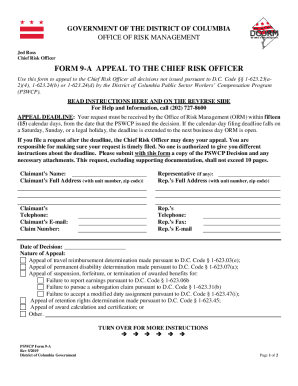
Ons not issued pursuant to D.C. Code 1-623.23(a2)(4), 1-623.24(b) or 1-623.24(d) by the District of Columbia Public Sector Workers Compensation Program (PSWCP). READ INSTRUCTIONS HERE AND ON THE REVERSE SIDE For Help and Information, call (202) 727-8600 APPEAL DEADLINE: Your request must be received by the Office of Risk Management (ORM) within fifteen (15) calendar days, from the date that the PSWCP issued the decision. If the calendar-day filing deadline falls on a Saturday, Sunday, o.
Open form follow the instructions
Easily sign the form with your finger
Send filled & signed form or save
How to fill out the DC PSWCP Form 9-A online
Filing an appeal using the DC PSWCP Form 9-A is a crucial step for individuals looking to challenge decisions made by the District of Columbia Public Sector Workers’ Compensation Program. This guide provides clear, step-by-step instructions on how to fill out the form online, ensuring that your appeal is submitted accurately and efficiently.
Follow the steps to complete your DC PSWCP Form 9-A online.
- Click the ‘Get Form’ button to access the DC PSWCP Form 9-A and open it in your preferred online editor.
- Begin by entering the claimant's name in the designated field. Ensure that the name matches the individual's identification.
- In the next field, provide the full address of the claimant, including unit number and zip code.
- If applicable, fill in the representative's information. Include their full name and address.
- Enter the claimant's telephone number and email address in the respective fields.
- Input the claim number as specified in your correspondence with the Public Sector Workers’ Compensation Program.
- Record the date of the decision that you are appealing. This is crucial for establishing the appeal deadline.
- Select the nature of your appeal by checking the appropriate box. Be specific about the area you are contesting.
- Clearly articulate your reasons for disagreeing with the program decision. Answer all required questions, providing detailed facts and what you wish the Chief Risk Officer to do.
- Count the total number of pages that will accompany your appeal, including attachments, and record this in the relevant field.
- Sign and date the form, affirming that all information is true to the best of your knowledge.
- Finally, save your completed form and consider downloading or printing it for your records, ensuring that you maintain a copy for future reference.
Ensure your appeal is heard by completing the DC PSWCP Form 9-A online today.
Experience a faster way to fill out and sign forms on the web. Access the most extensive library of templates available.
Related content
Use this form to appeal to the Chief Risk Officer all decisions not issued pursuant to...
by DA ARcER · 1994 · Cited by 47 — Our picture of the carbon cycle in the upper ocean...
The following are official PSWCP forms approved for use. Form A-1 – Request for...
Get answers to your most pressing questions about US Legal Forms API.
What is the role of a Risk Officer?
The Risk Officer will identify, assess threats and come up with preventive measures and decide how to avoid, reduce or transfer risks. He or she will be responsible for managing the risk to the Agency's employees, customers, reputation, assets and interests of stakeholders.
What is the difference between a chief risk officer and a risk manager?
Chief Risk Officer Qualifications The CRO is responsible for identifying and assessing risks, and then developing modules and treatments to combat or minimize these risks. A successful risk manager has the analytical skills, quantification skills, and requisite expertise to do all these.
How to become a chief risk officer?
Most Chief Risk Officers have advanced degrees and a minimum of 10 years experience in a corporate role. For example, a Master's of Business Administration (MBA) with a focus in economics or accounting would be appropriate to qualify for top jobs in this field.
What is the role of the chief risk officer?
Typically, the CRO is responsible for the firm's risk management operations, including managing, identifying, evaluating, reporting and overseeing the firm's risks externally and internally to the organization and works diligently with senior management such as chief executive officer and chief financial officer.
What does a chief risk officer do?
The chief risk officer (CRO) is the corporate executive tasked with assessing and mitigating significant competitive, regulatory and technological threats to an enterprise's capital and earnings. The position is sometimes called chief risk management officer or simply risk management officer.
Use professional pre-built templates to fill in and sign documents online faster. Get access to thousands of forms.
If you believe that this page should be taken down, please follow our DMCA take down process here.