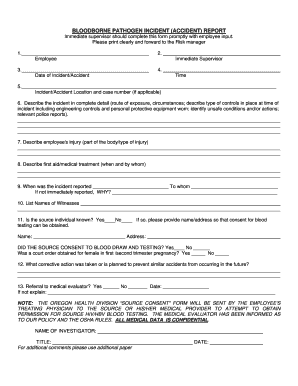
Employee 2. 3. Date of Incident/Accident 4. Immediate Supervisor Time 5. Incident/Accident Location and case number (if applicable) 6. Describe the incident in complete detail (route of exposure, circumstances; describe type of controls in place at time of incident including engineering controls and personal protective equi.
Open form follow the instructions
Easily sign the form with your finger
Send filled & signed form or save
How to fill out the Bloodborne Pathogen Incident (Accident) Report online
Completing the Bloodborne Pathogen Incident Report is essential for accurately documenting any incidents of exposure that occur in the workplace. This guide will walk you through each section of the form, ensuring that you provide all necessary information clearly and concisely.
Follow the steps to complete your report online.
- Click ‘Get Form’ button to access the report. This will allow you to open the document in your preferred editor.
- In the first section, enter the name of the employee reporting the incident. This should be the person who experienced the exposure.
- Next, include the name of the immediate supervisor overseeing the reporting employee.
- Fill in the date of the incident. Make sure to provide the specific date it occurred.
- Indicate the time the incident took place.
- Detail the location where the incident occurred, including any case number that may apply.
- Provide a comprehensive description of the incident. Include details about the exposure route, circumstances, controls in place, and any unsafe conditions or actions observed.
- Describe the nature of the injury, specifying the part of the body affected and the type of injury sustained.
- Document the first aid or medical treatment given, including who provided it and when.
- Note when the incident was reported and to whom. If there was a delay in reporting, explain the reason.
- List the names of any witnesses who observed the incident.
- Indicate whether the source individual is known and if they consent to blood testing. Provide their name and address if applicable.
- Detail any corrective actions taken to prevent future incidents.
- Specify if a medical referral was made and include the date. If not, explain why.
- Finally, include the names and titles of the investigators involved, along with the date of the report.
- Once you've completed the form, review the entries for accuracy. Save your changes, and then download, print, or share the report as needed.
Complete your Bloodborne Pathogen Incident Report online today to ensure accuracy and compliance.
Experience a faster way to fill out and sign forms on the web. Access the most extensive library of templates available.
Related content
The follow-up must also include evaluation of reported illnesses that may be related to...
by MA de Perio · 2012 · Cited by 3 — The facility/store director was required to...
Get answers to your most pressing questions about US Legal Forms API.
Why is reporting incidents of exposure to bloodborne pathogens important?
Prompt reporting also can help the worker avoid spreading bloodborne infection to others. Further, it enables the employer to evaluate the circumstances surrounding the exposure incident to try to find ways to prevent such a situation from occurring again.
What are the 3 main diseases of concern regarding bloodborne pathogens?
Bloodborne pathogens are infectious microorganisms in human blood that can cause disease in humans. These pathogens include, but are not limited to, hepatitis B (HBV), hepatitis C (HCV) and human immunodeficiency virus (HIV). Needlesticks and other sharps-related injuries may expose workers to bloodborne pathogens.
How do I report a bloodborne pathogen exposure incident?
Exposure Incident Reporting An exposure incident should include the following: The time, date, and location of the exposure. An account of all the people involved, including the exposed person, names of their first aid providers, and if possible, the name of the source individual.
Which of the following are exposure incidents?
An exposure incident is any eye, mouth, mucous membrane, non-intact skin, or other parenteral contact with blood or other potentially infectious material (OPIM). (For example, a puncture from a contaminated sharp such as an injection needle or a cut from a scalpel blade or suture needle.)
What is a bloodborne pathogen exposure incident?
An exposure incident is a specific eye, mouth, other mucous membrane, non-intact skin, or parenteral contact with blood or other potentially infectious materials (OPIM), as defined in the standard that results from the performance of a worker's duties.
Which is an example of a blood borne pathogen exposure incident?
Needlesticks or cuts from used needles or sharps. Contact of your eyes, nose, mouth, or broken skin with blood. Assaults – bites, cuts, or knife wounds. Splashes or punctures – especially when drawing blood.
What is the first step after a bloodborne exposure incident?
Step 1, provide immediate care to the exposure site: this includes washing the puncture area for 15 minutes with soap and water. Remember, do not force bleed the wound! Splashes to the mucous membranes (eyes, nose, mouth, or non-intact skin) should also be flushed thoroughly for 15 minutes with water.
What are the incidents involving bloodborne pathogens?
A BBP exposure incident occurs when contact with blood or OPIM occurs in one of the following manners: Contact with the eyes, mouth, or other mucous membranes (eg, nose) Contact with non-intact skin (eg, cuts, scrapes, rashes, dermatitis, acne, hangnails)
Use professional pre-built templates to fill in and sign documents online faster. Get access to thousands of forms.
If you believe that this page should be taken down, please follow our DMCA take down process here.