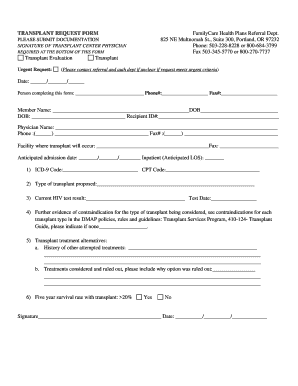
TRANSPLANT REQUEST FORM Amilcare Health Plans Referral Dept. 825 NE Multnomah St., Suite 300, Portland, OR 97232 Phone: 503-228-8228 or 800-684-3799 Fax 503-345-5770 or 800-270-7737 PLEASE SUBMIT.
Open form follow the instructions
Easily sign the form with your finger
Send filled & signed form or save
How to use or fill out the OR Transplant Request Form online
Filling out the OR Transplant Request Form is an essential step in initiating a transplant request. This guide provides comprehensive, step-by-step instructions to help you navigate the form efficiently and accurately.
Follow the steps to fill out the OR Transplant Request Form online:
- Press the ‘Get Form’ button to access the OR Transplant Request Form and open it in your preferred editor.
- Begin by entering your personal details, including the date of request, the name of the person completing the form, and their contact information such as phone number and fax number.
- Fill in the member’s name, date of birth, and recipient ID number. Ensure that all information is accurate to avoid any delays in processing.
- Provide the physician's name, along with their phone number and fax number, ensuring all contact details are correct.
- Specify the facility where the transplant will occur and include the respective fax number.
- Indicate the anticipated admission date and the expected length of stay (LOS) for the inpatient procedure.
- Enter the ICD-9 code and CPT code relevant to the transplant procedure being requested.
- Detail the type of transplant proposed and include the latest HIV test result along with the test date.
- If applicable, provide any evidence of contraindications for the type of transplant, citing the relevant DMAP policies, rules, and guidelines.
- List any alternative treatments considered, including the history of treatment attempts and reasons for ruling out options, ensuring the rationale is included.
- Confirm the five-year survival rate associated with the transplant. Indicate 'Yes' or 'No' as appropriate.
- Sign and date the form at the bottom, ensuring that the signature of the transplant center physician is included.
- Once all fields are completed, ensure to review the information for accuracy. You can then save your changes, download, print, or share the form as needed.
Start completing your OR Transplant Request Form online today!
Experience a faster way to fill out and sign forms on the web. Access the most extensive library of templates available.
Related content
View the latest data about the status of U.S. organ donation and transplantation. Advanced...
Fax completed form and supporting documentation to 503 494-5292. Pre Transplant: Liver...
... form of PGD3 within 72 hours post- transplantation. As shown ... Between February and...
Get answers to your most pressing questions about US Legal Forms API.
How long does it take to get approved for a transplant?
Once you are added to the national organ transplant waiting list, you may receive an organ fairly quickly or you may wait many years. In general, the average time frame for waiting can be 3-5 years at most centers and even longer in some geographical regions of the country.
How do you get approved for a transplant?
The Organ Transplant Process Get a Referral. Your doctor must refer you. ... Gather Information. Learn about transplant lists, costs, and recovery. ... Select a Transplant Center. Make sure the transplant center meets your needs. ... Make an Appointment. Contact the transplant hospital. ... Get Listed.
What determines who gets a transplant?
When an organ donor becomes available, all the patients in the pool are compared to that donor. Factors such as medical urgency, time spent on the waiting list, organ size, blood type and genetic makeup are considered. The organ is offered first to the candidate that is the best match.
What disqualifies you from getting a transplant?
Absolute contraindications for adults and children include, but may not be limited to: Major systemic disease. Age inappropriateness (70 years of age) Cancer in the last 5 years except localized skin (not melanoma) or stage I breast or prostate.
What is the hardest organ to transplant?
Lungs are the most difficult organ to transplant because they are highly susceptible to infections in the late stages of the donor's life. They can sustain damage during the process of recovering them from the donor or collapse after surgeons begin to ventilate them after transplant.
What does it mean when someone calls you a transplant?
someone or something that has moved or been moved from one place to another: I'm a transplant from California.
What happens when you get the call for a transplant?
Receiving the Call Unless your transplant is scheduled, when a donor organ becomes available, you will receive a phone call. This can occur at any time. When you get the phone call, you should proceed to the designated location to prepare for surgery. It is important to know that false alarms do occur.
How do you become a transplant candidate?
1. Get a Referral: You must get a referral from your physician in order to be evaluated by a transplant program as a potential transplant candidate. 2. Gather Information: Order a free copy of Partnering with Your Transplant Team.
Who decides if you get a transplant?
The hospital's transplant team will decide whether you are a good candidate for transplant. Each hospital has their own criteria for accepting candidates for transplant.
How do I apply for a transplant?
Steps you need to take Your physician must give you a referral. Contact a transplant hospital. ... Schedule an appointment for an evaluation and find out if you are a good candidate for transplant. During the evaluation, ask questions to learn as much as possible about that hospital and its transplant team.
Use professional pre-built templates to fill in and sign documents online faster. Get access to thousands of forms.
If you believe that this page should be taken down, please follow our DMCA take down process here.