Loading
Get Uk Weatherbys Age And Markings Certificate Instructions 2015-2026
How it works
-

Open form follow the instructions
-

Easily sign the form with your finger
-

Send filled & signed form or save
How to fill out the UK Weatherbys Age And Markings Certificate Instructions online
Completing the UK Weatherbys Age And Markings Certificate is crucial for accurate horse identification. This guide provides thorough instructions to help users navigate the form effectively, ensuring that all necessary details are captured clearly and correctly.
Follow the steps to complete the Age And Markings Certificate with confidence.
- Click ‘Get Form’ button to obtain the form and open it in the editor.
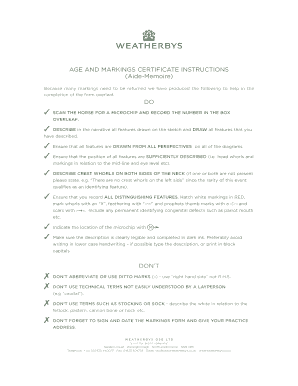
- Clearly scan the horse for a microchip and record the number in the designated box on the form.
- In the narrative section, describe all distinguishing features of the horse, making sure to include a detailed account of each feature depicted in your sketch.
- Draw all identified features from various perspectives in the provided diagrams to provide a comprehensive view.
- Clarify the position of features, such as head whorls and markings, in relation to the horse's mid-line and eye level.
- Describe any crest whorls present on both sides of the neck; if lacking, denote their absence clearly (e.g., 'There are no crest whorls on the left side').
- Record all unique characteristics of the horse, using specific notation: hatch white markings in red, mark whorls with an 'X', feathering with '——', and scars with '➞'. Include congenital defects if applicable.
- Indicate the location of the microchip with an 'M'.
- Ensure your writing is legible and completed in dark ink; if possible, use block capitals or type the description.
- Avoid abbreviations and technical jargon that a layperson might not understand; always use clear, descriptive language.
- Remember to sign and date the form, and provide your practice address.
- Once you have completed the form, save your changes, download a copy for your records, print the form if needed, or share it as required.
Start filling out your forms online today to ensure smooth processing.
Related links form
Star: A white marking between or above the horse's eyes. Stars come in varying sizes and shapes including round, half-moon, heart, oval and/or crescent. Snip: Like a star (above) in varying sizes and shapes, but located on the nose or muzzle. Strip: A narrow white strip that runs down the middle of a horse's face.