DATE OF SERVICE AGING AND LONGER SUPPORT ADMINISTRATION (ALTA)Pressure Injury Assessment and Documentation (Pressure Injury Numbering from Nursing Services Basic Injury Assessment) Use one form per.
Loading

Open form follow the instructions

Easily sign the form with your finger

Send filled & signed form or save
How to fill out the WA DSHS 13-783 online
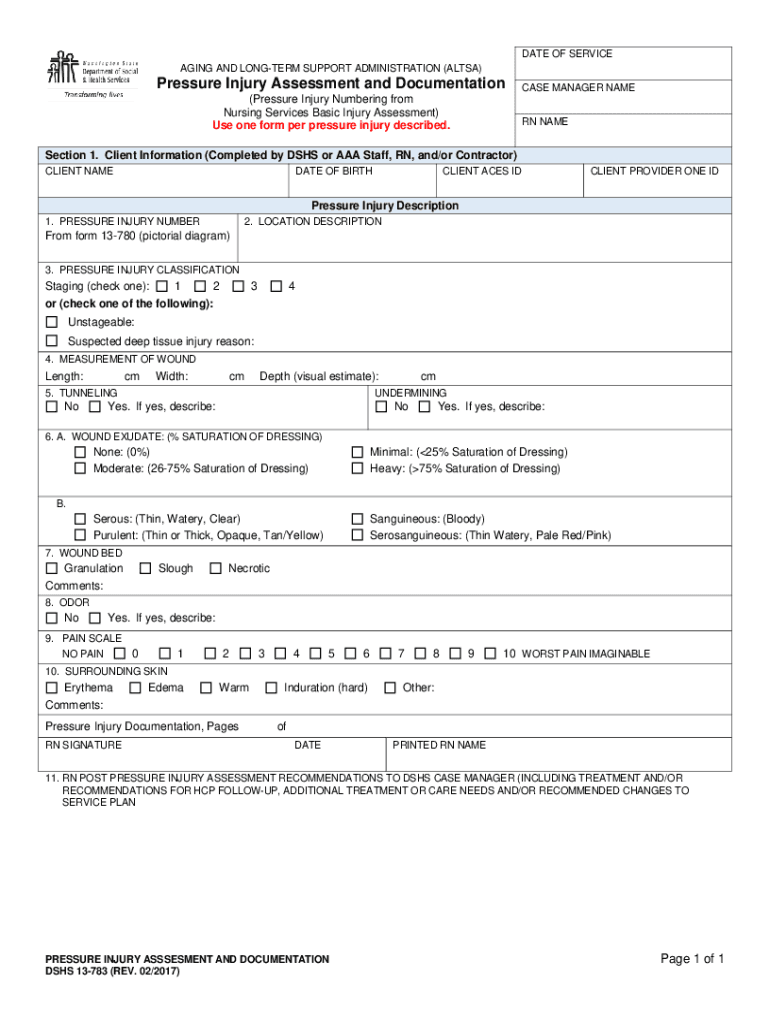
The WA DSHS 13-783 form is essential for documenting pressure injuries as part of care assessment. This guide will support you in accurately completing the form online, ensuring that all pertinent information is recorded for effective communication and care management.
Follow the steps to complete the WA DSHS 13-783 online effectively.
- Select the ‘Get Form’ button to retrieve the form and open it in your document editor.
- In the client information section, enter the client name, client ACES ID, date of birth, and client provider one ID. Ensure all details are accurate to facilitate proper processing.
- Describe the pressure injury in the designated fields: enter the pressure injury number, location description (using the pictorial diagram provided in form 13-780), and pressure injury classification. Select the appropriate staging option.
- Measure the wound dimensions. Input the length and width in centimeters, and provide a visual estimate of the depth.
- Indicate the presence of tunneling and undermining. If applicable, describe these conditions in the provided text fields.
- Assess the wound exudate percentage. Choose one of the saturation options and select the appropriate description for the type of wound exudate.
- Document the state of the wound bed by selecting the correct descriptions such as granulation, slough, or necrotic. Include any additional comments as necessary.
- Evaluate and document the presence of odors associated with the wound, providing a description if applicable.
- Rate the pain experienced by the patient using the provided scale from zero to ten, recording this information clearly.
- Describe the condition of the surrounding skin, selecting relevant descriptors like erythema, edema, and warmth. Add comments as needed.
- Finally, the registered nurse should sign and date the form, print their name, and provide post-pressure injury assessment recommendations within the designated section.
- Once all sections have been completed, save your changes, and download or print the form for submission or sharing, as necessary.
Complete and submit your WA DSHS 13-783 form online to ensure accurate and timely documentation of pressure injuries.
Experience a faster way to fill out and sign forms on the web. Access the most extensive library of templates available.
Related content
DSHS 13-783 (REV. 02/2017). AGING AND LONG-TERM SUPPORT ADMINISTRATION (ALTSA) ... Client...
DSHS 13-783 (REV. 02/2017) ... Use one form per pressure injury described. ... Client...
Please note: Any current pressure injuries require further detailed documentation on...
Get answers to your most pressing questions about US Legal Forms API.
Why do we perform skin assessment?
Skin assessment is used to predict the development of pressure ulcers, and therefore is an extremely useful preventative tool. The small resource use associated with skin assessment is highly likely to be offset by costs savings as more pressure ulcers are prevented. Skin assessment - NCBI National Institutes of Health (NIH) (.gov) https://.ncbi.nlm.nih.gov › books › NBK333153 National Institutes of Health (NIH) (.gov) https://.ncbi.nlm.nih.gov › books › NBK333153
When assessing a patient's skin, what does the nurse need to know?
There are five key areas to note during a focused integumentary assessment: color, skin temperature, moisture level, skin turgor, and any lesions or skin breakdown. 14.4 Integumentary Assessment – Nursing Skills – 2e pressbooks.pub https://wtcs.pressbooks.pub › nursingskills › chapter › 1... pressbooks.pub https://wtcs.pressbooks.pub › nursingskills › chapter › 1...
How do you inspect a patient's skin?
Inspect and palpate skin for the following: Color: Contrast with color of mucous membrane. Texture. Turgor: Lift a fold of skin and note the ease with which it moves (mobility) and the speed with which it returns into place. Moisture. Pigmentation. Lesions. Hair distribution. Warmth: Feel with back of your hand. Inspect Skin luc.edu https://.meddean.luc.edu › pulmonar › pstep76 luc.edu https://.meddean.luc.edu › pulmonar › pstep76
How would you describe skin in nursing assessment?
The physical assessment of the skin involves inspection and palpation and may reveal local or systemic problems in the patient. When palpating the skin, it is important to note: Texture – it should be smooth and even. Thickness – very thin skin may indicate steroid therapy or arterial insufficiency. Proper Skin Assessment - Nursing Review (Video) mometrix.com https://.mometrix.com › academy › skin-assessment mometrix.com https://.mometrix.com › academy › skin-assessment
How to document a pressure injury?
Provide an accurate description of the pressure ulcer or of skin characteristics. Accurately measure the wound length, width, and depth, and note any drainage. Indicate changes in color, consistency, and odor.
What is the medical definition of skin observation?
Skin observation protocol is a protocol that uses the CARE algorithm to identify clients who are at high risk of having or developing a pressure injury.
Use professional pre-built templates to fill in and sign documents online faster. Get access to thousands of forms.
If you believe that this page should be taken down, please follow our DMCA take down process here.