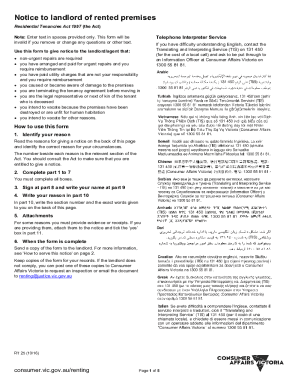
Notice to landlord of rented premises Residential Tenancies Act 1997 (the Act)Telephone Interpreter ServiceNote: Enter text in spaces provided only. This form will be invalid if you remove or change.

How it works
  • Open form

    Open form follow the instructions

  • Easily sign form

    Easily sign the form with your finger

  • Share form

    Send filled & signed form or save

How to fill out the AU RT 25 - Victoria online

Filling out the AU RT 25 - Victoria form is an essential process for notifying your landlord about various situations related to your rental agreement. This guide provides clear, step-by-step instructions to help you complete the form accurately and efficiently.

Follow the steps to successfully fill out the AU RT 25 - Victoria form.

  1. Click ‘Get Form’ button to access the document and open it in your online editor.
  2. Identify your reason for notifying the landlord based on the options provided in the form. Familiarize yourself with the relevant sections of the Residential Tenancies Act 1997 that correspond to your situation.
  3. Complete Parts 1 through 7 of the form, ensuring that you fill out every required box to maintain the validity of your notice.
  4. Sign the form in Part 8 and write your name in Part 9 to authenticate your notice.
  5. In Part 10, specify your reason for the notice by writing the section number and the exact text that describes your situation, as outlined on the back of the form.
  6. If applicable, gather any necessary evidence or receipts related to your notice. Attach these documents to the form and select 'yes' in Part 11 to indicate that attachments are included.
  7. Once the form is completely filled out, send a copy of it to the landlord using your chosen delivery method. Ensure you keep copies for your own records. If the landlord does not respond, consider sending a copy to Consumer Affairs Victoria.

Complete your AU RT 25 - Victoria form online now to ensure your notice is filed correctly.

Get form

Experience a faster way to fill out and sign forms on the web. Access the most extensive library of templates available.

Related content

Influenza C infections in Western Australia and...

by L Jelley · 2016 · Cited by 17 — Objectives. This study aimed at analyzing the...

Learn more
Self-Drive Victoria

Travel across Victoria and experience the region's stunning landscapes, abundant wildlife...

Learn more
Orthodontic Product Catalog - Stronger security is...

As you know, the orthodontic business and treatment models are changing. Patients have...

Learn more
Questions & Answers

Get answers to your most pressing questions about US Legal Forms API.

Contact support

What is the difference between a nonsuit and a dismissal?

When a court dismisses a lawsuit with prejudice, it marks the end of that claim for both the plaintiff and defendant. The plaintiff can neither bring the case back to the court nor take it to a higher court. On the other hand, a nonsuit without prejudice refers to temporarily dismissing a lawsuit by the plaintiff.

Although a Motion for Nonsuit or a Notice of Nonsuit is effective immediately upon filing, there must still be an order formally dismissing the case.

Motion for Nonsuit in Texas A Motion for Nonsuit is what a creditor typically files to dismiss a lawsuit. The motion is usually filed “without prejudice“. This means that the Plaintiff is voluntarily giving up on their case but they reserve the right to re-file the case if they want to.

A compulsory nonsuit is a decision by a court that a case cannot proceed to trial, either on substantive or procedural grounds. Depending on which grounds the nonsuit is entered, the plaintiff may or may not be able to file his case again.

Nonsuit is a judgment given against a plaintiff in which the court dismisses a case because the plaintiff either was unable to make an adequate showing or is unwilling to continue with the case. A nonsuit may be voluntary or involuntary.

When a court dismisses a lawsuit with prejudice, it marks the end of that claim for both the plaintiff and defendant. The plaintiff can neither bring the case back to the court nor take it to a higher court. On the other hand, a nonsuit without prejudice refers to temporarily dismissing a lawsuit by the plaintiff.

Motion for Nonsuit in Texas A Motion for Nonsuit is what a creditor typically files to dismiss a lawsuit. The motion is usually filed “without prejudice“. This means that the Plaintiff is voluntarily giving up on their case but they reserve the right to re-file the case if they want to.

A voluntary nonsuit in state court is a procedural right to voluntarily dismiss the case, but it is created by statute. Va. Code Ann. § 8.01-380. Although it is a voluntary dismissal, a nonsuit does not operate the same way as a voluntary dismissal in federal court.

motion for dismissal. (non-suit) n. application by a defendant in a lawsuit or criminal prosecution asking the judge to rule that the plaintiff (the party who filed the lawsuit) or the prosecution has not and cannot prove its case.

motion for dismissal. (non-suit) n. application by a defendant in a lawsuit or criminal prosecution asking the judge to rule that the plaintiff (the party who filed the lawsuit) or the prosecution has not and cannot prove its case.

Get This Form Now!

Use professional pre-built templates to fill in and sign documents online faster. Get access to thousands of forms.

If you believe that this page should be taken down, please follow our DMCA take down process here.

Get AU RT 25 - Victoria