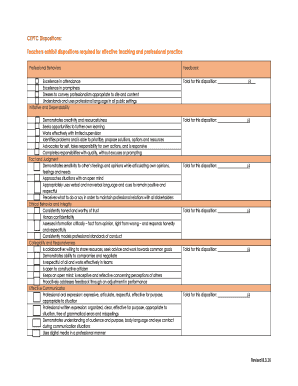
CE PTC Dispositions: Teachers exhibit dispositions required for effective teaching and professional practice Professional BehaviorsFeedback:o Excellence in attendance o Excellence in promptness o.

How it works
  • Open form

    Open form follow the instructions

  • Easily sign form

    Easily sign the form with your finger

  • Share form

    Send filled & signed form or save

How to fill out the CEPTC Dispositions online

This guide is designed to assist users in completing the CEPTC Dispositions form online. By following the outlined steps, you will navigate each section effectively and ensure your responses reflect your professional behaviors and dispositions.

Follow the steps to complete the CEPTC Dispositions form online.

  1. To begin, click the ‘Get Form’ button to access the CEPTC Dispositions document and open it in your preferred online editor.
  2. Review the categories presented in the form, such as Professional Behaviors, Initiative and Dependability, and others. Each category contains specific behaviors you will need to assess.
  3. For each category, reflect on your own performance and rate yourself based on the provided criteria, marking the appropriate total score in the designated space.
  4. Ensure to provide specific feedback or comments in the section labeled 'Please clarify areas of concern.' This allows for a constructive assessment of your dispositions.
  5. After completing the ratings and comments, you will need to sign and date the form. Input your signature in the 'STUDENT SIGNATURE' field, followed by the current date.
  6. If an assessor is required, they should also sign and date in their respective field at the bottom of the form.
  7. Finally, review your completed form for accuracy. Save any changes you made, then download or print the document to share or submit as needed.

Complete the CEPTC Dispositions form online today for an accurate assessment of your professional dispositions.

Get form

Experience a faster way to fill out and sign forms on the web. Access the most extensive library of templates available.

Related content

OPTN/UNOS Operations and Safety Committee Meeting...

Oct 25, 2016 — It was noted that all products are now in the UNOS Connect Learning...

Learn more
alveolar lung recruitment maneuver utilization...

by BS Bergstrom · 2019 — some form of lung recruitment to increase organ utilization...

Learn more
IEEE U 1tH NIm Ifll 08031738-0

I CEPTC rAn1. AN 125 VDC Battery Banks: Check Value ... package to your Supervisor for...

Learn more
Questions & Answers

Get answers to your most pressing questions about US Legal Forms API.

Contact support

What are the 3 dispositions?

However, research has revealed that often learners possess thinking abilities in these areas, but aren't disposed to use them. The project has identified three logically distinct components that are necessary for dispositional behavior: ability, inclination, and sensitivity.

Professional Dispositions Demonstrate genuine enthusiasm and optimism. Foster a positive climate for learning. Act on the premise that all children can learn. Provide positive, authentic feedback. Focus on possibilities rather than obstacles. Respond to challenges. Treat all forms of diversity as learning opportunities.

Dispositions are guided by beliefs and attitudes related to values such as caring, fairness, honesty, responsibility and social justice.

The rubric delineates the six dispositions – social justice and equity, collaboration, critical thinking, professional ethics, reflective teaching and learning, and life-long learning.

Children's desirable dispositions, such as resourcefulness, curiosity, and persistence, can be strengthened. Conversely, teachers can help diminish undesirable dispositions, such as selfishness, impatience, and intolerance.

Dispositions, such as curiosity, independence, resilience, and perseverance are often described as innate or natural character traits that children possess from birth.

A disposition is an attitude or approach that we have towards our experiences in life. Examples of dispositions are curiosity, perseverance, and patience. Our dispositions can influence how we respond to the opportunities, problems and challenges we encounter in our daily experiences.

Building shared responsibility for learning experiences requires both teachers and students to develop the following five dispositions. Curiosity About Students' Learning. ... Eagerness for Inquiry. ... Willingness to Collaborate. ... Good Communication. ... Empathy.

Get This Form Now!

Use professional pre-built templates to fill in and sign documents online faster. Get access to thousands of forms.

If you believe that this page should be taken down, please follow our DMCA take down process here.

Get CEPTC Dispositions