Elves if the property is a single dwelling or a flat with its own water supply (hot and cold) and they are competent to do so. In particular landlords should: understand different types of water systems understand Legionella bacteria and the factors which increase the risk of an outbreak in a domestic setting understand the control measures which if present will reduce the risk of an outbreak within a domestic setting Before considering carrying out a risk assessment you should famil.
Loading

Open form follow the instructions

Easily sign the form with your finger

Send filled & signed form or save
How to fill out the UK Legionnaires Disease Risk Assessment online
This guide provides clear and detailed instructions for filling out the UK Legionnaires Disease Risk Assessment online. It aims to assist users in completing the risk assessment form effectively, ensuring that all necessary components are addressed.
Follow the steps to complete your risk assessment form online:
- Press the ‘Get Form’ button to acquire the risk assessment form and open it in your preferred editor.
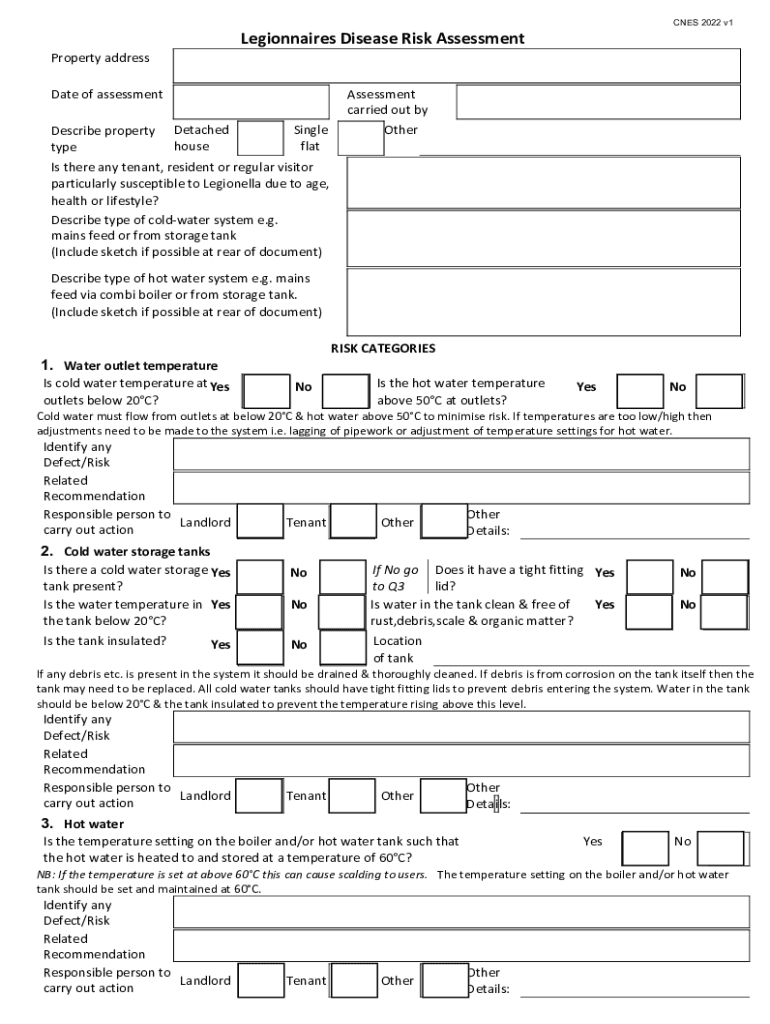
- Begin by entering the property address and the date of the assessment. Clearly describe the type of property, such as whether it is a detached house or a single flat.
- Identify yourself as the assessor by filling in your name and designation in the section labeled ‘Assessment carried out by’.
- Indicate if there are any tenants, residents, or regular visitors who may be particularly susceptible to Legionella due to their age, health, or lifestyle. This is important for assessing risk.
- Describe the type of cold-water system present: indicate whether it is a mains feed or from a storage tank, and consider including a sketch on the provided space.
- Provide details about the hot water system, specifying if it is a mains feed via a combi boiler or from a storage tank, with a sketch if necessary.
- Proceed to assess the water outlet temperatures. Answer the questions regarding cold water temperatures below 20°C and hot water temperatures above 50°C, noting any recommendations needed.
- Evaluate the cold-water storage tanks by answering if they are present, then assess the temperature and conditions within the tanks.
- Check the temperature settings on the boiler and hot water tank to ensure the hot water is stored at 60°C.
- Identify little used outlets, such as those in guest bathrooms, and determine their usage frequency.
- If showers are present, identify their locations and ensure they are cleaned and maintained regularly.
- Assess for any dead legs or redundant pipework that could lead to stagnation and enter any risk management recommendations.
- For unoccupied properties, confirm a flushing protocol is in place to maintain water flow.
- Educate tenants by confirming you have given them advice about Legionnaires Disease risks and responsibilities.
- Once all sections are complete, review the assessment. You should be able to save changes, download, or print the document for sharing.
Complete your UK Legionnaires Disease Risk Assessment online today for a safe and compliant property.
Experience a faster way to fill out and sign forms on the web. Access the most extensive library of templates available.
Related content
These difficulties include deciding who to test, where and when to sample the ... To...
Health Protection Network site: http://www.hps.scot.nhs.uk/about/HPN.aspx. Citation for...
Legionnaires' disease, also known as legionellosis, is a form of atypical pneumonia caused...
Get answers to your most pressing questions about US Legal Forms API.
Is a Legionella Risk Assessment a legal requirement?
There is a legal duty for landlords to assess and control the risk of exposure to legionella bacteria, but Health and Safety law does not require landlords to produce or obtain, nor does HSE recognise, a 'Legionnaires testing certificate'.
How do I do a Legionella risk assessment?
The Legionella Risk Assessment Process. Step 1: Identify the Hazards. Step 2: Consider Who May be At Risk. Step 3: Implement Control Measures. Step 4: Keep Records. Step 5: Review the Risk Assessment.
What does a Legionella Risk Assessment involve?
The HSE states that legionella risk assessment needs to identify whether: Water is stored or re-circulated as part of your system. The water temperature in some or all parts of the system is between 20 45 °C. There are sources of nutrients such as rust, sludge, scale and organic matters.
Can anyone complete a Legionella risk assessment?
A risk assessment should also consider anyone who could be potentially exposed to any legionella bacteria in your system, and particularly groups that are at a higher risk of contracting legionellosis. However, once you have completed your risk assessment you may decide that the risks are insignificant.
How often should you carry out a Legionella risk assessment?
The guidance used to say that a legionella risk assessment should be reviewed at least every 2 years but now it says the risk assessment should be a living document which must be regularly reviewed to ensure it remains up to date.
What happens during a legionella risk assessment?
A Legionella Risk Assessment will include the review of your current records and a check of your previous assessments to ensure that all recommendations of remedial work or maintenance have been acted upon.
Who can complete a Legionella risk assessment?
If you are responsible for water systems that workers, residents or tenants are exposed to, then you have a legal duty to manage the risk of legionella and protect against outbreaks of Legionnaires' disease, this will require you to carry out a legionella risk assessment.
Do landlords have to have a Legionella risk assessment?
No, landlords are not legally required to carry out a Legionella risk assessment. However, landlords do have a more general legal duty of care to protect the health and safety of their tenants a part of which is to ensure their property's water is safe to drink and use.
Do landlords need to do a Legionella risk assessment?
There is a legal duty for landlords to assess and control the risk of exposure to legionella bacteria, but Health and Safety law does not require landlords to produce or obtain, nor does HSE recognise, a 'Legionnaires testing certificate'.
How do I get a Legionella risk assessment?
The Legionella Risk Assessment Process. Step 1: Identify the Hazards. Step 2: Consider Who May be At Risk. Step 3: Implement Control Measures. Step 4: Keep Records. Step 5: Review the Risk Assessment.
Use professional pre-built templates to fill in and sign documents online faster. Get access to thousands of forms.
If you believe that this page should be taken down, please follow our DMCA take down process here.