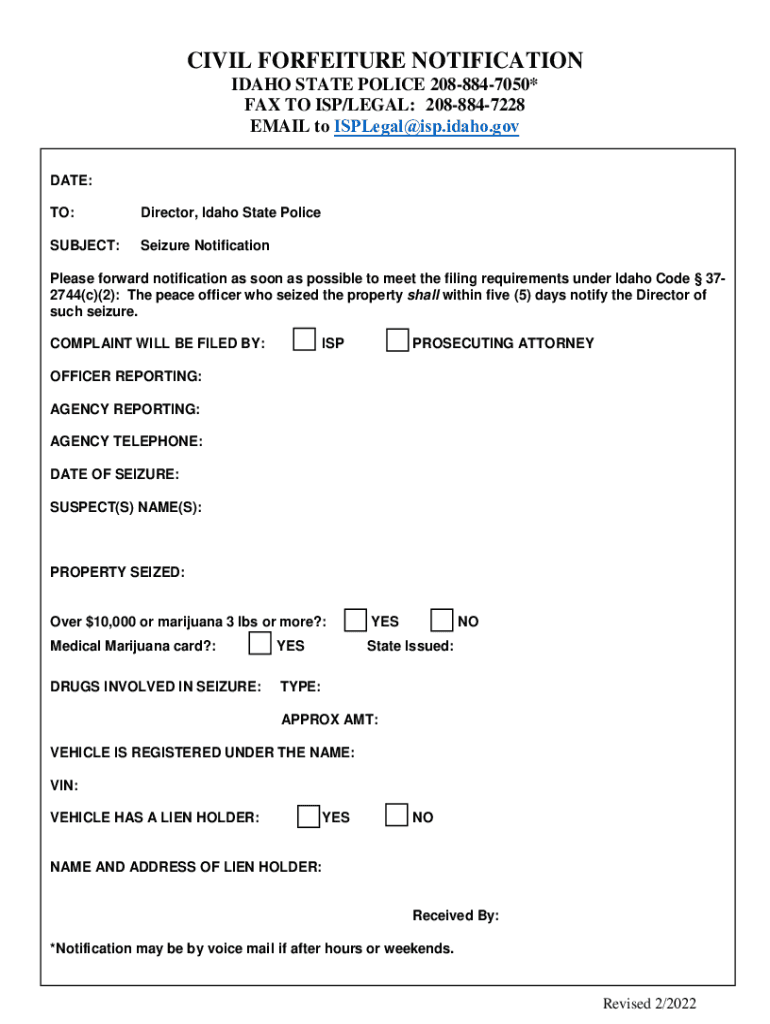
CIVIL FORFEITURE NOTIFICATION IDAHO STATE POLICE 2088847050* FAX TO ISP/LEGAL: 2088847228 EMAIL to ISPLegal isp.idaho.gov DATE: TO:Director, Idaho State PoliceSUBJECT:Seizure NotificationPlease forward.
Loading

Open form follow the instructions

Easily sign the form with your finger

Send filled & signed form or save
How to fill out the ID Civil Forfeiture Notification online
Filling out the ID Civil Forfeiture Notification form online can ensure compliance with legal requirements while providing a clear notification of property seizure. This guide will help you understand each section of the form for a smooth and accurate completion.
Follow the steps to complete the ID Civil Forfeiture Notification form.
- Click ‘Get Form’ button to obtain the form and open it for filling out.
- Enter the date in the designated field to indicate when the notification is being completed.
- Fill in the recipient information by entering 'Director, Idaho State Police' in the 'TO' section.
- In the 'SUBJECT' line, state 'Seizure Notification' to specify the purpose of the notification.
- Fill out the 'COMPLAINT WILL BE FILED BY' section by selecting either ISP or Prosecuting Attorney.
- Provide the name of the officer reporting, the agency reporting, and their telephone number in the designated fields.
- Input the date of seizure to document when the property was taken.
- List the names of all suspects involved in the seizure under 'SUSPECT(S) NAME(S)'.
- Detail the property seized by entering a description under 'PROPERTY SEIZED'.
- Indicate if the value of the property exceeds $10,000 or if the seized marijuana is 3 lbs or more by selecting 'YES' or 'NO'.
- If relevant, mention whether a medical marijuana card is held under the appropriate question.
- Complete the drugs involved in the seizure section, specifying the type and approximate amount.
- Declare if the vehicle is registered under a specific name and provide the VIN in the relevant fields.
- Indicate if there is a lien holder on the vehicle by selecting 'YES' or 'NO', then enter the name and address of the lien holder if applicable.
- Conclude the form by adding 'Received By' information, if available.
- After filling out all sections, you can save your changes, download, print, or share the completed form as needed.
Complete your ID Civil Forfeiture Notification online today to ensure timely and accurate reporting.
Experience a faster way to fill out and sign forms on the web. Access the most extensive library of templates available.
Related content
Search and Seizure Warrant. Download Form (pdf, 531.56 KB). Form Number: AO 93. Category:...
CHE. VEHICLE SEIZURE FORM. PD 571-1218 (Rev. 11-07). TYPE OR PRINT LEGIBLY. OWNER. BERGA...
The police are a constituted body of persons empowered by a state, with the aim to enforce...
Get answers to your most pressing questions about US Legal Forms API.
What is a seizure warrant?
Search and seizure is a procedure used in many civil law and common law legal systems by which police or other authorities and their agents, who, suspecting that a crime has been committed, commence a search of a person's property and confiscate any relevant evidence found in connection to the crime.
What is a seizure in law enforcement?
Forcible possession; a grasping, snatching, or putting in possession. In Criminal Law, a seizure is the forcible taking of property by a government law enforcement official from a person who is suspected of violating, or is known to have violated, the law.
When can the government seize assets?
Federal law allows law enforcement agencies and prosecutors to seize property, including money, from people convicted of certain federal crimes, such as drug trafficking, money laundering, and organized crime. The seizure is known as forfeiture, and it's done without compensation to the owner.
What is a reasonable search and seizure?
A search or seizure is reasonable if the police have a warrant from a judge based on probable cause to believe that a suspect has committed a crime. (Read more here about what probable cause means.) Also, a search may be reasonable without a warrant if an exception applies under the circumstances.
What are the two types of seizures in law?
By its terms, the Fourth Amendment governs two types of seizures: the seizure of things (or more precisely, tangible property) and the seizure of persons.
What is a seizure under the 4th Amendment?
Seizure. The Fourth Amendment proscribes unreasonable seizure of any person, person's home (including its curtilage) or personal property without a warrant.
What violates the 4th Amendment?
An arrest is found to violate the Fourth Amendment because it was not supported by probable cause or a valid warrant. Any evidence obtained through that unlawful arrest, such as a confession, will be kept out of the case.
What constitutes illegal search and seizure?
Definition. An unreasonable search and seizure is a search and seizure by a law enforcement officer without a search warrant and without probable cause to believe that evidence of a crime is present.
What assets can be seized in forfeiture?
Updated October 16, 2020 Asset forfeiture is when the government takes a person's property because it suspects the property was used in committing a crime or was obtained by way of criminal activity. California's asset forfeiture laws can be used to seize most types of property, including: houses, boats, cars, and ...
Use professional pre-built templates to fill in and sign documents online faster. Get access to thousands of forms.
If you believe that this page should be taken down, please follow our DMCA take down process here.