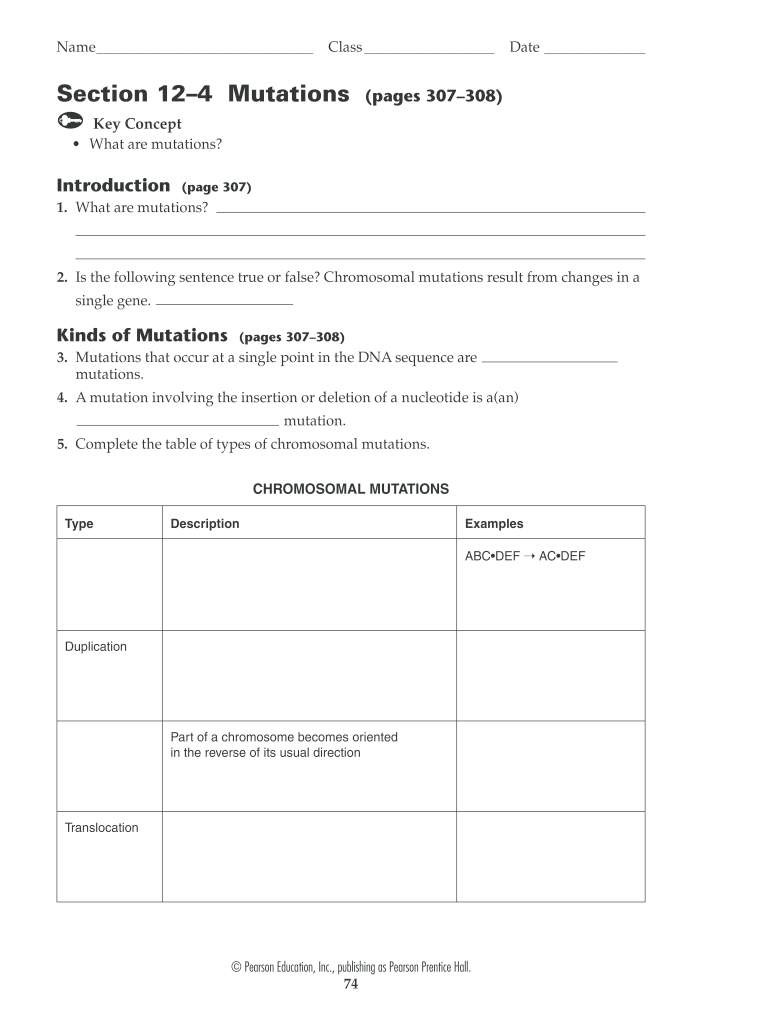
Name Class Section 12 4 Mutations pages 307 308 Key Concept What are mutations Introduction page 307 2. Is the following sentence true or false Chromosomal mutations result from changes in a single gene. Kinds of Mutations 3. Mutations that occur at a single point in the DNA sequence are mutations. 4. A mutation involving the insertion or deletion of a nucleotide is a an 5. Complete the table of types of chromosomal mutations. CHROMOSOMAL MUTATIONS Type Description Examples ABC DEF AC DEF Duplication Part of a chromosome becomes oriented in the reverse of its usual direction Translocation Pearson Education Inc* publishing as Pearson Prentice Hall* 6. Circle the letter of each sentence that is true about gene mutations. a* Point mutations affect just one nucleotide. b. The substitution of one nucleotide for another in the gene never affects the function of the protein* reading frame of the genetic message. d. Frameshift mutations affect every amino acid that follows the point of the mut....
Loading

Open form follow the instructions

Easily sign the form with your finger

Send filled & signed form or save
How to fill out the Section 12 4 Mutations online
Filling out the Section 12 4 Mutations form online can be a straightforward process if you follow the right steps. This guide will help you understand the necessary components and provide clear instructions for successfully completing the form.
Follow the steps to fill out the Section 12 4 Mutations form online
- Click ‘Get Form’ button to obtain the form and open it in the editor.
- Begin by entering your name in the designated field. This identifies who is completing the form.
- Next, input your class information in the appropriate section. This is important for organizational purposes.
- Provide the current date in the specified area to ensure the form is timely and relevant.
- Move to the sections regarding mutations. Answer the question about the definition of mutations, ensuring clarity and accuracy.
- Determine whether the statement about chromosomal mutations is true or false, as this will gauge your understanding of the material.
- For the 'Kinds of Mutations' section, identify the types of mutations by filling in the answers based on your understanding of genetic principles.
- Complete the table detailing types of chromosomal mutations. Make sure to include descriptions and examples accurately.
- Address the statements about gene mutations, circling the correct letters for those that are true.
- Conclude by reviewing your entries for accuracy and completeness, then save your changes.
- Finally, choose to download, print, or share the completed form as needed.
Complete your documents online for convenience and efficiency.
Experience a faster way to fill out and sign forms on the web. Access the most extensive library of templates available.
Related content
A frameshift mutation in a gene refers to the insertion or deletion of nucleotide bases in...
There are four types of chromosomal mutations: deletion, duplication, inversion, and...
This lesson is for a senior level biology course and emphasizes the relationship between...
Get answers to your most pressing questions about US Legal Forms API.
What is mutation 12?
Any sudden heritable change is called mutation. Gene mutations are the changes that occur in one or more genes that can lead to harmful diseases or illnesses. Genes can be defined as small portions of the DNA, knob like and present in a single linear row over the chromosomes.
How many mutations do you probably have that your parents do not have?
This means that typically every child has around 60 to 70 new mutations that their biological parents don't have. These mutations are responsible for genetic variation along with many genetic diseases.
Are mutations inherited from parents?
Do Parents Pass Gene Mutations to Children? If a parent carries a gene mutation in their egg or sperm, it can pass to their child. These hereditary (or inherited) mutations are in almost every cell of the person's body throughout their life.
How many mutations do people usually have?
This means that a human genome accumulates around 64 new mutations per generation because each full generation involves a number of cell divisions to generate gametes.
What are the 4 types of mutation?
Mutations can be of many types, such as substitution, deletion, insertion, and translocation.
Can you have a trait that your parents don't have?
We call this mode of inheritance “recessive”. Unlike with dominant conditions, the parents of a child with a recessive disease will not show signs of the disease.
Do parents pass gene mutations to children?
Can I inherit genetic mutations? Yes, you can inherit germline genetic mutations, while somatic mutations occur with no previous history of the mutation in your family. There are several patterns that genetic mutations can pass from the parent to a child (hereditary).
What are the code types of mutations?
There are three types of DNA Mutations: base substitutions, deletions and insertions.
Use professional pre-built templates to fill in and sign documents online faster. Get access to thousands of forms.
If you believe that this page should be taken down, please follow our DMCA take down process here.