Loading
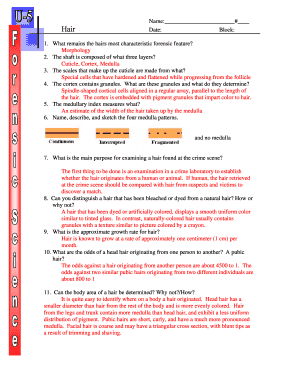
Get What Remains The Hair's Most Characteristic Forensic Feature
How it works
-

Open form follow the instructions
-

Easily sign the form with your finger
-

Send filled & signed form or save
How to fill out the What Remains The Hair's Most Characteristic Forensic Feature online
This guide provides comprehensive instructions for completing the What Remains The Hair's Most Characteristic Forensic Feature form online. Each section of the form is outlined step-by-step for clarity and ease of understanding.
Follow the steps to effectively complete the form online.
- Click ‘Get Form’ button to obtain the form and open it for editing.
- In the first field, enter the name of the person or entity submitting the form.
- Enter the date of submission in the specified format.
- Complete the 'Block' section by providing any relevant identification or case number.
- For the first question, describe what remains the hair’s most characteristic forensic feature, focusing on morphology.
- In the next section, list the three layers of the hair shaft: cuticle, cortex, and medulla.
- Detail the material composition of the cuticle scales, indicating they are formed from special cells that have hardened and flattened.
- In the section about the cortex, explain the characteristics of the granules within and their role in determining hair color.
- For the medullary index, provide an estimate of the width of the hair occupied by the medulla.
- Name, describe, and sketch the four medulla patterns as required by the form.
- Explain the primary purpose of collecting hair evidence at a crime scene.
- Address whether hair can be distinguished as dyed or natural and provide reasoning.
- Indicate the approximate growth rate of hair, noted as one centimeter per month.
- Discuss the odds of hair originating from the same person and note different statistics for head and pubic hair.
- Clarify whether the body area of a hair can be determined and explain the distinguishing features of hair from different body areas.
- Reflect on the ability to determine the racial origin of hair and the methods for identification.
- Address the question regarding determining the age and sex of hair, including the role of DNA.
- Explain the conditions under which a hair may be identified as forcibly removed.
- Discuss the reasons why hair found at a crime scene may not be typically used for DNA typing.
- Contrast natural and synthetic fibers based on their characteristics.
- List features for observation under a microscope, including cortex color, cuticle structure, medulla index, and end shape.
- Finally, suggest where an investigator might find control hairs in a missing person’s case.
- After completing all fields, save your changes, and consider downloading, printing, or sharing the form.
Complete your documents online to ensure accuracy and efficiency.
Hair evidence can provide information about the race of the individual, and it can also show if the hair has been chemically treated, or if has been cut or pulled out in a certain way. Hair evidence can also show where in the body it was located, as well as genetic information such as blood type or DNA.
Industry-leading security and compliance
US Legal Forms protects your data by complying with industry-specific security standards.
-
In businnes since 199725+ years providing professional legal documents.
-
Accredited businessGuarantees that a business meets BBB accreditation standards in the US and Canada.
-
Secured by BraintreeValidated Level 1 PCI DSS compliant payment gateway that accepts most major credit and debit card brands from across the globe.