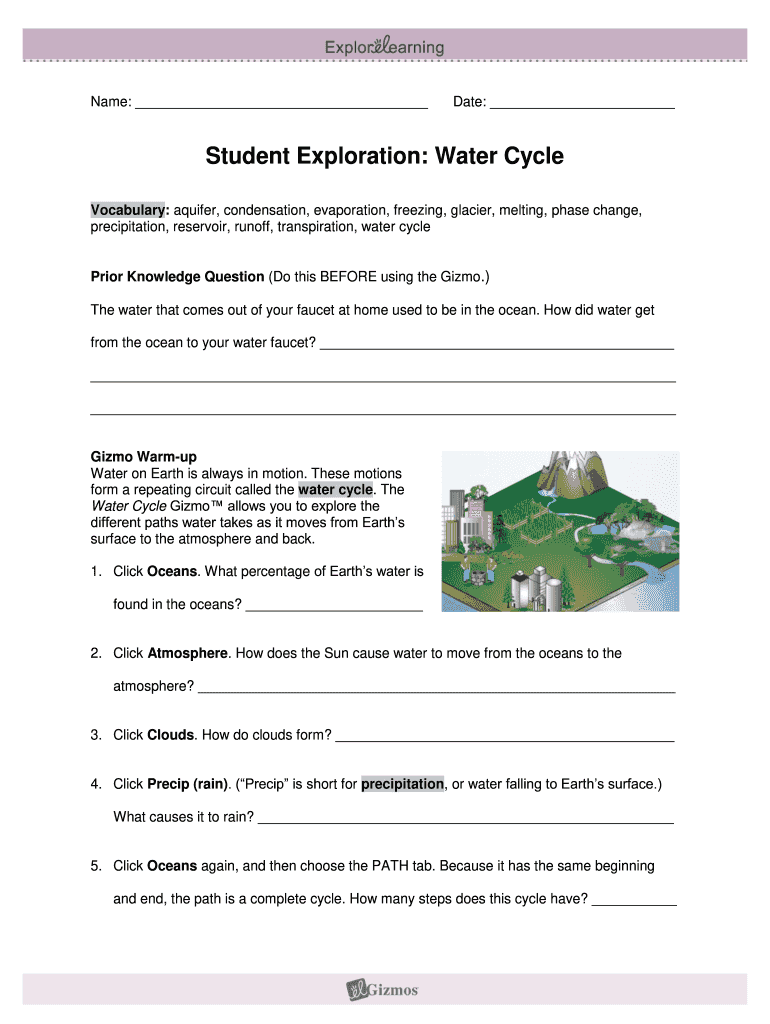
Name: Date: Student Exploration: Water Cycle Vocabulary: aquifer, condensation, evaporation, freezing, glacier, melting, phase change, precipitation, reservoir, runoff, transpiration, water cycle.

Open form follow the instructions

Easily sign the form with your finger

Send filled & signed form or save
How to use or fill out the ExploreLearning Student Exploration: Water Cycle online
This guide provides comprehensive instructions for completing the ExploreLearning Student Exploration: Water Cycle form online. Users with varying levels of familiarity can follow these clear steps to enhance their understanding of the water cycle effectively.
Follow the steps to fill out the form completely and accurately.
- Press the ‘Get Form’ button to access the form and open it in your preferred digital editor.
- Begin by providing your name in the designated field at the top of the document. This personalizes your exploration experience.
- Insert the current date in the space provided to keep track of when the exploration is completed.
- Move to the vocabulary section. Here, familiarize yourself with key terms related to the water cycle. Make sure to understand terms such as 'aquifer,' 'evaporation,' and 'precipitation' as they will be critical for later sections.
- Respond to the prior knowledge question about how water transitions from the ocean to your faucet. Consider the processes involved in the water cycle.
- Proceed to the Gizmo warm-up section. Answer the prompts about Earth’s water percentage and how the Sun facilitates the water cycle.
- In the activity section, set up your Gizmo simulation. Start by selecting the simulation tab and pressing 'Reset' to begin your exploration.
- Create two distinct water cycles in the Gizmo. Record the steps of each cycle in the designated areas labeled Cycle 1 and Cycle 2.
- Analyze and fill in the data questions, referencing the Gizmo for answers regarding Earth's water distribution.
- Define the phase changes in the specified blanks by using the terms 'liquid,' 'gas,' or 'solid' as appropriate.
- Identify and fill in the process descriptions that correspond to the transitions between the different states of water.
- Engage with the discussion point regarding global water shortages and share your insights in the space provided.
- Once all fields are completed, review your responses for accuracy, then save your changes or download the document as needed. You may also choose to print or share your completed form.
Get started by filling out the ExploreLearning Student Exploration: Water Cycle online today!
Experience a faster way to fill out and sign forms on the web. Access the most extensive library of templates available.
Related content
NASA eClips™ Guides are resources that can be used in formal and nonformal educational...
Right here, we have countless book Explore Learning Student Exploration Answers Water...
Thus, students will have the opportunity to explore 'learning zones' that have been built...
Get answers to your most pressing questions about US Legal Forms API.
How do you explain the water cycle to students?
The water cycle shows the continuous movement of water within the Earth and atmosphere. It is a complex system that includes many different processes. Liquid water evaporates into water vapor, condenses to form clouds, and precipitates back to earth in the form of rain and snow.
What is the defining characteristic of a water cycle gizmo?
Answer: A fundamental characteristic of the hydrologic cycle is that it has no beginning an it has no end. It can be studied by starting at any of the following processes: evaporation, condensation, precipitation, interception, infiltration, percolation, transpiration, runoff, and storage. Explore all similar answers.
What is the water cycle simple definition?
The water cycle shows the continuous movement of water within the Earth and atmosphere. It is a complex system that includes many different processes. Liquid water evaporates into water vapor, condenses to form clouds, and precipitates back to earth in the form of rain and snow.
What are the 7 steps of water cycle?
THE WATER CYCLE. EVAPORATION. CONDENSATION. PRECIPITATION. INTERCEPTION. INFILTRATION. PERCOLATION. TRANSPIRATION.
What are the parts of the water cycle Gizmo?
0:01 17:26 Water Cycle Gizmo - YouTube YouTube Start of suggested clip End of suggested clip Water takes as it moves from earth's surface to the atmosphere. And back click ocean what percentageMoreWater takes as it moves from earth's surface to the atmosphere. And back click ocean what percentage of earth's water is found in oceans.
What is a water cycle gizmo?
Gizmo Background: Water on Earth is always in motion. These motions form a repeating circuit called the water cycle. The Water Cycle Gizmo™ allows you to explore the different paths water takes as it moves from Earth's surface to the atmosphere and back.
What is the water cycle definition for kids?
The Short Answer: The water cycle is the path that all water follows as it moves around Earth in different states. Liquid water is found in oceans, rivers, lakes—and even underground. Solid ice is found in glaciers, snow, and at the North and South Poles. Water vapor—a gas—is found in Earth's atmosphere.
How do you teach the water cycle in class?
Fill a large bowl a quarter of the way with water and place it outside in the sun. Put an empty mug or cup into the bowl and cover the bowl with plastic wrap. Tie a string or place a rubber band around the plastic wrap to keep it in place and have your students watch the water cycle unfold.
Use professional pre-built templates to fill in and sign documents online faster. Get access to thousands of forms.
If you believe that this page should be taken down, please follow our DMCA take down process here.