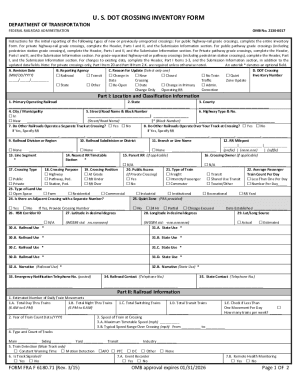
DEPARTMENT OF TRANSPORTATION. S. DOT CROSSING INVENTORY FORM OMB No. 21300017FEDERAL RAILROAD ADMINISTRATIONInstructions for the initial reporting of the following types of new or previously unreported.

How it works
  • Open form

    Open form follow the instructions

  • Easily sign form

    Easily sign the form with your finger

  • Share form

    Send filled & signed form or save

How to fill out the FRA F 6180.71 online

This guide provides comprehensive instructions on how to complete the FRA F 6180.71 form online. Whether you are reporting a new or previously unreported highway-rail grade crossing, the detailed steps below will help you navigate each section of the form with ease.

Follow the steps to accurately complete the FRA F 6180.71 form.

  1. Click ‘Get Form’ button to obtain the form and open it in the editor.
  2. Fill out the Revision Date and select the Reporting Agency, which is essential for identifying the form's validity and purpose.
  3. In the Reason for Update section, choose the appropriate option reflecting the status of the crossing, such as 'New' or 'Closed'.
  4. Complete the DOT Crossing Inventory Number by entering the designated 7-character code.
  5. Proceed to Part I to provide Location and Classification Information. Include details like the Primary Operating Railroad, State, County, and City or Municipality.
  6. Specify the Street/Road Name & Block Number and the Highway Type & Number, indicating the proximity of the crossing location.
  7. Answer questions regarding the operation of other railroads at the crossing by selecting 'Yes' or 'No' and providing further details as necessary.
  8. Fill in the Railroad Division, Subdivision, Branch or Line Name, and RR Milepost if applicable. Specify line segment and nearest railroad timetable information.
  9. Complete additional sections in Part I regarding crossing types, purposes, and public access, ensuring all relevant checkboxes are marked.
  10. In Part II, provide Railroad Information, including the Estimated Number of Daily Train Movements and the Year of Train Count Data. Record train speeds and track types.
  11. Proceed to Part III to fill out the Highway or Pathway Traffic Control Device Information, noting any signs or signals present at the crossing.
  12. Complete Part IV for Physical Characteristics, detailing the features of the crossing such as traffic lanes, surface, and illumination status.
  13. In Part V, provide details regarding Public Highway Information, including the Highway System and Functional Classification.
  14. Finally, complete the Submission Information section to submit your contact details, organization, phone number, and submission date.
  15. Once all changes are made, you can save the form, download it for printing, or share it as needed.

Complete your FRA F 6180.71 form online today to ensure accurate reporting.

Get form

Experience a faster way to fill out and sign forms on the web. Access the most extensive library of templates available.

Related content

us dot crossing inventory form - FRA Safety Data...

U. S. DOT CROSSING INVENTORY FORM. DEPARTMENT OF TRANSPORTATION. FEDERAL RAILROAD...

Learn more
49 CFR § 234.401 - Definitions. | CFR | US Law |...

Inventory Form means the U.S. DOT Crossing Inventory Form (Form FRA F 6180.71). Inventory...

Learn more
Updates to the Inventory Coding Guide - Virginia...

Oct 8, 2009 — Added 3 new codes per revisions issued by the FHWA on 2-2- ... FEDERAL...

Learn more
Questions & Answers

Get answers to your most pressing questions about US Legal Forms API.

Contact support

How many grade crossings are there in the US?

Highway-rail grade crossings are intersections where highways cross railroad tracks at-grade. Approximately 212,000 highway-rail grade crossings exist on approximately 140,000 miles of track that make up the United States' railroad system.

There are two types of crossings–private and public. Private crossings are not required to have advance signs or other markings and are found on roadways not maintained by public authority.

Active Grade Crossings have active warning and control devices such as bells, flashing lights, and gates, in addition to passive warning devices such as crossbucks (the familiar x-shaped signs that mean yield to the train), yield or stop signs and pavement markings.

A passive crossing is one that does not have flashing lights or automatic gates. ● The crossbuck sign, the white X sign, is a regulatory sign that means Yield. Crossbuck signs are required at all public railroad crossings. The railroad companies and maintain crossbuck signs.

Types of level crossings Active control uses one or more of lights, booms, gates, audible warning devices or lit signs to warn that rail traffic is approaching a level crossing. Passive control uses only signs to warn about the presence of a level crossing.

Active Grade Crossings have active warning and control devices such as bells, flashing lights, and gates, in addition to passive warning devices such as crossbucks (the familiar x-shaped signs that mean yield to the train), yield or stop signs and pavement markings.

A passive crossing is one that does not have flashing lights or automatic gates. ● The crossbuck sign, the white X sign, is a regulatory sign that means Yield. Crossbuck signs are required at all public railroad crossings. The railroad companies and maintain crossbuck signs.

Highway-rail grade crossings that don't have lights and gates are called "passive" crossings because there are no devices that activate when a train approaches. Some crossings have flashing lights, bells and other electric devices that warn of an approaching train.

Get This Form Now!

Use professional pre-built templates to fill in and sign documents online faster. Get access to thousands of forms.

If you believe that this page should be taken down, please follow our DMCA take down process here.

Get FRA F 6180.71