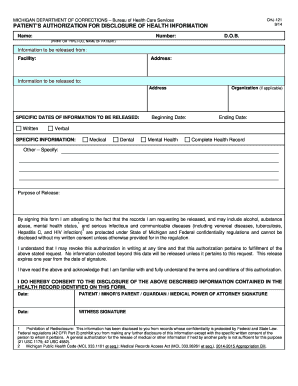
OF PATIENT) Information to be released from: Facility: Address: Information to be released to: Address SPECIFIC DATES OF INFORMATION TO BE RELEASED: Written Beginning Date: Organization (if applicable) Ending Date: Verbal SPECIFIC INFORMATION: Medical Dental Mental Health Complete Health Record Other – Specify: Purpose of Release: By signing this form I am attesting to the fact that the records I am requesting be released, and may include alcohol, substance 1 abuse, mental hea.
Open form follow the instructions
Easily sign the form with your finger
Send filled & signed form or save
How to fill out the MI CHJ-121 online
Filling out the MI CHJ-121 form is an essential step for authorizing the disclosure of health information. This guide provides clear, step-by-step instructions to help users complete the form accurately and efficiently.
Follow the steps to successfully complete the MI CHJ-121 form.
- Click the ‘Get Form’ button to obtain the form and open it in your preferred digital editor.
- In the first section labeled 'Name', print or type the full name of the patient whose health information you are authorizing for disclosure.
- Next, enter the patient’s identification number and date of birth in the designated fields.
- Indicate the information to be released by specifying the facility's name where the patient is receiving care. Also, provide the facility's address.
- Fill in the recipient's address in the section labeled 'Information to be released to'.
- Specify the dates of information to be released. Include both the beginning and ending dates for the requested releases, both for written and verbal disclosures.
- Select the type of information you want to be released by checking the appropriate boxes: Medical, Dental, Mental Health, Complete Health Record, or Other. If you choose 'Other', please specify the type.
- State the purpose of the release in the designated space provided on the form.
- Sign and date the form in the area designated for the patient or their guardian, also include your relationship to the patient if applicable.
- Finally, ensure a witness signs and dates the form in the designated witness signature area.
- After completing the form, you can save your changes, download a copy, print the document, or share it as needed.
Complete the MI CHJ-121 form online today to ensure your health information is accurately disclosed as needed.
Experience a faster way to fill out and sign forms on the web. Access the most extensive library of templates available.
Related content
Oct 1, 2024 — The Michigan Department of Corrections' (MDOC) Patient Authorization for...
CH 121 - Life Chemistry, Introduction to Chemistry I. CH 122 - Life Chemistry II...
the Garmin products you own, such as their serial numbers and dates of purchase. We also...
Get answers to your most pressing questions about US Legal Forms API.
Can you request medical records from 20 years ago?
Requesting medical records from 20 years ago can be complicated, as many providers may only retain records for the legally mandated period, which is usually around six years in Michigan. However, if your records were maintained longer than required, you can make a formal request. For ease, leveraging platforms like USLegalForms can facilitate your request concerning MI CHJ-121 documentation.
How long do you have to stay in Michigan to be a resident?
To be considered a resident in Michigan, you typically need to establish your primary home there and be physically present for six months in most cases. This residency status can impact various legal rights and benefits. If you’re dealing with issues related to MI CHJ-121, establishing residency may play a pivotal role.
What is a level 1 prisoner in Michigan?
A level 1 prisoner in Michigan is one classified as having the least risk of reoffending. This classification may affect the conditions of their incarceration, including eligibility for parole and programs. Understanding classifications can be critical when dealing with cases involving MI CHJ-121.
How long do you stay on Otis, Michigan?
Staying on OTIS (Offender Tracking Information System) in Michigan varies depending on the nature of the offense and the individual's sentence. Generally, the information remains accessible for public view for a certain period, often until the offender serves their time or is discharged. For legal matters like MI CHJ-121, knowing how long this information persists can be important.
What does it mean when an offender is discharged in Michigan?
When an offender is discharged in Michigan, it typically means that they have completed their sentence or were released early due to parole or other legal allowances. This process varies based on the nature of the offense and the behavior of the individual during incarceration. If you are looking into MI CHJ-121, it is crucial to understand how discharges affect legal status.
How do I get my medical records from the Michigan Department of Corrections?
To obtain your medical records from the Michigan Department of Corrections, you will need to complete a request form and submit it according to their guidelines. Be prepared to provide specific personal information and details about the records you require. For assistance, you might explore solutions like USLegalForms that can help ensure your request meets necessary legal requirements related to MI CHJ-121.
How long are doctors required to keep medical records in Michigan?
Doctors in Michigan must retain medical records for at least six years following the last treatment provided. This compliance ensures that patients can review pertinent medical histories when needed. If MI CHJ-121 impacts your situation, it’s advisable to access these records while they are still available.
How many years is considered a life sentence in Michigan?
In Michigan, a life sentence generally means imprisonment for the duration of an offender's life without the possibility of parole. However, some sentences can allow for parole after a certain period, depending on the crime and legal circumstances. If you're researching aspects of MI CHJ-121, understanding sentencing can play a critical role in your case.
What is the record retention law in Michigan?
Michigan's record retention law mandates that healthcare providers keep medical records for a minimum of six years. This law is essential for safeguarding patient rights and ensuring continuity of care. If you are navigating the complexities of MI CHJ-121, understanding these regulations can be beneficial in obtaining your necessary documents.
How to fill out an authorization for release of medical information?
Filling out an authorization for the release of medical information involves several straightforward steps. You'll need to clearly identify the records you wish to obtain, provide your details, and specify who will receive the information. To streamline the process for MI CHJ-121 documents, consider using USLegalForms, which offers simplified templates and guidance to ensure compliance.
Use professional pre-built templates to fill in and sign documents online faster. Get access to thousands of forms.
If you believe that this page should be taken down, please follow our DMCA take down process here.
This form is available in several versions. Select the version you need from the drop-down list below.