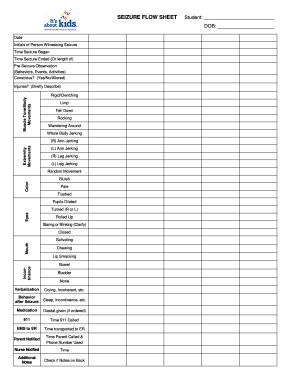
Iors, Events, Activities) Conscious? (Yes/No/Altered) Muscle Tone/Body Movements Injuries? (Briefly Describe) Rigid/Clenching Limp Fell Down Rocking Wandering Around Whole Body Jerking Extremity Movements (R) Arm Jerking (L) Arm Jerking (R) Leg Jerking (L) Leg Jerking Random Movement Color Bluish Pale Flushed Pupils Dilated Eyes Turned (R or L) Rolled Up Staring or Blinking (Clarify) Closed Mouth Salivating Chewing Lip Smacking Incontinence Bowel Bladder Verbalization Crying, Incoheren.
Open form follow the instructions
Easily sign the form with your finger
Send filled & signed form or save
How to fill out the Flow Sheet - Seizure online
Filling out the Flow Sheet - Seizure accurately is crucial for documenting seizure events effectively. This guide will provide you with clear, step-by-step instructions on how to complete the form online.
Follow the steps to successfully complete the Flow Sheet - Seizure.
- Click ‘Get Form’ button to obtain the form and access it for editing.
- Begin by entering the student's name and date of birth in the designated fields at the top of the form.
- Record the date of the seizure event in the provided space. Ensure that the date is accurately reflected.
- In the 'Initials of Person Witnessing Seizure' section, write the initials of the individual who observed the seizure.
- Document the exact time the seizure began and ended, or note the duration if the exact end time is unknown.
- In the 'Pre-Seizure Observation' section, detail any relevant behaviors, events, or activities leading up to the seizure. Include whether the person was conscious during this time.
- Next, examine and indicate any muscle tone or body movements observed during the seizure. Choose from the options provided, such as 'Rigid/Clenching' or 'Rocking.'
- If there are observed injuries resulting from the seizure, provide a brief description in the 'Injuries' section.
- In the 'Extremity Movements' section, indicate any jerking movements in the limbs, specifying right or left as applicable.
- Assess the individual's color during the seizure and mark any observations such as 'Bluish,' 'Pale,' or 'Flushed.'
- Pay attention to the eyes during the seizure and document their position and behavior in the corresponding fields.
- Note any activities such as salivating or lip smacking under the 'Mouth' section and indicate if there was any incontinence.
- Document any verbalizations made during the seizure, such as crying or incoherent sounds.
- Record the behavior immediately following the seizure, including any state of sleep or incontinence.
- If medication was administered, such as , record that in the 'Medication' section.
- Indicate the time 911 was called, if applicable, and document transportation details to the emergency room.
- Notify the parent about the seizure event and record the time and phone number used in the respective sections.
- Be sure to record the times when the nurse was notified and any additional notes related to the event.
- If there are notes on the back, check the corresponding box.
- Complete the narrative section by providing a comprehensive overview based on the subjective, objective, assessment, plan, and implementation categories.
- Finally, secure the signature of the provider by signing in the designated areas and input the provider's number.
- Once all fields are completed, save changes, and consider downloading, printing, or sharing the completed form as needed.
Complete your documentation by filling out the Flow Sheet - Seizure online today.
Experience a faster way to fill out and sign forms on the web. Access the most extensive library of templates available.
Related content
Apr 6, 2023 — What are epilepsy and seizures? The epilepsies are chronic neurological...
This is how the epileptologist reading your EEG knows that you have identified your event...
HACCP plan, process flow, floor plan, photographs, batch records, complaint records...
Get answers to your most pressing questions about US Legal Forms API.
What are the 4 stages of seizures?
The four phases of seizure are: Prodromal. Early ictal (the “aura”) Ictal. Postictal.
What is the protocol for a seizure?
Here are things you can do to help someone who is having this type of seizure: Ease the person to the floor. Turn the person gently onto one side. ... Clear the area around the person of anything hard or sharp. ... Put something soft and flat, like a folded jacket, under his or her head. Remove eyeglasses.
How do you document seizure like activity?
Write down what happened as soon as you can. Include as much information as possible about the following areas: BEHAVIOR BEFORE THE SEIZURE - what was the person doing at the time of event, change in mood or behavior hours or days before, 'warning' or 'aura' shortly before event.
How do you record seizure activity?
If you care for someone who is experiencing seizures, it can be very helpful to record them with a smartphone or video camera. This can then be shown to the person's doctor, which may help in diagnosis and treatment. During and/or after the seizure, ask the person some questions and record their responses to you.
How do you evaluate seizure activity?
A generalized seizure is recognizable at the bedside when tonic-clonic activity is present. If the patient is actively seizing, attempt to observe motor activity, as posturing (decerebrate/decorticate) and eye deviation may provide clues to the epileptic focus.
How do you document seizure activity?
Write down what happened as soon as you can. Include as much information as possible about the following areas: BEHAVIOR BEFORE THE SEIZURE - what was the person doing at the time of event, change in mood or behavior hours or days before, 'warning' or 'aura' shortly before event.
How do you measure seizure activity?
Electroencephalography (EEG) Clinicians can find evidence of abnormal electrical activity in the brain and figure out the type or types of seizures a patient is having, as well as the origin(s), by measuring brain waves over minutes to a couple of hours.
How is seizure activity diagnosed?
Electroencephalography. If a doctor suspects epilepsy is causing your symptoms, he or she may order an electroencephalography, or EEG. This tool is the most specific test for diagnosing epilepsy because it records the electrical activity of the brain.
Use professional pre-built templates to fill in and sign documents online faster. Get access to thousands of forms.
If you believe that this page should be taken down, please follow our DMCA take down process here.