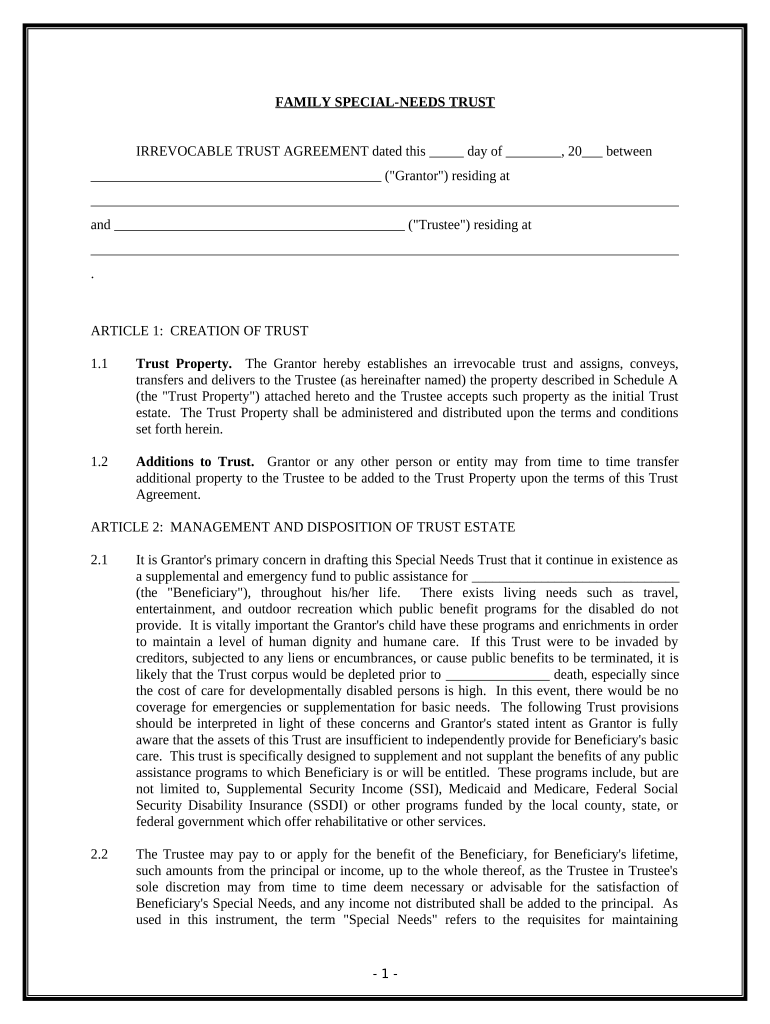
FAMILY SPECIALIZED TRUSTIRREVOCABLE TRUST AGREEMENT dated this day of, 20 between ( Granter ) residing at and ( Trustee ) residing at. ARTICLE 1: CREATION OF TRUST1.1 Trust Property. The.
Loading

Open form follow the instructions

Easily sign the form with your finger

Send filled & signed form or save
How to fill out the Special Needs Trust Form online
Filling out the Special Needs Trust Form online can be a straightforward process when guided through each step. This guide provides clear and supportive instructions to help you complete the form accurately and efficiently, ensuring you meet all necessary requirements.
Follow the steps to successfully complete the Special Needs Trust Form online.
- Click ‘Get Form’ button to obtain the Special Needs Trust Form and open it in your preferred editor.
- Begin by entering the date on which the trust agreement is being created in the specified format.
- Provide the name and address of the Grantor in the designated fields. Ensure all details are complete.
- Next, enter the name and address of the Trustee. This person or entity will administer the trust.
- In Article 1, specify the Trust Property by detailing the assets included in Schedule A.
- In Article 2, describe the beneficiary's needs and how the trust is intended to function as a supplement to public assistance.
- Detail the distributions allowed by the Trustee during the beneficiary's lifetime, emphasizing the importance of special needs.
- Review the Trustee's powers outlined in Article 3 to understand their responsibilities and privileges.
- Complete any additional optional provisions related to withdrawals or insurance policies.
- Finally, sign and date the document at the appropriate places, and save your completed form.
Start filling out your Special Needs Trust Form online today to ensure the needs of beneficiaries are met.
Experience a faster way to fill out and sign forms on the web. Access the most extensive library of templates available.
Related content
A Special Needs Trust (SNT) is a trust that contains the assets of certain individuals for...
SUPPLEMENTAL SECURITY INCOME—better known by the initials "SSI," this benefit program is...
This publication is for people interested in assisting victims of disasters or those in...
Get answers to your most pressing questions about US Legal Forms API.
What is the difference between a complex trust and a qualified disability trust?
A Trust that does not require distribution of all its income by the terms of the trust agreement is called a “Complex” Trust, and is allowed an exemption of $100. A “Qualified Disability Trust” or “QDT” is allowed the same exemption as an individual under IRS Code §642(b)(2)(C).
What is a special needs trust in Ohio?
The purpose of the Special Needs Trust is to hold the assets in a manner whereby those assets are not counted as “available resources” of the minor or ward when determining the individual's eligibility for governmental need-based assistance.
What is a complex trust?
Definition of a complex trust The trust must retain some of its income and not distribute all of it to beneficiaries. The trust must distribute some or all of the principal to the beneficiaries. The trust must distribute some funds to charitable organizations.
Who qualifies for a special needs trust in Massachusetts?
To qualify for the special needs trust exception, the trust must be established for the benefit of a disabled individual under age 65. This exception does not apply to a trust established for the benefit of an individual age 65 or older.
What is a special need trust in New York?
Supplemental Needs Trust (SNT) The SNT is a Medicaid planning tool used to shelter a disabled person's assets for: Maintaining eligibility for governmental benefits like Medicaid. Enhancing the disabled person's quality of life by paying for needs Medicaid does not cover.
What is the difference between a qualified disability trust and a special needs trust?
Key Takeaways. A qualified disability trust (QDisT) is a special needs trust that qualifies for a federal tax exemption. Most special needs trusts meet the requirements to be treated as qualified disability trusts, and can be reported as such at tax time.
How do you determine if a trust is a simple or complex trust?
A simple trust must distribute all its income currently. Generally, it cannot accumulate income, distribute out of corpus, or pay money for charitable purposes. If a trust distributes corpus during a year, as in the year it terminates, the trust becomes a complex trust for that year.
Who pays tax on complex trust?
For complex non-grantor trusts, the tax may be paid by the beneficiaries, the trust itself, or a combination, depending on the circumstances in any given year. While the maximum rates are the same for a trust and an individual, trusts are taxed more aggressively than individuals.
Use professional pre-built templates to fill in and sign documents online faster. Get access to thousands of forms.
If you believe that this page should be taken down, please follow our DMCA take down process here.