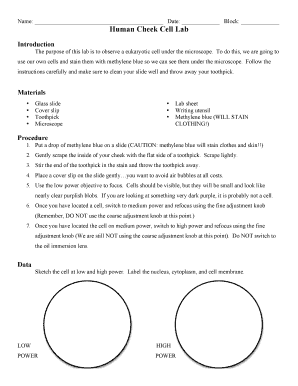
Roscope. To do this, we are going to use our own cells and stain them with methylene blue so we can see them under the microscope. Follow the instructions carefully and make sure to clean your slide well and throw away your toothpick. Materials Glass slide Cover slip Toothpick Microscope Lab sheet Writing utensil Methylene blue (WILL STAIN CLOTHING!) Procedure 1. Put a drop of methylene blue on a slide (CAUTION: methylene blue will stain clothes and skin!!) 2. Ge.

How it works
  • Open form

    Open form follow the instructions

  • Easily sign form

    Easily sign the form with your finger

  • Share form

    Send filled & signed form or save

How to fill out the Human Cheek Cell Lab Report Introduction online

Filling out the Human Cheek Cell Lab Report Introduction is a crucial step in documenting your laboratory work. This guide provides clear and systematic instructions to help you complete the form accurately and efficiently.

Follow the steps to successfully complete your lab report introduction.

  1. Click ‘Get Form’ button to obtain the form and open it in the editor.
  2. In the 'Name' field, enter your full name as required for documentation.
  3. In the 'Date' field, input the current date of the lab report.
  4. Fill in the 'Block' section with the relevant block or period during which the lab was conducted.
  5. Review the 'Introduction' section that provides insight into the lab's purpose, which is to observe eukaryotic cells.
  6. Make sure to list all 'Materials' used in your experiment, including glass slide, cover slip, toothpick, and methylene blue.
  7. Follow the provided 'Procedure' steps in detail to ensure accuracy in your experiment documentation.
  8. Proceed to the 'Data' section to sketch and label your observations from low and high power views of the cells.
  9. Complete the 'Analysis' section by answering all questions based on your lab findings.
  10. After completing the form, review all entries for accuracy before saving your changes.
  11. Finally, download, print, or share the completed lab report as needed.

Start filling out your Human Cheek Cell Lab Report Introduction online today!

Get form

Experience a faster way to fill out and sign forms on the web. Access the most extensive library of templates available.

Related content

References - Molecular Biology of the Cell

References. General. Celis JE (ed) (1998) Cell Biology: A Laboratory Handbook, 2nd edn.

Learn more
lab report - malugu james

Purpose The purpose of this lab is to learn how to prepare a wet mound, to learn proper...

Learn more
STUDENT LAB INSTRUCTIONS - DNA Learning Center

In this experiment, a sample of human cells is obtained by saline mouthwash. DNA is...

Learn more
Questions & Answers

Get answers to your most pressing questions about US Legal Forms API.

Contact support

What are the observations about the human cheek cell?

Cheek cell under microscope (observation): Large irregular shaped cells can be seen. Cell membrane can be observed. A deep blue colored nucleus can be seen at the central of each cell. ( each cell contains a nucleus )

The individual cells have a flat, irregular shape and a very thin membrane. Cheek cells are a popular item of study in the classroom. These easily obtained specimens are viewed under the microscope and used as a source for DNA fingerprinting studies. They are also used in diagnostic tests.

This human cheek cell is a good example of a typical animal cell. It has a prominent nucleus and a flexible cell membrane which gives the cell its irregular, soft-looking shape. Like most eukaryotic cells, this cell is very large compared to prokaryotic cells.

Large irregularly shaped cells with distinct cell membranes. A distinct nucleus at the central part of each individual cell (dark blue in color). A lightly stained cytoplasm in each cell.

Conclusion. As the cells observed do not have a cell wall, nor a prominent vacuole, the cells of the specimen on the slide are animal cells.

To view cheek cells, gently scrape the inside lining of your cheek with a toothpick. DO NOT GOUGE THE INSIDE OF YOUR CHEEK! 2. Gently roll & tap the toothpick onto the center of a glass slide with a single drop of water.

Observations. There are a large number of regularly shaped cells lying side by side and each cell has a distinct cell wall. A distinct nucleus is present on the periphery of each cell. Lightly stained cytoplasm is observed in each cell.

Purpose: To view animal and plant cells and distinguish between them. This lab provides the opportunity to view living cells and identify the parts of a cell that you have only seen in diagrams up to the point.

Get This Form Now!

Use professional pre-built templates to fill in and sign documents online faster. Get access to thousands of forms.

If you believe that this page should be taken down, please follow our DMCA take down process here.

Get Human Cheek Cell Lab Report Introduction