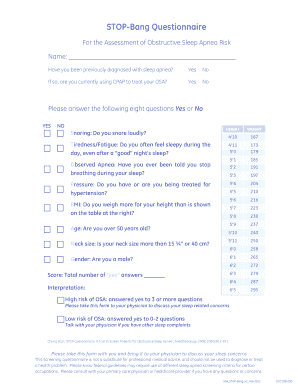
STOP-Bang Questionnaire For the Assessment of Obstructive Sleep Apnea Risk Name: Have you been previously diagnosed with sleep apnea? Yes No If so, are you currently using CPAP to treat your OSA?.

How it works
  • Open form

    Open form follow the instructions

  • Easily sign form

    Easily sign the form with your finger

  • Share form

    Send filled & signed form or save

How to fill out the STOP-Bang Questionnaire - Bge-healthaheadcomb online

The STOP-Bang Questionnaire is a vital tool used to evaluate the risk of obstructive sleep apnea. This guide will provide you with clear, step-by-step instructions on how to fill out this questionnaire effectively online, ensuring that users of all backgrounds can navigate the process with confidence.

Follow the steps to complete your STOP-Bang Questionnaire effectively.

  1. Click ‘Get Form’ button to obtain the questionnaire and open it in an online editor.
  2. Begin by entering your name in the designated field at the top of the form.
  3. Indicate whether you have been previously diagnosed with sleep apnea by selecting 'Yes' or 'No'.
  4. If applicable, specify if you are currently using CPAP to treat your obstructive sleep apnea by selecting 'Yes' or 'No'.
  5. Answer the eight questions provided in the form by selecting 'Yes' or 'No' for each question regarding snoring, tiredness, observed apnea, hypertension, BMI, age, neck size, and gender.
  6. After answering the questions, calculate your score by totaling the number of 'Yes' responses you provided.
  7. Use the interpretation section to determine your level of risk for obstructive sleep apnea based on your score: high risk if you answered 'Yes' to 3 or more questions, low risk if 0-2 questions were answered 'Yes'.
  8. Review the guidance at the bottom of the form regarding discussing your results with your physician and ensure all information is complete.
  9. Finally, choose to save changes, download, print, or share the completed questionnaire as necessary.

Complete your STOP-Bang Questionnaire online today to take an important step in assessing your sleep health.

Get form

Experience a faster way to fill out and sign forms on the web. Access the most extensive library of templates available.

Questions & Answers

Get answers to your most pressing questions about US Legal Forms API.

Contact support

How do you score the stop-bang questionnaire?

The STOP-Bang questionnaire is a scoring model consisting of eight easily administered questions starting with the acronym STOP-Bang (Appendix) and is scored based on Yes/No answers (score: 1/0). Thus, the scores range from a value of 0 to 8.

The STOP-BANG questionnaire is one of the most widely accepted screening tools for OSA. OSA (obstructive sleep apnea) is associated with increased risk of perioperative cardiopulmonary complications, including critical care admission.

In the initial validation study, at a score of at least 3, the STOP-Bang questionnaire demonstrated a sensitivity of 84%, 93%, and 100% to detect all OSA (apnea-hypopnea index [AHI] ≥5), moderate OSA (AHI ≥15), and severe OSA (AHI ≥30), respectively.

Results: With sensitivity and specificity scores of 91.2% and 88.6%, respectively, positive predictive value 90.5%, negative predictive value 40.2%, the twin diagnostic test (STOP-Bang and pulse oximetry) was found to be highly congruent with the polysomnography (PSG), achieving a diagnostic accuracy of 85%.

Study Impact: In this study of the STOP, STOP-Bang, the 4 variable tool, and the Epworth Sleepiness Scale, the STOP-Bang had the highest sensitivity in identifying persons with moderate-to-severe and severe OSA, whereas the 4-Variable tool excelled at ruling out moderate-to-severe and severe OSA.

When evaluating the predictive values of Berlin, STOP-BANG and ESS to identify patients at risk for OSA, Berlin had the highest sensitivity, but STOP-BANG had the highest specificity, area under the curve (AUC), and PPV. Sensitivity and specificity of ESS were between the others.

STOP-Bang QUESTIONNAIRE The STOP questionnaire includes four questions related to snoring, tiredness, observed apnea, and high blood pressure, and shows a moderately high level of sensitivity (65.6%) and specificity (60%) in detecting OSA (AHI >5 events/h) in surgical patients.

The STOP-Bang questionnaire has a high pooled sensitivity of 89.1% (95% CI: 87.3% to 90.8%; I2=46.2%), 90.7% (95% CI: 88.5% to 92.6%; I2=84.4%),and 93.9% (95% CI: 90.1% to 96.3%; I2=10.1%) to screen for all (AHI ≥5), moderate-to-severe (AHI ≥15) and severe (AHI ≥30) OSA, respectively.

Get This Form Now!

Use professional pre-built templates to fill in and sign documents online faster. Get access to thousands of forms.

If you believe that this page should be taken down, please follow our DMCA take down process here.

Get STOP-Bang Questionnaire - Bge-healthaheadcomb