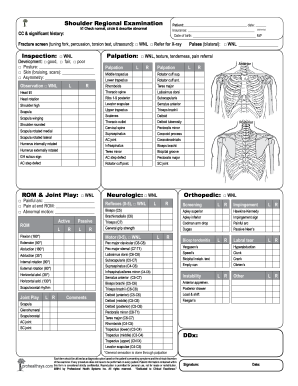
Date of birth: M/F Check normal, circle & describe abnormal CC & significant history: Fracture screen (tuning fork, percussion, torsion test, ultrasound): WNL Refer for X-ray Inspection: WNL Development: good, fair, poor Posture: Skin (bruising, scars): Asymmetry:.
Open form follow the instructions
Easily sign the form with your finger
Send filled & signed form or save
How to fill out the Shoulder Assessment Form Pdf online
Filling out the Shoulder Assessment Form Pdf online is a crucial step in documenting a patient's shoulder examination. This guide provides clear, step-by-step instructions to ensure that users can complete the form accurately and efficiently.
Follow the steps to successfully complete the form online.
- Click ‘Get Form’ button to access the form and open it in your preferred editor.
- Begin by entering the patient's name in the designated field at the top of the form, followed by the date of the examination.
- In the 'CC & significant history' section, provide details of the patient's chief complaint and relevant medical history.
- Proceed to the 'Inspection' section and check 'WNL' or document observations regarding posture, skin conditions, and asymmetry.
- Conduct palpation assessments and document findings for the left (L) and right (R) sides, noting texture, tenderness, or pain referrals.
- In the 'ROM & Joint Play' section, record the range of motion (active and passive) and any signs of pain or abnormal motion.
- Complete the neurologic and orthopedic evaluations and document any findings in the respective fields.
- Finally, review all entries for accuracy, save your changes, and choose your preferred option to download, print, or share the completed form.
Start completing your documentation online today.
Experience a faster way to fill out and sign forms on the web. Access the most extensive library of templates available.
Related content
Range of Joint Motion Evaluation Chart. NAME OF PATIENT. CLIENT IDENTIFICATION NUMBER...
Shoulder EVALUATION FORM. Date: Pt Name: Pt Number: Diagnosis: Referred by:...
Joint Location. Compensation. Key Suspected Compensations. □ Side. Scapulothoracic. □...
Get answers to your most pressing questions about US Legal Forms API.
How do you assess shoulder movement?
Instructions: Ask the patient to abduct their shoulder, whilst you simultaneously palpate the inferior pole of the scapula. Assess the degree and smoothness of scapular movement. On average 50-70% of the scapula's initial movement occurs at the glenohumeral joint.
How do you score the ases shoulder form?
The ASES score contains a physician-rated and patient-rated section; however, only the pain visual analog scale (VAS) and 10 functional questions are typically used to tabulate the reported ASES score. The total score - 100 maximum points - is weighted 50% for pain and 50% for function.
What 4 motions would you assess during an examination of the shoulder?
Flexion, extension, abduction and adduction can be tested, and the degree of motion can be noted compared to normal. Internal and external rotation should be tested with elbow at 90° of flexion.
How do you assess shoulder health?
Your healthcare provider will hold your arm and bend your elbow 90 degrees. With one hand on your shoulder, they will grasp your elbow and rotate the arm back and forth. This test is positive if it causes pain or any odd clicking or clunking sounds in the shoulder.
What are the 4 main ligaments of the shoulder?
Ligaments In The Shoulder Glenohumeral Ligaments. Coraco-acromial Ligament. Coraco-clavicular Ligaments. Transverse Humeral Ligament.
How do you perform a shoulder assessment?
The examiner must support the arm of the patient at the level of the elbow so that the upper extremity can be as much relaxed as possible. Then the examiner has to internally rotate the shoulder while at the same time perform a cross-body adduction of the arm. The test is positive if pain is elicited.
What are the different types of shoulder movement?
The shoulder muscles have a wide range of functions, including abduction, adduction, flexion, extension, internal and external rotation.
What is included in the examination of the shoulder?
Palpation should include examination of the acromioclavicular and sternoclavicular joints, the cervical spine and the biceps tendon. The anterior glenohumeral joint, coracoid process, acromion and scapula should also be palpated for any tenderness and deformity.
Use professional pre-built templates to fill in and sign documents online faster. Get access to thousands of forms.
If you believe that this page should be taken down, please follow our DMCA take down process here.