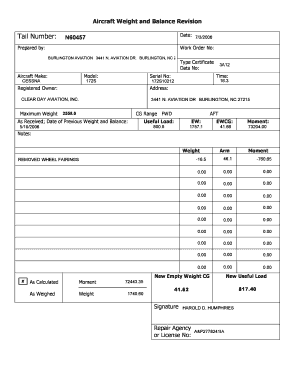
Aircraft Weight and Balance Revision Tail Number: Date: 7 3/2006 N60457 Prepared by: BURLINGTON AVIATION Work Order No: 3441 N. AVIATION DR. BURLINGTON, NC 27215 Type Certificate Data No: Aircraft.

How it works
  • Open form

    Open form follow the instructions

  • Easily sign form

    Easily sign the form with your finger

  • Share form

    Send filled & signed form or save

How to fill out the Aircraft Weight And Balance Revision online

Filling out the Aircraft Weight And Balance Revision form is an important step in ensuring compliance with safety regulations. This guide provides clear, step-by-step instructions to assist users in accurately completing the form online.

Follow the steps to fill out your form correctly.

  1. Click ‘Get Form’ button to obtain the form and open it in the editor.
  2. Begin by entering the tail number of the aircraft in the designated field. This identification number is key for tracking your aircraft's records.
  3. Fill in the date. Use the format MM/DD/YYYY to ensure clarity.
  4. In the 'Prepared by' section, input the name of the individual or organization responsible for the revision.
  5. Complete the work order number field, which helps in record-keeping for maintenance or revisions.
  6. Provide the aircraft make and model. In this case, enter 'CESSNA'.
  7. Enter the type certificate data number, ensuring this is correct as it links to the approved specifications for the aircraft.
  8. Complete the serial number of the aircraft. This number uniquely identifies your aircraft among all others.
  9. Indicate the maximum weight of the aircraft by filling in the corresponding field.
  10. In the 'As Received' section, provide the date of the previous weight and balance assessment.
  11. Input the useful load. This represents the weight of cargo, passengers, and usable fuel.
  12. Fill in the empty weight (EW) along with the loading arm values in the related fields.
  13. Complete the moment calculations based on the weights and arms you have input.
  14. Review any notes provided or add relevant comments as necessary.
  15. Once all fields are completed accurately, you can save changes, download, print, or share the form as required.

Complete your Aircraft Weight And Balance Revision online today for efficient document management.

Get form

Experience a faster way to fill out and sign forms on the web. Access the most extensive library of templates available.

Related content

Weight & Balance Handbook (FAA-H-8083-1B)

The Aircraft Weight and Balance Handbook has been prepared in recognition of the...

Learn more
(PDF) Aircraft Weight and Balance Handbook...

3/15/07 3:44:48 PM Aircraft Weight and Balance Handbook FAA-H-8083-1A 8083-1A Cover.indd 1...

Learn more
Model 162 - Cessna Flight Training

The above performance figures are based on airplane weights at 1320 pounds (598.7 kg)...

Learn more
Questions & Answers

Get answers to your most pressing questions about US Legal Forms API.

Contact support

What is the validity of aircraft weight and balance?

The aircraft's weight and balance data is important information for a pilot that must be frequently reevaluated. Although the aircraft was weighed during the certification process, this information is not valid indefinitely. Equipment changes or modifications affect the weight and balance data.

The new FAA standards increase the weight of an average adult passenger and carry-on bag to 190 pounds in the summer and 195 pounds in the winter, which is up 12% from 170 pounds and 175 pounds, FOX Business reported.

The FAA requires that a current and accurate empty weight and EWCG be known for an aircraft. This information must be included in the weight and balance report, which is a part of the aircraft permanent records. The weight and balance report must be in the aircraft when it is being flown.

“You need to have the current weight and balance data on board the aircraft. This includes basic empty weight and moment, as well as the approved envelope for the aircraft. FAR 91.9 prohibits operation of the aircraft without complying with the operating limitations.

The most important reason for weighing an aircraft is to find out its empty weight (basic empty weight) and to find out where it balances in the empty weight condition. When an aircraft is to be flown, the pilot in command must know what the loaded weight of the aircraft is and where its loaded CG is.

When loading cargo, airlines will take care to balance the weight around the center of gravity. However, in the cabin, too many passengers at the front or rear of the plane can cause an unwelcome imbalance.

Yes, the empty weight and center of gravity data does need to be updated. Anytime weight or center of gravity is changed, the mechanic must update the aircraft weight and balance.

Ascertain from the pilot's operating handbook the empty weight of the aircraft and determine the weights of people, baggage, and fuel. Multiply each weight by the arm—the distance from the reference datum—to find the moment. Add all the weights to find the gross weight. Add all the moments to find the total moment.

Get This Form Now!

Use professional pre-built templates to fill in and sign documents online faster. Get access to thousands of forms.

If you believe that this page should be taken down, please follow our DMCA take down process here.

Get Aircraft Weight And Balance Revision