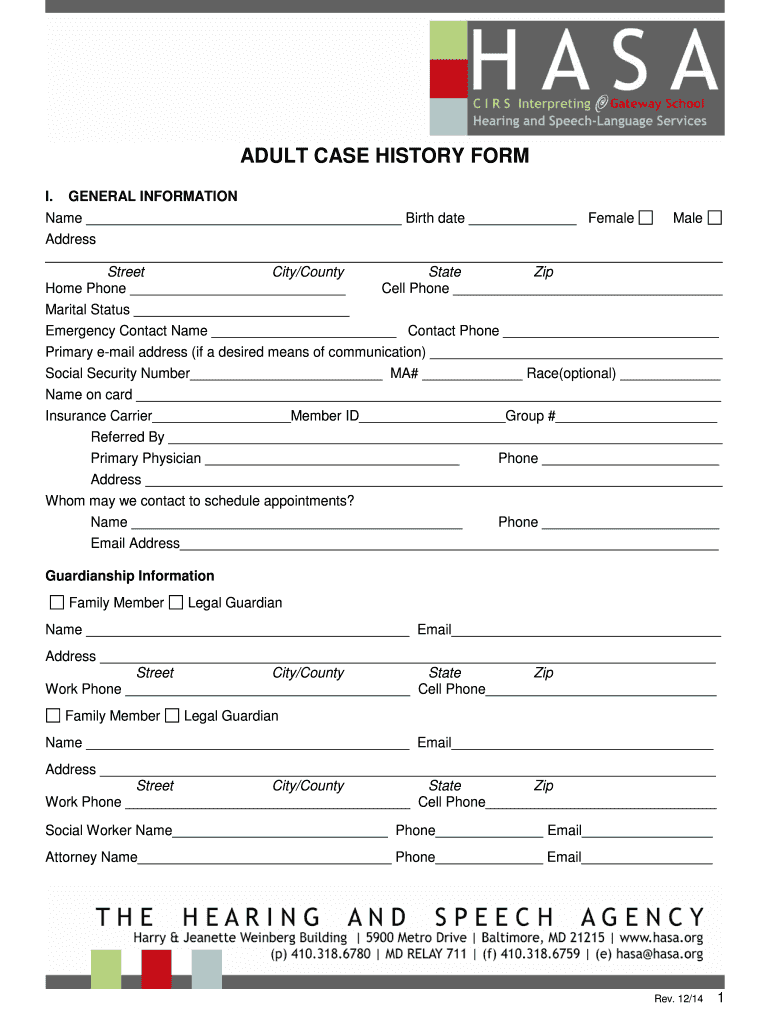
ADULT CASE HISTORY FORM I.GENERAL Informational Birth date Female Male Address Street City/County State Zip Home Phone Cell Phone Marital Status Emergency Contact Name Contact Phone Primary email.
Loading

Open form follow the instructions

Easily sign the form with your finger

Send filled & signed form or save
How to fill out the MD HASA Adult Case History Form online
Completing the MD HASA Adult Case History Form online is an important step in ensuring that your health and communication needs are accurately documented. This guide will walk you through each section and field of the form, making the process straightforward and user-friendly.
Follow the steps to complete the MD HASA Adult Case History Form online.
- Press the ‘Get Form’ button to obtain the form and open it for editing.
- In the General Information section, provide your name, birth date, gender, address, and contact details. Include your marital status and emergency contact information.
- Fill in your insurance information, including the name on the card, insurance carrier, member ID, and group number. Note if you have a referral and your primary physician’s details.
- Provide information on guardianship if applicable, detailing any family members or legal guardians and their contact information.
- Next, describe your employment history by listing your employer and occupation, along with your highest level of completed education.
- In the Description of Concerns section, check all that apply to your concerns about communication or social interaction. Provide a detailed description of your issues.
- Answer questions regarding your medical and health history, including hospitalizations, surgeries, medications, and any significant medical problems.
- Complete the Hearing Health History section by indicating whether you believe you have a hearing problem and providing details if necessary.
- Proceed to the Speech/Language Development section and address questions related to your communication abilities and any past difficulties.
- Fill in your School History section if applicable, detailing your current educational status, attitudes, and any concerns about academic performance.
- Provide Financial Information for the financially responsible party if it differs from the patient.
- Finally, review the Consent to Obtain & Release Information and Consent for Treatment sections, ensuring you understand what you are authorizing.
- Once all sections are completed, save any changes, and choose to download, print, or share the form as needed.
Complete your MD HASA Adult Case History Form online today for a streamlined process.
Experience a faster way to fill out and sign forms on the web. Access the most extensive library of templates available.
Related content
CIRCUIT COURT ☐ DISTRICT COURT OF MARYLAND FOR. Located at. Telephone. Case No. NOTE:...
Include in a bulleted format the pertinent review of systems questions that you asked...
If the case report involves more than two (2) suspect products attach another copy of Form...
Get answers to your most pressing questions about US Legal Forms API.
What assessments are used to diagnose speech and language disorders?
Screening tests are most often used to determine if a child may have a communication disorder, usually as a next step when a concern has been identified.... Clinical Linguistic Auditory Milestone Scale (CLAMS) Early Language Milestone Scale (ELM-2) Receptive-Expressive Emergent Language Scale (REEL) [B]
How do you assess speech and language development?
The speech-language pathologist will talk to you about your child's communication and general development. He or she will also use special spoken tests to evaluate your child. A hearing test is often included in the evaluation because a hearing problem can affect speech and language development.
What is a case history in speech therapy?
Thank you for the feedback... the Case History Form is a document meant for parents to fill out, which helps SLPs obtain information and decide where they need to probe further.
What are the ways in identifying children with speech and language disorder?
Symptoms Repetition of sounds, words, or parts of words or phrases after age 4 (I want... ... Putting in (interjecting) extra sounds or words (We went to the... ... Making words longer (I am Boooobbby Jones.) Pausing during a sentence or words, often with the lips together. Tension in the voice or sounds.
How do you identify and assess students with speech disorders and language disorders?
It is recommended that an in-depth speech/language evaluation include an assessment of the child's: hearing ability and hearing history. history of speech-language development. oral-motor functioning and feeding history. expressive and receptive language performance (syntax, semantics, pragmatics, phonology)
How do you identify students with communication disorders?
Identify the Signs: Communication Disorders Does not babble using consonant sounds (4-7 months) Makes only a few sounds or gestures like pointing (7-12 months) Does not understand what others say (7 months-2 years) Says only a few words (12-18 months) Words are not easily understood (18 months-2 years)
Use professional pre-built templates to fill in and sign documents online faster. Get access to thousands of forms.
If you believe that this page should be taken down, please follow our DMCA take down process here.