Loading
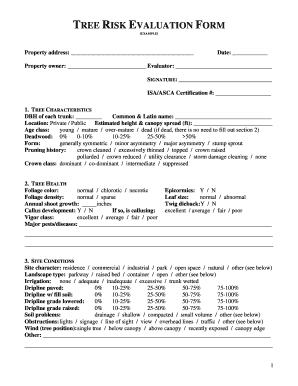
Get Tx Tree Risk Evaluation Form - City Of Austin
How it works
-

Open form follow the instructions
-

Easily sign the form with your finger
-

Send filled & signed form or save
How to use or fill out the TX Tree Risk Evaluation Form - City Of Austin online
The TX Tree Risk Evaluation Form is an important document for assessing the health and risk factors of trees in the City of Austin. This guide provides clear steps to help you fill out the form accurately and efficiently online.
Follow the steps to fill out the TX tree risk evaluation form online.
- Click ‘Get Form’ button to obtain the form and open it in the editor.
- Begin by entering the property address in the designated space, followed by the date of evaluation.
- In the next fields, provide the name of the property owner and the evaluator. Do not forget to include the evaluator's signature and their ISA/ASCA Certification number.
- Next, move to the 'Tree Characteristics' section. Here, fill in the diameter at breast height (DBH) for each trunk and specify both the common and Latin names of the trees being evaluated.
- Indicate the location of the tree, whether it is on private or public property. Then, estimate the height and canopy spread in feet.
- Select the age class from the available options: young, mature, over-mature, or dead. If the tree is dead, you won’t need to fill out section 2.
- Assess the deadwood percentage by selecting the appropriate range from 0% to over 50%.
- Describe the tree's form by choosing from the options provided: generally symmetric, minor asymmetry, or major asymmetry.
- Document the pruning history by selecting any applicable options from the list.
- For the 'Tree Health' section, indicate foliage color, epicormics presence, foliage density, leaf size, and any twig dieback.
- Evaluate annual shoot growth and callus development, noting the vigor class and any major pests or diseases affecting the tree.
- In the 'Site Conditions' section, share information about the site character, landscape type, and irrigation adequacy.
- Provide details regarding the dripline conditions, soil problems, obstructions, tree position, and any other relevant site conditions.
- For 'Tree Defects', identify and rate all areas and severity of defects that apply, using the provided legend.
- Document any other features such as lean, soil heaving, and potential root failures.
- In the 'Target and Abatement' section, describe the use under the tree, occupancy, and whether the target can be moved.
- Specify the risk abatement action to take, providing any additional comments.
- Finally, review and complete the comments or other risk factors section and calculate the risk rating as outlined.
- Once all fields have been filled in, you can save changes, download, print, or share the completed form.
Start filling out the TX Tree Risk Evaluation Form online today to ensure the health and safety of your trees.
4:04 27:05 Look at the roots and soil around the tree first. Then work your way up go around the stem. And takeMoreLook at the roots and soil around the tree first. Then work your way up go around the stem. And take a look for defects. There finally examine what most people do first which is the major branches.