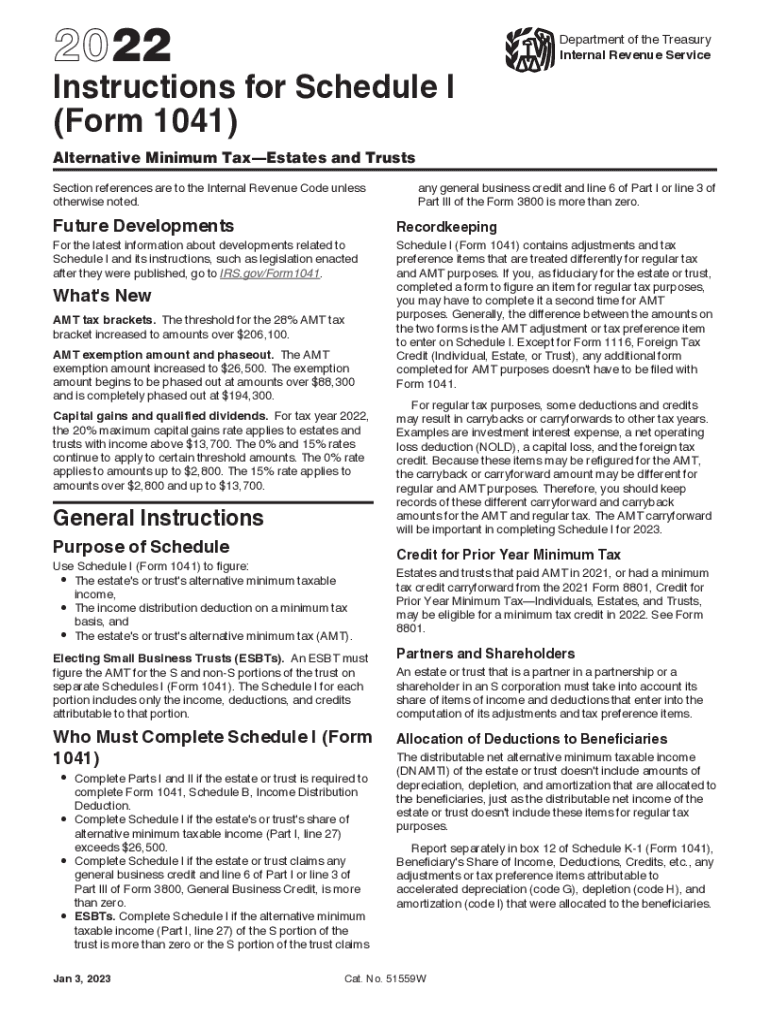
S otherwise noted. Future Developments For the latest information about developments related to Schedule I and its instructions, such as legislation enacted after they were published, go to IRS.gov/Form1041. What's New AMT tax brackets. The threshold for the 28% AMT tax bracket increased to amounts over $206,100. AMT exemption amount and phaseout. The AMT exemption amount increased to $26,500. The exemption amount begins to be phased out at amounts over $88,300 and is completely phased out at.

Open form follow the instructions

Easily sign the form with your finger

Send filled & signed form or save
How to fill out the IRS Instructions 1041 - Schedule I online
This guide provides a clear and supportive approach to completing the IRS Instructions 1041 - Schedule I online. Users of all backgrounds can navigate through the essential steps and components of this vital IRS form with confidence.
Follow the steps to accurately complete your IRS Instructions 1041 - Schedule I.
- Click ‘Get Form’ button to obtain the form and open it in the editor.
- Begin with Part I of the form. On line 1, enter the adjusted total income or loss for the estate or trust. This figure is from Form 1041, line 17. This will serve as your starting point.
- Continue to line 2 and input any AMT disallowed investment interest expense from the previous year, which is a crucial component for accurate reporting.
- For line 3, list any pertinent taxes paid, including state and local income or real property taxes included in Form 1041. Make sure to be precise about any refunds from these taxes that are included in income.
- Proceed to Part II of the form. Calculate the income distribution deduction on a minimum tax basis which is vital for determining how much income should be reported by beneficiaries.
- Complete Part III focused on alternative minimum tax calculations. Follow the instructions carefully for lines 51 through 54, ensuring any foreign tax credits or special deductions are accounted for.
- Upon completing all relevant sections, you can choose to save any changes made, download, print for your records, or share the form directly. Ensure you maintain a copy for future reference.
Complete your IRS Instructions 1041 - Schedule I online today to ensure accurate filing.
Experience a faster way to fill out and sign forms on the web. Access the most extensive library of templates available.
Related content
Income distribution deduction (from Schedule B, line 15). Attach Schedules K-1 (Form 1041)...
estate or trust. Computing Adjusted Gross Income as per Form 1041 Instructions ... Form...
Dec 6, 2017 — All Schedules K-1 you received from partnerships ... amended Form 1041...
Get answers to your most pressing questions about US Legal Forms API.
Can trust pay final year taxes?
The trust must pay taxes on any interest income it holds and does not distribute past year-end. Interest income the trust distributes is taxable to the beneficiary who receives it. The amount distributed to the beneficiary is considered to be from the current-year income first, then from the accumulated principal.
When can you file a final 1041?
The tax year-end can be Dec. 31 or the end of any other month that results in an initial tax period of 12 months or less. You must file Form 1041 (U.S. Income Tax Return for Estates and Trusts) by the 15th day of the fourth month after the tax year-end (adjusted for weekends and holidays).
How are trust distributions reported?
An irrevocable trust reports income on Form 1041, the IRS's trust and estate tax return. Even if a trust is a separate taxpayer, it may not have to pay taxes. If it makes distributions to a beneficiary, the trust will take a distribution deduction on its tax return and the beneficiary will receive IRS Schedule K-1.
Do you have to file a 1041 if there is no income?
Form 1041 is not needed if there is less than $600 of gross income, there is no taxable income and there aren't any nonresident alien beneficiaries.
When must an estate tax return be filed?
To send an estate tax return, you must first register the estate online. You must register by 5 October after the tax year you're sending a return for. For example, if you're sending a return for the 2019 to 2020 tax year (6 April 2019 to 5 April 2020) then you must register by 5 October 2020.
Are distributions from a trust taxable to the recipient?
When trust beneficiaries receive distributions from the trust's principal balance, they do not have to pay taxes on the distribution. ... The trust must pay taxes on any interest income it holds and does not distribute past year-end. Interest income the trust distributes is taxable to the beneficiary who receives it.
Are distributions from an estate taxable to the beneficiary?
While beneficiaries don't owe income tax on money they inherit, if their inheritance includes an individual retirement account (IRA) they will have to take distributions from it over a certain period and, if it is a traditional IRA rather than a Roth, pay income tax on that money.
Do you have to file a final 1041?
Not every estate is required to file Form 1041 for income earned. If the estate has no income producing assets or the annual gross income is less than $600, no return is necessary. The executor or personal representative of the estate must file the tax return. ...
Where are distributions reported on 1041?
The smaller of the two is the income distribution deduction. Place your answer on line 15, Schedule B, and then carry the result to line 18 on page 1 of Form 1041.
Can I file a short year 1041?
If the return is for a short tax year (less than 12 months) and is also a Final Return, fill in the Fiscal Year information and use the most current Form 1041 to file this return. It is not uncommon for an estate or trust to have a short tax year when they file the final tax return for an entity.
Use professional pre-built templates to fill in and sign documents online faster. Get access to thousands of forms.
If you believe that this page should be taken down, please follow our DMCA take down process here.