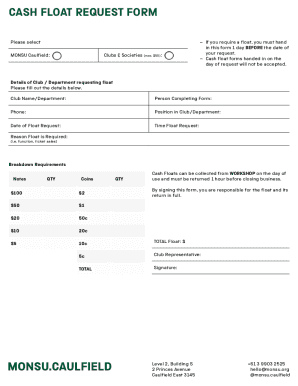
CASH FLOAT REQUEST FORM Please select MONS Caulfield:Clubs & Societies (max. $50): If you require a float, you must hand in this form 1 day BEFORE the date of your request. Cash float forms handed.
Loading
Open form follow the instructions
Easily sign the form with your finger
Send filled & signed form or save
How to fill out the AU Monsu Caulfield Cash Float Request Form online
Filling out the AU Monsu Caulfield Cash Float Request Form online can simplify the process of requesting cash floats for your events. This guide provides a clear step-by-step approach to ensure you complete the form correctly and efficiently.
Follow the steps to successfully complete the Cash Float Request Form
- Press the ‘Get Form’ button to retrieve the Cash Float Request Form and open it in your preferred editor.
- Provide the details of your club or department in the designated section. Include your club name or department, the name of the person completing the form, their phone number, and their position within the club or department.
- Indicate the date and time you are requesting the cash float. Ensure this information is accurate, as it is essential for timely processing.
- Specify the reason the float is required. Examples include functions or ticket sales. This helps the administration understand the necessity of your request.
- Fill in the breakdown requirements for the float. Indicate the quantity of each type of coin and notes you require for your float.
- Review all the entered information for accuracy. It is vital that all details are correct to avoid any delays in the processing of your request.
- Sign the form as the club representative. This step confirms that you understand the responsibility for the float and its necessary return.
- Once completed, you can save changes, download the form, print it, or share it as needed to complete the submission process.
Complete your cash float requests online today and ensure a smooth process for your upcoming events.
Experience a faster way to fill out and sign forms on the web. Access the most extensive library of templates available.
Related content
Mar 20, 2006 — The student organisations made no CAF money available to other bodies...
Jan 30, 2021 — Each resident is eligible for one residential parking permit. Residents...
Get answers to your most pressing questions about US Legal Forms API.
Why do you need a cash float?
In general, businesses need to closely monitor their cash float to ensure that they have sufficient liquidity to cover operational expenses during this processing period. It becomes even more critical for businesses with high transaction volumes, as delays in processing can lead to temporary cash flow constraints.
What is an example of a cash float?
In banking, the term float refers to money temporarily counted twice due to processing delays. For example, a check written on a Monday might not clear until four days later on a Friday.
What is the formula for cash float?
How to Calculate Float. The formula to calculate float is: Float = firm's available balance – firm's book balance.
What do you put in a cash float?
This is usually a relatively small amount of cash, broken up into different bills and change so that customers can receive change. While this money is put forward by the business, it is not spent—the cash drawer is meant to reflect both the total sales of the shift plus the full cash float.
What is a good amount for cash drawer?
The amount of money you should start with in a cash register is between $100 and $150. Also, a good rule of thumb is to keep at least $20 on a dollar bill and $20 on a $5 bill. That amount allows you to return the change to your customers within one sales shift.
How much of a cash float do I need?
Though the exact amount might vary from business to business, make sure to have cash, sometimes referred to as petty cash, on-hand in the morning. For a small business, $100 to $150 should be more than enough. A good rule of thumb is to keep at least $20 in five-dollar bills and $20 in one-dollar bills.
How does a cash float work?
Cash float is the term for the total amount of checks in between the time when the check is written and taken off the books of the payer, but not out of their bank account, and before it's in the back account of the payee, even though they already would have recorded it in their books.
Use professional pre-built templates to fill in and sign documents online faster. Get access to thousands of forms.
If you believe that this page should be taken down, please follow our DMCA take down process here.