Loading
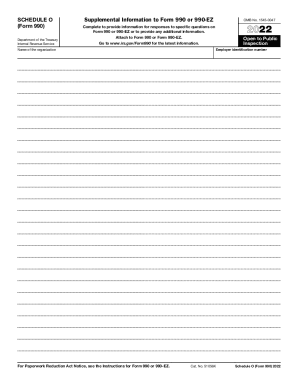
Get Irs 990 - Schedule O 2022-2026
How it works
-

Open form follow the instructions
-

Easily sign the form with your finger
-

Send filled & signed form or save
How to fill out the IRS 990 - Schedule O online
This guide provides a clear and concise approach to filling out the IRS 990 - Schedule O online. By following these steps, users can efficiently provide the required supplemental information about their organization.
Follow the steps to complete your IRS 990 - Schedule O online.
- Click ‘Get Form’ button to obtain the form and open it in your editor.
- Begin by entering the name of your organization in the designated field. Be sure to include the complete name as it appears in your official documents.
- Next, provide the employer identification number (EIN) in the specified field. This number is crucial for identifying your organization within the IRS system.
- Refer to the specific questions on Form 990 or 990-EZ to determine which parts of Schedule O you need to fill out. This schedule should be used to provide narrative explanations required for questions in Parts III, V, VI, VII, IX, XI, and XII.
- Complete the narrative responses by clearly identifying each part and line of Form 990 or 990-EZ that your responses address. This helps maintain a clear correspondence between your answers and the original form.
- If your organization had any late filings, attach a separate statement explaining the reasons for the delay. However, do not use this schedule for that statement.
- Once all required information is entered, review your responses for accuracy and completeness. Ensure that all narrative explanations are relevant to the specific questions.
- Finally, save your changes, download a copy for your records, and share or print the completed Schedule O as necessary.
Take action and file your IRS 990 - Schedule O online today to ensure compliance and clarity in your organization's reporting.
Schedule D (Form 990) is used by an organization that files Form 990 to provide the required reporting for donor advised funds, conservation easements, certain art and museum collections, escrow or custodial accounts or arrangements, endowment funds, and supplemental financial information.