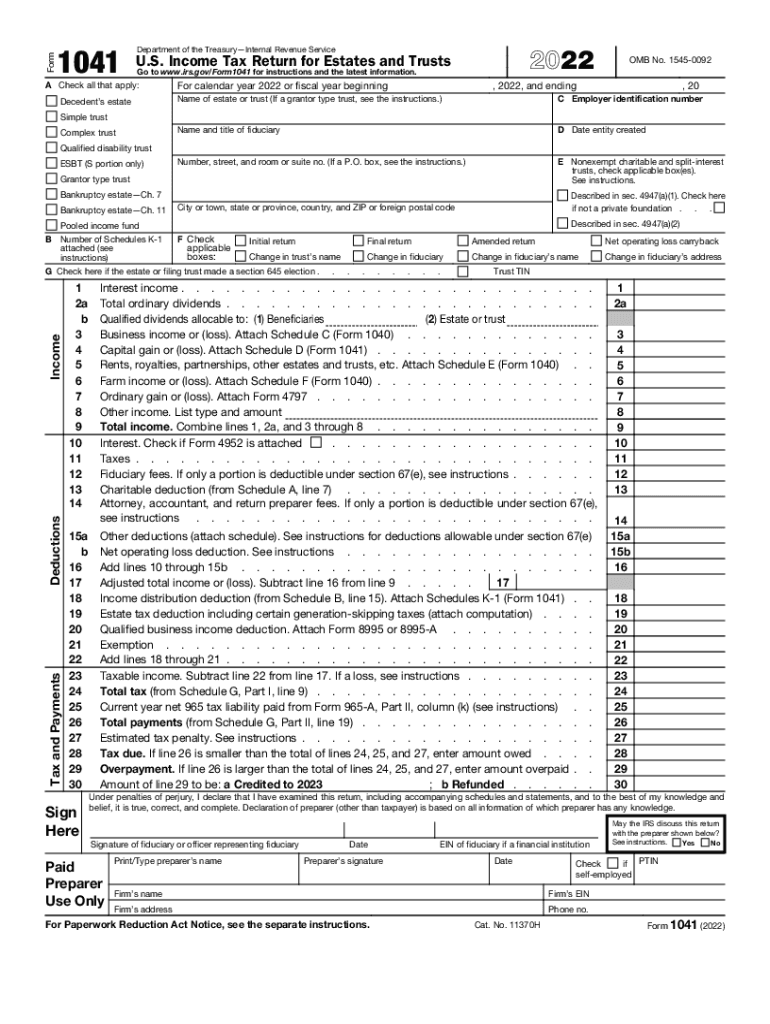
Form10412022Department of the TreasuryInternal Revenue Service. S. Income Tax Return for Estates and Trusts Go to www.irs.gov/Form1041 for instructions and the latest information. A Check all that.
Loading

Open form follow the instructions

Easily sign the form with your finger

Send filled & signed form or save
How to fill out the IRS 1041 online
Filing the IRS Form 1041, the U.S. Income Tax Return for Estates and Trusts, is essential for fiduciaries managing estates or trusts. This guide provides comprehensive, step-by-step instructions to ensure a smooth and accurate online filing process.
Follow the steps to accurately complete the IRS 1041 online
- Click the ‘Get Form’ button to access and open the IRS Form 1041 in your preferred online editing tool.
- Begin by completing the identification section, which includes the name of the estate or trust, the employer identification number (EIN), and the fiduciary's details. Ensure that you accurately provide the creation date of the entity.
- Choose the applicable box for the type of entity, such as decedent's estate, simple trust, or complex trust. This affects tax treatment, so select carefully.
- Continue to the income section, where you will list different types of income such as interest, dividends, and business income. Be prepared to attach additional schedules if necessary.
- In the deductions section, input all allowable expenses, including fiduciary fees and charitable deductions. Follow instructions closely as some deductions may require additional calculations.
- Calculate the taxable income. This step involves subtracting your deductions from the total income to determine the final taxable amount.
- Move to the tax computations section where you will calculate the tax owed based on the taxable income. Review instructions as there are unique credits and special considerations that may apply.
- Complete the payments section, noting any estimated payments made or amounts owed. Ensure you include applicable penalties and prior year payments as necessary.
- Review the signature section, ensuring it is signed by the fiduciary or the authorized representative. This step is crucial as unsigned forms may be rejected.
- Finally, save your changes, and consider downloading or printing the completed form for your records. Follow the prompts to submit electronically as applicable.
Complete your IRS Form 1041 online today for a seamless filing experience.
Experience a faster way to fill out and sign forms on the web. Access the most extensive library of templates available.
Related content
Sep 22, 2022 — Form 1041 is used by a fiduciary to file an income tax return for every...
Department of the Treasury—Internal Revenue Service. Form 1041 U.S. Income Tax Return...
Go to www.irs.gov/Form8912 for instructions and the latest information. ... Enter the sum...
Get answers to your most pressing questions about US Legal Forms API.
Who must file Form 1041?
If the estate generates more than $600 in annual gross income, you are required to file Form 1041, U.S. Income Tax Return for Estates and Trusts. An estate may also need to pay quarterly estimated taxes.
What is an IRS 1041?
Form 1041, U.S. Income Tax Return for Estates and TrustsPDF, is used by the fiduciary of a domestic decedent's estate, trust, or bankruptcy estate to report: Income, deductions, gains, losses, etc.
What expenses can a trustee deduct?
State, local, and real property taxes. Expenses of the estate. Administrative expenses, such as trustee fees. Other miscellaneous itemized deductions subject to a 2% limitation of adjusted gross income.
Where do beneficiary distributions go on 1041?
The distribution amount will be reported on Form 1041 Schedule B, Line 10 - Other Amounts paid, credited, or otherwise required to be distributed.
What are three 3 available deductions from a decedent's gross estate?
A deduction from the gross estate is allowed for funeral expenses, administration expenses, claims against the estate, certain taxes, and unpaid mortgages or other indebtedness allowable under the local law governing the administration of the decedent's estate ( Code Sec.
What deductions are allowed on Form 1041?
On Form 1041, you can claim deductions for expenses such as attorney, accountant and return preparer fees, fiduciary fees and itemized deductions. After the section on deductions is complete you'll get to the kicker – taxes and payments.
Is there a standard deduction on Form 1041?
The current exemption amount on a Form 1041 is $600 for a Decedents' Estate, $300 for a trust that is required to distribute all income currently, and $100 for all other trusts other than a Qualified Disability Trust which (subject to income limitations) is allowed the same amount as one personal exemption on a Form ...
What are directly apportioned deductions on Form 1041?
Depreciation, depletion, and amortization are directly apportioned deductions. The beneficiaries' portion of depreciation, depletion, and amortization is reported directly to the Schedule K-1 (Form 1041) Beneficiary's Share of Income, Deductions, Credits, etc.
Use professional pre-built templates to fill in and sign documents online faster. Get access to thousands of forms.
If you believe that this page should be taken down, please follow our DMCA take down process here.