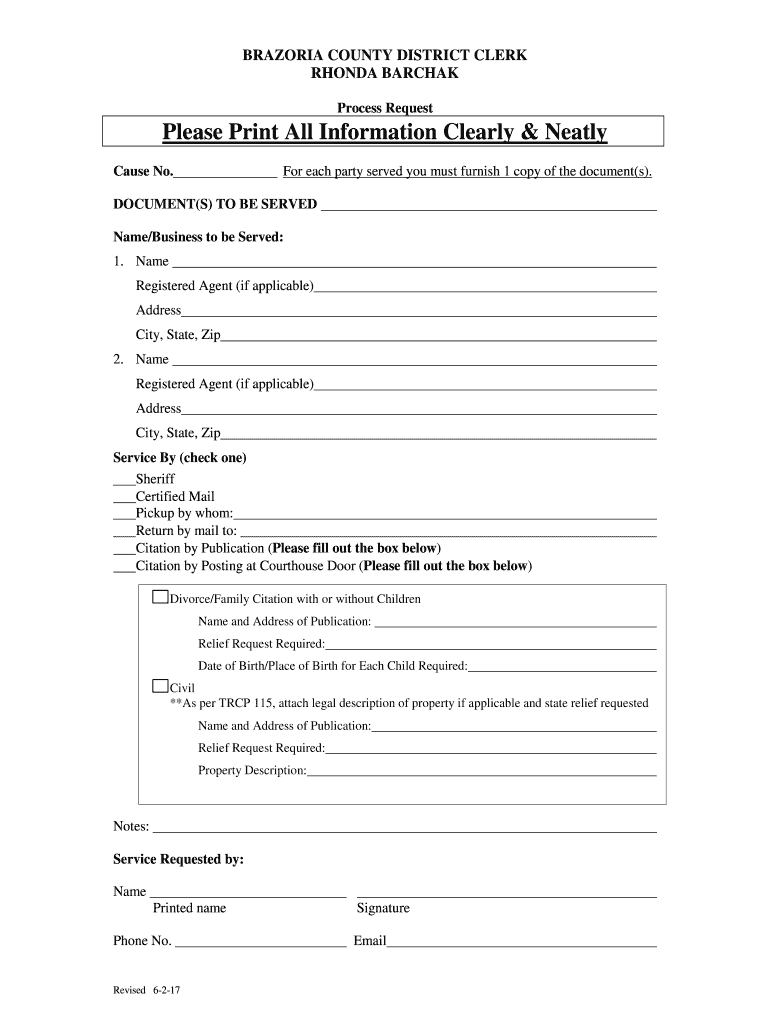
TO BE SERVED Name/Business to be Served: 1. Name Registered Agent (if applicable) Address City, State, Zip 2. Name Registered Agent (if applicable) Address City, State, Zip Service By (check one) Sheriff Certified Mail Citation by Posting at Courthouse Door Pickup by whom: Return by mail to: Citation by Publication (Please fill out the box below) Divorce/Family Citation with or without Children Name and Address of Publication: Relief Request Required: Date of Birth/Place of Birth for Each Child .
Loading

Open form follow the instructions

Easily sign the form with your finger

Send filled & signed form or save
How to fill out the TX Process Request online
Filling out the TX Process Request is an essential step in ensuring that documents are properly served. This guide provides clear instructions to assist you through the process of completing the form online.
Follow the steps to complete the TX Process Request with ease.
- Click ‘Get Form’ button to obtain the form and open it in the editor.
- Begin by entering the Cause No. in the designated field at the top of the form. This number helps to identify your case.
- For each party that needs to be served, fill in the information clearly. Start with the first person's or business's name and include their registered agent if applicable.
- Next, provide the complete address, including city, state, and zip code for the first party.
- Repeat the process for any additional parties by entering their names, registered agents, and addresses in the same manner.
- Select the method of service by checking the appropriate option for Sheriff, Certified Mail, Citation by Posting at Courthouse Door, or Pickup by whom.
- Specify the return address for the documents to be mailed back after service if applicable.
- If you are requesting citation by publication, fill out the required fields, including the name and address of the publication.
- In the section for Relief Request, provide any necessary information and specify the relief you are seeking, including any relevant details about children if applicable.
- If the request involves property, attach a legal description and make sure to state the relief requested in the designated space.
- Complete the service requested by section with your name, printed name, and phone number to ensure proper communication.
- Finally, sign the form and include your email address for follow-up notifications.
- Once you have reviewed all the information for accuracy, save your changes, and choose to download, print, or share the completed form as needed.
Begin completing your TX Process Request online today!
Experience a faster way to fill out and sign forms on the web. Access the most extensive library of templates available.
Related content
We are currently processing mailed documents received August 22, 2025. Related...
A party may serve on another party - no later than 30 days before the end of the discovery...
The MEMOBUS/Modbus requested operation is in the process loop but the drive is not done...
Get answers to your most pressing questions about US Legal Forms API.
What can a process server do and not do?
A process server can serve papers, particularly legal documents related to court cases, and handle the necessary paperwork. However, they cannot coerce you or threaten you in any way while executing their duties. Understanding these limitations is vital for ensuring a smooth process. For clarity and support with your TX Process Request, USLegalForms offers reliable resources.
What does a process server do in Texas?
In Texas, a process server serves legal documents, ensuring that individuals are informed about their court obligations. Their role includes tracking down the intended recipients and completing the service accurately. After successfully delivering the documents, they submit proof of service to the court. For those managing legal documents, using USLegalForms can simplify your TX Process Request.
How many times can a process server come to your house in Texas?
A process server can return to your residence several times to deliver legal documents, often within a required timeframe set by law. The specific number of attempts can depend on the case and the nature of the documents. It is essential to remember that persistent attempts can occur until the server completes the TX Process Request. For efficient handling, explore USLegalForms.
What happens if you don't answer the door to a process server in Texas?
If you do not answer the door, a process server may leave the documents with a responsible individual at your address, or they might try to serve you multiple times. Eventually, they could switch to alternative methods allowed by Texas law, such as mailing the documents. Ignoring the serve can lead to complications, so consider how USLegalForms can assist with your TX Process Request.
Do process servers call you in Texas?
Generally, process servers in Texas do not call you before serving documents. Their role is to deliver legal papers legally and directly at your residence or workplace. Although they may have your phone number, their priority is to fulfill the TX Process Request in person. If you want to manage your documents effectively, consider using USLegalForms.
What does a Texas process server do?
A Texas process server delivers legal documents to individuals involved in court cases. Their job includes providing notifications about lawsuits, subpoenas, or other legal actions. After serving, they usually file a return of service with the court. If you need assistance with your TX Process Request, consider utilizing USLegalForms for streamlined service.
How many times will a process server try to serve you in Texas?
In Texas, a process server typically attempts to serve documents several times, usually within a week. If the server cannot reach you, they may return at different times and days to improve their chances. Multiple attempts ensure that the service process is completed according to Texas law. Using a service like USLegalForms can help simplify your TX Process Request.
Who can serve process in Texas?
In Texas, individuals who are over 18 years old and not a party to the case can serve process. This includes licensed private process servers, sheriff's deputies, or anyone appointed by the court. If you are unsure about who can serve documents in your case, consulting the US Legal feature can help clarify your options and ensure compliance with legal requirements.
What can a process server legally do in Texas?
In Texas, a process server can deliver legal documents, such as summons and subpoenas, to the intended recipient. They must comply with state laws regarding service of process, including identifying themselves and ensuring the documents reach the right person. If you have specific questions about a process server's actions, the US Legal platform can provide you with the necessary information to understand the process better.
Can you refuse a process server in Texas?
You can refuse to accept documents from a process server in Texas, but this refusal does not prevent the legal documents from being delivered to you. Texas law allows for alternative methods of service, meaning that you may still be legally served even if you do not accept the documents. To understand your rights and responsibilities, consider using resources from US Legal.
Use professional pre-built templates to fill in and sign documents online faster. Get access to thousands of forms.
If you believe that this page should be taken down, please follow our DMCA take down process here.