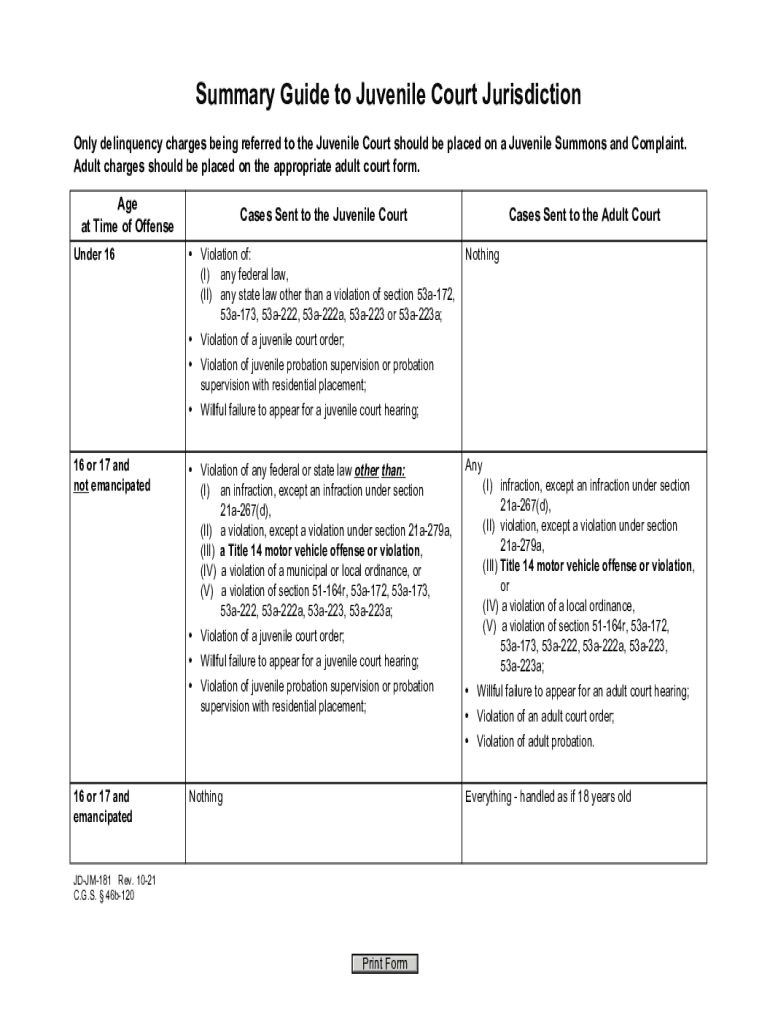
Summary Guide to Juvenile Court Jurisdiction Only delinquency charges being referred to the Juvenile Court should be placed on a Juvenile Summons and Complaint. Adult charges should be placed on the.
Loading

Open form follow the instructions

Easily sign the form with your finger

Send filled & signed form or save
How to fill out the CT JD-JM-181 online
The CT JD-JM-181 form is essential for filing juvenile summons and complaints in the Connecticut juvenile court system. This guide provides clear and comprehensive instructions on completing the form online, ensuring a smooth submission process for users.
Follow the steps to fill out the CT JD-JM-181 form online.
- Press the ‘Get Form’ button to retrieve the form and open it for editing. This will allow you access to the CT JD-JM-181 document in a digital format.
- Begin by entering the necessary personal information of the individual associated with the case in the designated fields. Ensure that all details are accurate and up to date.
- Indicate the age of the individual at the time of the offense. Be sure to select the appropriate age category to determine the jurisdiction, as this impacts the handling of the case.
- If applicable, list any violations that are pertinent to the case. Refer to the guidelines provided to ensure that only relevant charges are included on the form.
- Review all the filled sections for accuracy and completeness. It is vital that every part of the form is filled out correctly to avoid delays in processing.
- Once completed, you can save your changes to the document. Additionally, you may choose to download, print, or share the form as needed.
Complete your documents online with confidence by following these steps.
Experience a faster way to fill out and sign forms on the web. Access the most extensive library of templates available.
Related content
Violation of an adult court order;. • Violation of adult probation. JD-JM-181 Rev...
Form No.Name of FormVersionFormJD‑JM‑009AApplication for Order of DetentionRev...
Abbr.: AD = Addictive, CA = Carcinogen, CT =Cardiovascular Toxicant, ... Page 181. THS...
Get answers to your most pressing questions about US Legal Forms API.
What does it mean to be tried as a juvenile?
Juvenile court is the court system that handles complaints against children who are alleged to be delinquent or undisciplined.
What is the age of a juvenile in CT?
In the State of Connecticut, children under the age of 18 who are arrested are treated as juvenile offenders and have their cases heard in juvenile court. (There are exceptions to the 18-and-under rule in certain types of serious criminal conduct; those cases are transferred to adult court.)
How old is a juvenile in NYC?
A Juvenile Delinquent is a youth between ages 12 and 15 who has committed an offense. 16 and 17 year old youth charged with all misdemeanors or felonies that have been removed from Criminal/Supreme Court are also considered Juvenile Delinquents. All juvenile delinquency cases are heard in Family Court.
What is raise the age in CT?
Ten years ago, Connecticut took a giant step forward and “Raised the Age” of criminal responsibility from 16 to 18 years of age. As one of only three states in the country that still considered all 16 and 17 year olds as adults, no matter how minor the charge, it was a radical notion for the state to make this shift.
What age is considered to be a juvenile?
While an adult is usually a person over 18 (or in some cases, over 21), juvenile refers to persons under the age of 18 years. Therefore, 'juvenile' and 'minor' are two different terms, an important detail in criminal cases.
Use professional pre-built templates to fill in and sign documents online faster. Get access to thousands of forms.
If you believe that this page should be taken down, please follow our DMCA take down process here.